
If you enjoy game theory and praxeology, thinking through hypotheticals and threat models, risks and probabilities, then you‘ll probably enjoy this book. 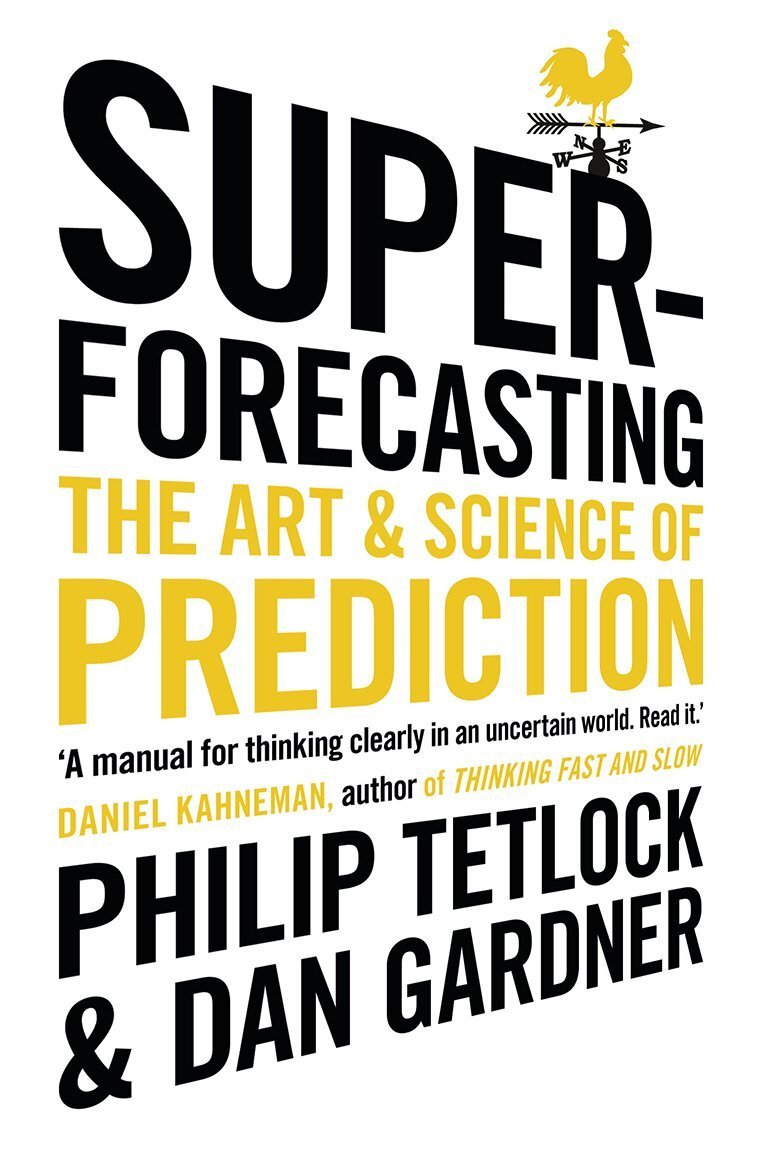
Discussion
#bookstr
#books
I enjoyed 'thinking fast and slow'.

A lot of Austrians are very suspicious of mathematical models of the kind you see in a lot of forecasting methods, what's different here?

It’s not a book about mathematical models but rather traits and skills of people who are standard deviations above average in predicting things. It talks more about how these people are successful (they’re largely describing praxeology without knowing it) by sourcing multiple data points, refining as they go, and assigning probabilities to different parts of decision trees.
Kind of like applying poker thinking to the real world.

Thanks. Added to my list
PRAISE FOR
SUPERFORECASTING
“Superforecasting is a rare book that will make you smarter and wiser. One of the giants of behavioral science reveals how to improve at predicting the future.”
— ADAM GRANT,
New York Times bestselling author of Give and Take
“Good judgment and good forecasting are rare, but they turn out to be made of teachable skills. By forcing forecasters to compete, Tetlock discovered what the skills are and how they work, and this book teaches the ability to any interested reader.”
— STEWART BRAND,
president, The Long Now Foundation
“Philip Tetlock is renowned for demonstrating that most experts are no better than ‘dart-throwing monkeys’ at predicting elections, wars, economic collapses, and other events. In his brilliant new book, Tetlock offers a much more hopeful message, based once again on his own groundbreaking research. He shows that certain people can forecast events with accuracy much better than chance—and so, perhaps, can the rest of us, if we emulate the critical thinking of these ‘superforecasters.’ The self-empowerment genre doesn’t get any smarter and more sophisticated than this.”
— JOHN HORGAN,
director, Center for Science Writings, Stevens Institute of Technology
“Superforecasting is the rare book that is both scholarly and engaging. The lessons are scientific, compelling, and enormously practical. Anyone who is in the forecasting business—and that’s all of us—should drop what they are doing and read it.”
— MICHAEL J. MAUBOUSSIN,
head, Global Financial Strategies, Credit Suisse
“There isn’t a social scientist in the world I admire more than Phil Tetlock.”
— TIM HARFORD,
author of The Undercover Economist
“From the Oracle of Delphi to medieval astrologers to modern overconfident experts, forecasters have been either deluded or fraudulent. For the first time, Superforecasting reveals the secret of making honest, reliable, effective, useful judgments about the future.”
— AARON BROWN,
chief risk officer, AQR Capital Management, and author of The Poker Face of Wall Street
“Socrates had the insight in ‘know thyself,’ Kahneman delivered the science in Thinking, Fast and Slow, and now Tetlock has something we can all apply in Superforecasting.”
— JUAN LUIS PEREZ,
global head, UBS Group Research
Had a quick scan of the first chapter, I wonder what this Bill Flack character would forecast with regards to Bitcoin?
It’s been a few years since I read it so I can’t remember who he is 😂
Bitcoin is a very good example though. People who get it have high conviction because they have studied it deeply, recognised and challenged their biases, have realised there are failure scenarios but they’re all incredibly low probability, and that drivers that will see NGU are extremely high probability. They’ve explored the branches of a big decision tree (the rabbit hole) and are benefiting from it.
As I said in my other comment, these people who are very good at predictions have stumbled on praxeology without realising it.
Years ago I read a lot of poker books and that teaches similar - you’re essentially looking at decision trees of probabilities just in a confined game. It’s a really good place to start. But I realised then you can take the same approach to many decisions in life if you understand the constraints and you’ll get way better than the average person at predicting future outcomes. I predicted and bet on Qatar to get the hosting rights to WC2022 using some of these skills early on and have got quite good at predicting elections (always bet on corruption 😂).
By no means do I get 100% right, but I’m definitely above average and it gets better over time as you bring more knowledge and data points into calls. This book explores people who have done this and gives some good tips if it’s something you want to get better at yourself.