Why is 2% the right amount of inflation?
It’s the amount they can get away with in order to debase the underlying currency, much like a hidden tax, without upsetting people to the point of rebellion.
(from today’s Informationist Newsletter)
Why is 2% the right amount of inflation?
It’s the amount they can get away with in order to debase the underlying currency, much like a hidden tax, without upsetting people to the point of rebellion.
(from today’s Informationist Newsletter)
It’s about the historical inflation rate of the gold supply.
That's a chart of cumulative supply, not median rate of change over time.
Given the increasing price per ounce over time you would think so, but no: in 2023 about 3,000 metric tons of gold were added to the global supply.
Think what that implies about inflation and Bitcoin.
Rate of change is percentage of total supply, not an absolute number. Total above-ground stock is circa 212,582 tonnes, so your 3,000 denotes 1,4%, which seems too high, but okay.
Mining added 1% to supply, in 2023, and the majority of the rest of the supply growth came from recycled gold (mostly melted jewelry, as people responded to the spike in price) leading to a temporary jump of market-available gold of 3%.
https://www.gold.org/goldhub/research/gold-demand-trends/gold-demand-trends-full-year-2023/supply
Not sure on those exact numbers since the page you link states 3,644 mined and 1,237 recycled in 2023, but I graphed production as a percentage of supply and you're right: it's basically 2%. Given this stability from 10 tons/yr to the recent 3,600 tons/yr, you have to wonder whether that's a free market decision. If not, then we still have the question of why 2%.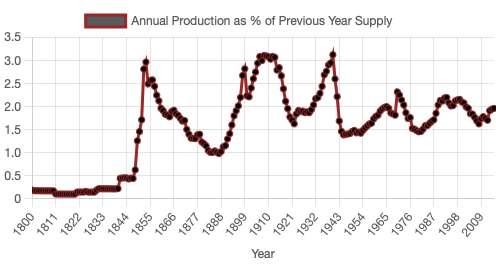
If wages remain stagnant for the majority but they keep that scheme going, at some point that breaks, no?
It's easier to steal from us a little at a time.
2% puts you at ~100% devaluation in around the lifespan of a human being.
It’s just the number that they choose so the people don’t stand up against them
Something something frog boiling in a pot of water.
Anyone who's ever played SimCity, fiddled with that tax throttle to see how much they can get away with taxing their citizens. Come on, admit it! 😜
In the 80s, some Roger Douglas, a kiwi minister of finance went on TV and shot a number between 0-1% (no research behind it). Then their central bank corrected Douglas' number to 2% to have more space for their magic.. And other central bankers liked it so much that they just copied the idea.
Also, most economies are export oriented, as exporter you gotta love a stable inflation.
The real answer is that 2% is entirely made up. It's arbitrary.
I hope this truth offends you so much it hurts.
Welcome to my Ted-Talk.
It’s because 2% is reasonably close to that of gold. Therefore if they can keep it there, they SHOULD be ok…
Trouble is spending buys votes.
This. It comes from the historical expansion rate of the gold supply, which is what people are most used to and find easy to account for and use in planning scenarios.
This is not true.
The 2% rate of inflation has nothing to do with gold. It is purely a construction by a New Zealand finance minister who recognized that cost of living increased ~1.7% a year. That finance minister then became a board member of the central bank of NZ and the central bank set the first inflation target of 2%, which caught on around the globe as a standard inflationary target.
This all happened in the late 80s early 90s.
That explains why they suddenly set it as an upper target. Doesn't explain why it "just feels right" to people.
You have to remember that the finance ministers of the time grew up under the gold standard. Even during the California gold rush, gold supply didn't increase over 1,5% per year.
Anything over 2% is de facto devaluation against commodities.
Did they grow up under the gold standard? This target was identified in the late 80s early 90s. Nixon revoked the dollars redeemability for gold in the 70s, and it’s not like the dollar was pegged to gold before he did that, he did that because they had already over printed them. The classical gold standard ended in the early 1900s, well before most finance ministers in the late 80s were born.
I grew up in Germany in the 80s and everyone was still talking about the gold standard and how the Deutschmark could be strengthened and the importance of the Bundesbank gold reserves.
Gold is still something central bankers think about a lot, and they still buy and buy and buy it. They're steadily repatriating it, on the down-low.
There actually is no evidence that, for instance, the ECB governors actually think their fiat is going to last forever, despite all the CBDC posturing (which seems to largely be a response to the digital yuan and Fedcoin and etc.). They're quietly stocking up gold reserves and trying to balance the per-capita amounts among the various member banks.
They’ve been talking about it for 50 years now, and it’s been over 100 since it actually existed. Bretton woods wasn’t a gold standard, it was a dollar standard, and the fed was already playing games and rehypothecating the gold countries could “redeem” as soon as they could.
The gold standard isn’t coming back because we live in a world where shipping 10tons of gold around is too slow a form of settlement. The central banks don’t want to be constrained by some arbitrary commodity reserve, and the politicians want to be able to spend money whenever they want however they want.
Gold is useful for jewelry, and as a hedge for the bunker dwellers in the case of nuclear war. The gold standard is dead otherwise.
Yes, me also, ppl dont think about money, most of them do not even think about using alternatives, like btc, lets hope this changes.
It’s not an upper target, it’s the target.
I’m not sure what people you’re talking about for whom it “feels right.” The bankers who use it to plan for their long term financial deals for estimating profitability? The exporters who expect to sell their wares for more? Equity owners for planning their ROIC? The worker saving their wage?
The ministers actually preferred a target of 0% to 1% (even closer to gold) and saw 2% as high, but politicians wanted more leeway and pressured them to push it up to 2% and eventually we ended up with the ECB "averaging 2%" in the mid-term, which allowed for inaction at 4% and led to the recent inflation break-out.
Since inflation rates were well above 2%, at the time, targeting 2% still resulted in a decrease, so the ministers went along with it and just stayed quiet when it crept below that, until it slipped into ZIRP and everyone started getting crushed by their debt. Then they reversed and it overshot in the other direction.
Fiat is simply not a commodity, so it needs to be tied to a commodity or replaced with one, or it'll always have these problems.
https://sites.lsa.umich.edu/mje/2023/09/04/why-the-2-inflation-target/
I guess it has some relationship to how long we live and pay attention to things. So the rate needs to be such that most people don’t notice. There is the propaganda through economic theories and brain washing
A New Zealander said so, that’s why.
Kind of