The entire mathematical formalism collapses because it depends on taking derivatives (on breaking time into infinitesimal pieces). You simply cannot do that if time is quantized and discrete. Once that assumption fails, everything built atop of the assumption fails as well.
This fundamentally changes the meaning of superposition and decoherence. In a quantized-time model, superposition is no longer a physically coexisting computational substrate; it is a potential state that exists between discrete ticks of time. Decoherence is no longer a gradual dynamical process, it is the unavoidable result of a time tick itself: a measurement. Under those conditions, the current mathematical framework is not incomplete; it is invalid if time is discrete.
That would imply physics is misidentifying what it is observing. What is being called a “logical qubit” is not a stable substrate existing across time, but a description of unresolved potential under an assumed continuous-time model. The substrate itself is not physically real in the sense required for computation, it is inferred.
If you genuinely believe computation can be performed on unresolved states across time, then go do it on Bitcoin.
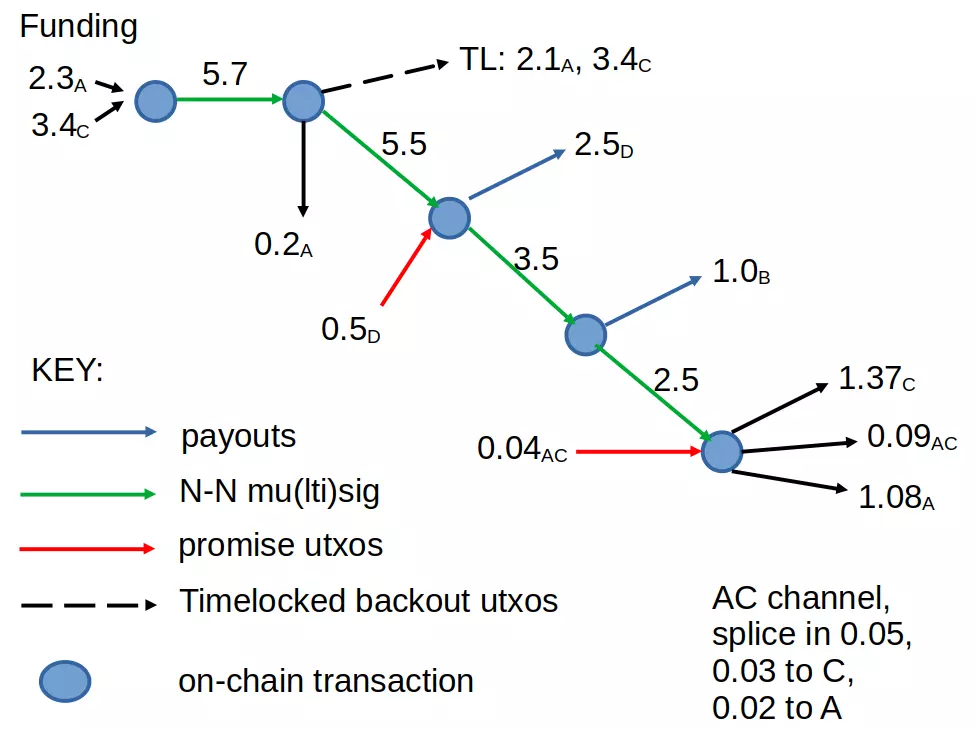
Bitcoin already gives you everything a “logical qubit” is supposed to provide: a globally defined state space, unresolved states that persist across discrete ticks of time, strict non-contradiction rules, and a clear measurement event that collapses possibilities into a single outcome. The mempool is full of fully specified, mutually exclusive state transitions that remain unresolved across blocks. They are public, conserved, and enforced by consensus.
So if superposition is a real computational substrate, stop theorizing about it in sealed labs and error models. Compute on Bitcoin. Use UTXOs. Use the mempool. Demonstrate interference, phase manipulation, or speedup in a system where the states are observable and the rules are fixed.
Only then does the problem become obvious: nothing “computes” in the way quantum computing claims, because unresolved states across discrete time do not form a substrate, they form potential. Resolution only occurs at measurement, and measurement is irreversible. That’s not a limitation of Bitcoin; it’s a property of time itself. If you don’t understand Bitcoin physically, you don’t understand time at all.
Bitcoin doesn’t just meet the criteria for a “logical qubit”, it exposes why the concept collapses once you demand an open, verifiable system.