

This is my exact contention.
Discussion

I think the best argument against XMR is that its network is small and the privacy is questionable. XMR is a great idea and would be very useful in some cases, but is it truly achieving what it intends? It is currently also not the easiest when coming to running a node, so not super decentralized. The unlimited supply would also mean that you can’t leave your monero in monero for too long.

No supply cap =/= unlimited supply
It has a fixed rate at which new coins are introduced on the tails emissions standard.
0.6 momero every 2 minutes, under this model Monero is more scarce than Bitcoin for the next ~16 years.
Please elaborate on nodes.
Most monero users know about the privacy implications and its trade offs, so far it hasn't been an issue, and the technology will get better.
Its current stock to flow is lower, but the intention of monero is to be a currency rather than a store of value. That’s fine.
I would suggest running a node, I have. I think it’s best to see for oneself.
There are many things to be aware of to use the privacy to its max. I think it’s pretty good as is.
Monero will have more changes and thus risk. It’s a small group of people. The small network lets bad actors run nodes and could be compromising the privacy. Kind of like how the tor network can be compromised.
I think the breaking monero series is great from some of the monero guys.
I never intend to leave it all in monero, but, it is more easily private than the hoops I have to jump through for BTC. (Don't you dare tell me lightning solves that, because it doesn't and lightning is trash that's barely useful without way too much custodial nonsense. On chain BTC is way simpler.)
I really do think that XMR is the digital twin of silver to BTC's gold. Besides there's enough space for both and will be for a long while.
The cake wallet is one of the greatest little things. I just don’t know how truly private monero is. Too bad local monero bowed out.

Nodes seem pretty decentralized. Not that far away from BTC node count. Maybe you'll find this interesting:
Since Bitcoin and monero are trying to achieve different things, this is a bigger problem for monero than bitcoin. Even on the home page of the link you shared shows this message
Bitcoin isn’t trying to hide, it’s trying to be unstoppable. I’m not trying to put down monero. 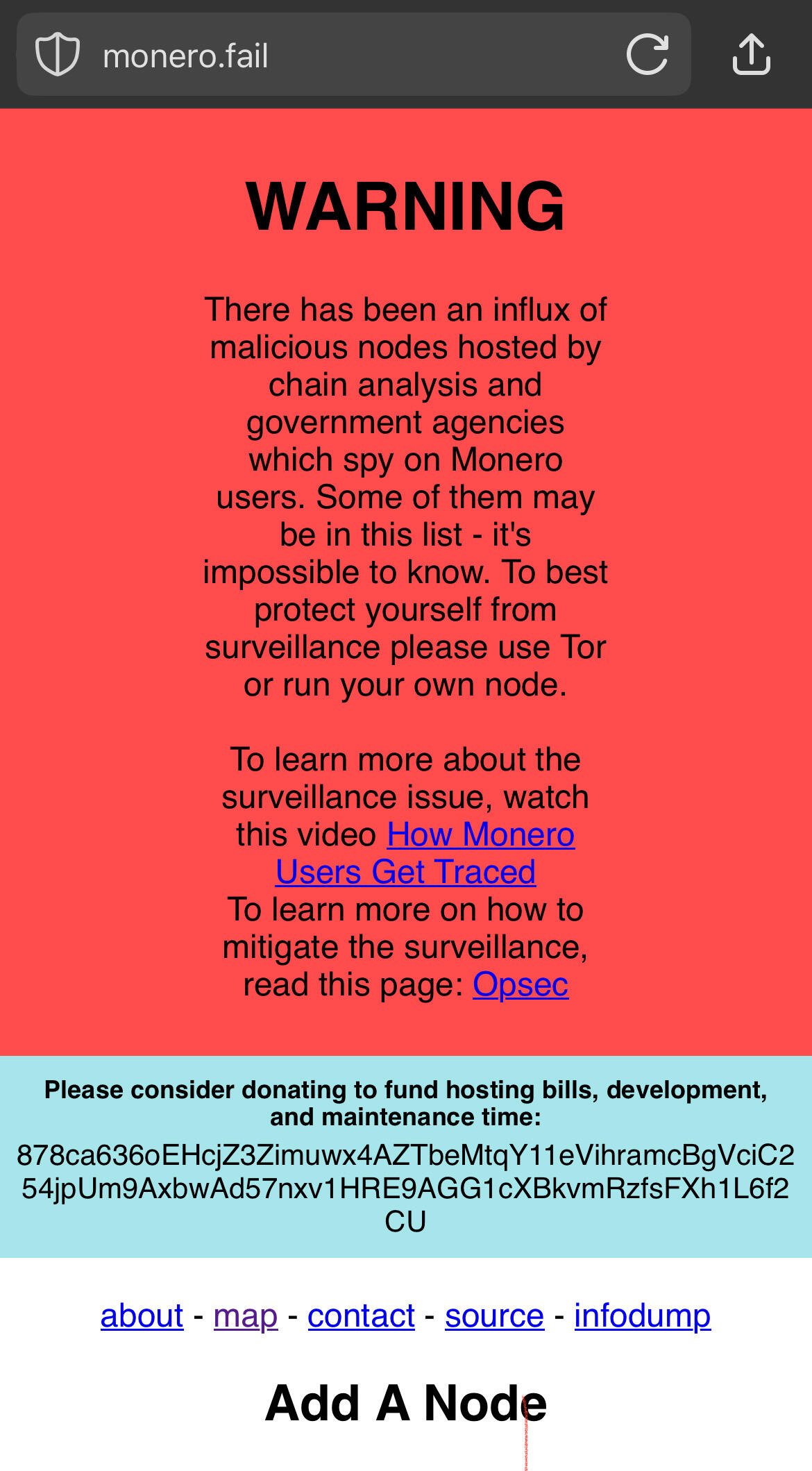

The problem with connecting to a malicious node to send a tx is simply that that node knows they are the first to see that tx.
obviously if you don't use protection, they will learn your IP address.
However,
This is true for all Bitcoin nodes by default anyway.
So if the node count is high,
and I don't think running an XMR node is any more complicated than Bitcoin
how is it less decentralized?
It’s not just the nodes I question, but the transactions. Putting enough transactions in from a bad actor can help identify other transactions. I’m not super up to speed on how they make their mining templates either.
I probably should have said that it can not easily remain decentralized. I believe because of the flexible block size in monero, it doesn’t provide good incentives for miners. If it was used a lot, I think the blockchain size could grow very rapidly. Ultimately I don’t think the rewards to those running the infrastructure are good enough. Bitcoin pays more when demand is high, monero pays less by allowing the block size to grow. But I’m not comparing the two. I am concerned that monero isn’t achieving what it intends to achieve, privacy.
When I have synced monero nodes in the past, it didn’t work to my satisfaction. Call that an opinion.
You mean a bad actor could spam the network with txs to themselves?
They then would know that anytime those outputs appear as inputs to another tx it is a decoy and not the true spend.
This is generally assumed to be low-key happening.
Im not up on the math but with a ring size of 16, I think you have to be responsible for a insane amount of the total tx volume to be statistically certain you're identifying the correct spend.
like over 95% of total volume and that's not happening.
meanwhile we have leaked Chainanalysis videos that literally SHOW us their tracing capabilities and they're basically dead in the water.
(UNLESS they get offchain stuff, exchange data or you connect to their malicious node without a condom etc)
Block size is a delicate balance and I'm not sure there's much to say except we'll find out. Since the block reward is penalized miners will only increase the block size when it makes financial sense for them to do it. ie, they can make more on fees than they lose by the penalty.
so far it has functioned fine.
last I checked the chain was 220gb. Still a long way from any urgency.
Of course there will be malicious nodes on Monero just like on Bitcoin. Not sure how that's unique to Monero. You can't stop that with open permissionless systems.
Satoshi has a whole section dedicated to privacy in the white paper. They were also attmpeting to have a form of privacy. And at the time that was probably good enough. It isn't anymore.
You should watch the recent chainalysis video on Monero so you can see yourself how little information they were able to glean even with the user using their malicious node. Remote nodes can see far less information on Monero transactions VS Bitcoin. They can't see amounts or receivers. They were basically correlating IP addresses (network level) to transactions which they admitted themselves wasn't an exact science. FCMP will render even these edge cases obsolete.

Because you can be pseudonomous with BTC and moving in and out of XMR deminishes any privacy you gain and hodling XMR deminishes your purchasing power.
The short of it, you only need one form of money. Money is a zero sum game. If you're not first, you're last.
I don't HODL Bitcoin, Monero, or Dollars, I spend, save, invest, and build retirement funds into all three, and I plan on doing so with as many assets, and currencies as possible.
However, my biggest allocation would probably be to Cryptocurrencies, and then into fiat assets like Nvidia, Apple, and Microsoft, and then into other stuff after that.

How does moving in and out of xmr diminish privacy?
You create a trail of transactions. The bigger the trail, the easier it is to be traced.
OK but what if cake wallet implements an any pay any recieve feature? Using xmr as plumbing for all transactions, sent or recieved in either btc or xmr, your choice?
So monero operates like a tunnel, if you're in the tunnel you're hidden but they can see when you enter or leave the tunnel.
Monero can't protect you from stupidity, that's why best way is to avoid KYC, and immediately liquidating.
Practice good opsec, and you'll be fine..
Don't ask for $18 million in Monero for ransomware then automatically swap it into BTC, and sell it to a KYC exchange.
Maybe ask for $18 million in monero, swap like a $1,000 of it, try a kyc free exchange but if need be use a kyc exchange but make your transaction less suspicious.
If you're moving in and out of BTC, you're making footprints on chain tied to balances you're spending. Swap to $50 of XMR from BTC, on chain tx, buy $50 of drugs with XMR, winner where that came from. Closely matches amount here on chain. With ever decreasing volume of activity, XMR becomes even less private. Best to just stay pseudonymous in btc
How can you see who bought $50 worth of drugs with xmr? I thought amounts aren't publicly visible
Beaver explains it okay. You can't see who or how much XMR but feds can see that drugs were sold and funds moved on BTC chain nearly equivalent in value. If you're not careful, leaking your IP and this giving reason to start monitoring you. You could just stay pseudonomous in BTC and use tor, Satoshi.
A $50 transaction is highly unlikely to get you arrested.
The reason people got arrested "using XMR" is because they steal $450,000 of medical records, and then make poor decisions that cause them to get caught.
The Breaking Monero explains where Monero's privacy weaknesses are.
The Monero Blockchain at large cannot be cracked, broken, or traced, however with multiple factors individual transactions could increase probabilistic guesses.
These factors are malicious nodes (also an issue in Tor), poisoned outputs where you reduce the anonymity set (thus reducing the probability), and EAE/EABE attacks where the end points of a transaction could be hypothetically tied (however this is counteracted by avoiding KYC generally).
There's a few other attacks I'm less familiar with but those are the most commonly discussed ones.
https://youtube.com/playlist?list=PLsSYUeVwrHBnAUre2G_LYDsdo-tD0ov-y
nobody can
but if you swap $50 of BTC and immediately do the deal, you're vulnerable to timing analysis.
and you were doing so well
until "with ever decreasing volume of activity"
which you just made up.



I agree you shouldn't move in and out of Monero via BTC but mostly because of the privacy failings of Bitcoin. If you convert BTC to XMR it should be with the intention of keeping it as XMR and spending it, taking advantage of the improved spending privacy that XMR affords.
Yes... which means you still have an on chain tx for the swap from to. Which means when you spend it on some drugs for a certain price, there is a on chain tx that closely matches the same value amount you spent on the drugs. Now you can say no one knows how much I spent on the drugs but if the fed is watching they will know how much you bought and it's rough estimate of how much its worth. Then they can see on chain tx in bitcoin for close to that amount and start monitoring you. BTC doesn't have a privacy failure. People do.
while this is pedantically correct,
it's foolish to believe that UX is irrelevant.
Bitcoin privacy UX is terrible.
Across the board, self custodial LN sucks, all the CJ options since Whirlpool are dodgy and difficult to establish privacy guarantees, buying with KYC is overtly encouraged for convenience etc...
so yeah sure
if you decide to be hard core,
label all your utxos
only buy non-KYC
keep your stacks separate
and never ever consolidate
sure.
OR
just use Monero™
and you don't have to worry about anything *except* for edge cases that are only relevant if you are under targeted surveillance
and if you move into XMR and hold it there for some time, you're going to lose purchasing power.