

OUT FUCKING RAGEOUS!
The FT markets columnist, Katie Martin, on bitcoin.
Martin has covered bitcoin for 7 + years at the FT and still, openly, does not get it.
This is 100% real, not ai, (except the gag at the end).
https://blossom.primal.net/2e4600e461b22a6b7c08f563a2f2939922764a75492f21f52fa43843b7441aed.mov
I cut together her comments from a Strategy video below.
Video:
Did someone create a TeethCoin already?

GM, BITCOIN IS MONEY.
IF IT ENDS UP BEING STORE OF VALUE AND NOTHING MORE, IT FAILS TO BE RELEVANT IN PEOPLE'S DAILY LIVES.
BITCOIN MUST BE USED FOR PAYMENTS TO STAY RELEVANT.
https://blossom.primal.net/5dfa1215a387761b706182add585cf1792d9150d9e8757993112be5e18dd7424.mp4
Bitcoin will be more than one thing. It's already a money in some places.

I spend Sats whenever it's possible but until it's widely accepted, I live in FIAT and save in Bitcoin.


I recommend nostr:nprofile1qqspnzgrfett3asxcuj0gksje6z2zxzpvgd27uvz58m9vsuqh8zzw6cpr9mhxw309a382emdv9hzumt8w4ujumn9wsargwp58qq3vamnwvaz7tmzv46xztnwdaehgunfdshxxctdqydhwumn8ghj7en9v4j8xtnwdaehgu3wvfskuep0w3hku7gpewmsc, nostr:nprofile1qqsxpfwtq34xpnqy9djsg7jjayq3rrst95r4xflje0nqlwjjwhfhrycpzpmhxue69uhkumewwd68ytnrwghszxthwden5te0wfjkccte9eekummjwsh8xmmrd9skctcpz4mhxue69uhhyetvv9ujuerpd46hxtnfduhse6ztph, nostr:nprofile1qqswmnfq2k830kvnylvyrezc97dsqce343qppqrwlgpqaux5qpuwdkspr4mhxue69uhkummnw3ezucnfw33k76twv4ezuum0vd5kzmp0xmzsa6



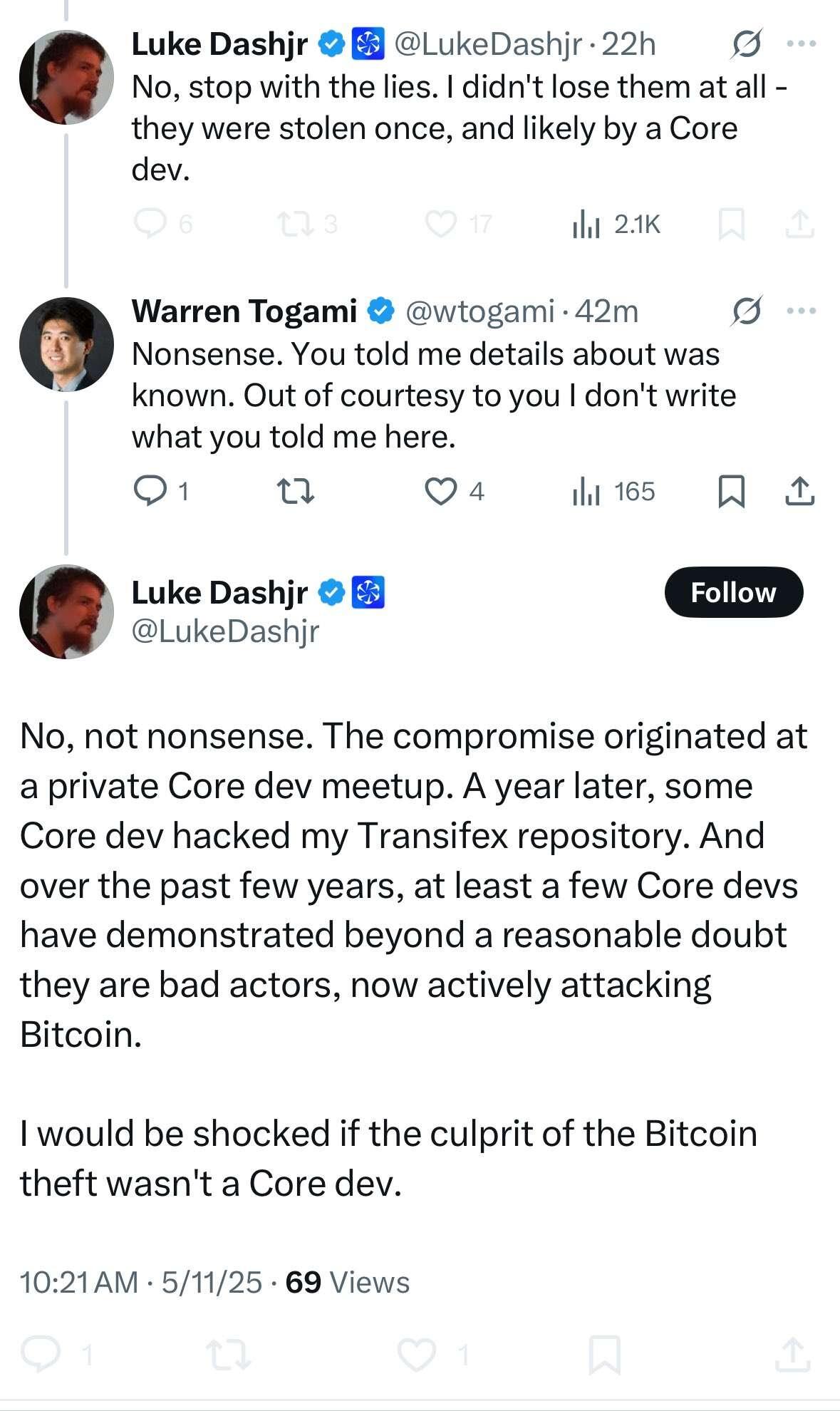
So you're saying that Core dev. don't want to change the code?

Sorry it's my fault. I asked it to postpone the green candle until August.
Running #bitcoin #knots instead of #BitcoinCore .
Fairly easy to implement with nostr:nprofile1qqs9df4h2deu3aae83fmet5xmrlm4w5l9gdnsy3q2n7dklem7ezmwfcpg3mhxw309umxcetgdpukgumjw35xzemdd9envat4xe682cmwv3m85aehvd6kyur3dd58v7re0ymk5mmfda3ngdtdddehydr9v9jzummwd9hkutcppemhxue69uhkummn9ekx7mp0f09vg9 .

It's much better. Bitcoin is free market!
AI is a powerful tool for a #ttrpg game master. 🥰
I'll do it too. Eventually...
I bet you've used nostr:nprofile1qqspnzgrfett3asxcuj0gksje6z2zxzpvgd27uvz58m9vsuqh8zzw6cpr9mhxw309a382emdv9hzumt8w4ujumn9wsargwp58qq3vamnwvaz7tmzv46xztnwdaehgunfdshxxctd9a4sn7 tutorial?

Absolutely nobody would have the right to vote in #Quebec (#Canada).

If you're not embarrassed, it means it's not decentralized enough.


Don't worry, they will. One day or the other, they will run out of FIAT.
✅ 4-Year Bitcoin Compounding Update
On a 4 years period, my Satoshis have generated an annual compounded return equivalent to 24%. I bet I did better than many people. No skills or knowledge are necessary. We simply need patience.
📊 This year marks my first full 4-year cycle since buying Bitcoin. I calculated the equivalent average annual compounded yield for each purchase, then weighted them by amount size.
Why 4 years?
Bitcoin’s block reward halves every 4 years.
Many countries have 4-year electoral cycles.
Without being too long, it’s long enough to filter out short-term noise while capturing Bitcoin’s structural growth.
#Bitcoin #Saving #BitcoinOnly
C'est une vidéo très intéressante sur la menace des ordinateurs quantiqus sur bitcoin.
Je serais plutôt en faveur d'un softfork avec BIP360 et je ne pense pas qu'on devrait faire quoi que ce soit avec les adresses dormants. Ceux qui veulent protéger leur BTC peuvent le faire.



FULL TEXT FOR THOSE THAT DONT DO TWITTER/X
The turbulence that has arisen out of the OP_RETURN PR has taken a lot of energy from the whole Bitcoin community over the past several days. To a certain degree that is unfortunate but on the other hand I believe it is good because it brings to the forefront some fundamental issues with the community. As you all know we don't have a CEO or Board of Directors - we therefore can only be successful and follow a common path via community alignment. Bitcoin's biggest threat is not government bans or quantum computing but losing cohesiveness and direction. In others words, the only enemy is us. We use this latest issue as an inflection point upon which we learn how to all better engage, or we drive a schism - it is up to us.
I got up early today because I wanted to capture some thoughts about where we stand and what issues we really face. I sent this note out to the Bitcoin Dev mailing list earlier today but since that is a small group, I wanted to share the guts of that note with the broader audience and this is what follows:
1 .Those outside of the dev community are perplexed by the process and feeling discounted, unheard, and/or rejected. Most of the issues/PRs/BIPs that the dev community deals with are beyond the ability of the general population to understand, but occasionally there are ones that they grasp (at least somewhat) and for which they have opinion. I’ve certainly learned that when someone has an opinion it is really important to let them express it, otherwise, the pressure inside them builds and they erupt like a volcano. The Bitcoin ecosystem and its members are radically different today than 5-10 years ago – it is bigger, wider, and has broader interests now - it appears that process and communication mechanisms currently used by Core are not capable of reaching the community properly anymore. Note that communication means two-way as well.
When someone buys Bitcoin or starts working within the ecosystem, there is no membership guide, owner’s manual, or employee on-boarding process. It comes off very badly when someone trying to engage is told that they don’t count or aren’t using proper channels, especially when they don’t even know where to go learn the rules of engagement. That isn’t necessarily anyone’s fault, but I’ve been involved in Bitcoin since 2017 and even now am still learning new things about the engagement process, and there definitely have been several surprises and frustrations for me over the past handful of days.
2. The ecosystem is much more complex than ever before with people and companies developing products and services with assumptions of how Bitcoin will operate. Many of these are being done in stealth-mode as well. Some people are pouring their heart and soul (and money) into their projects and the expectation of a standard is often crucial. I am one of these folks, beyond what I do in mining (CEO of Barefoot Mining) and as a board member at Ocean, I have been working for two years on a project related to enhancing block space access. This proposed change in standardness may impact my project in a negative manner, and, it is certainly possible others might be in a similar position. Regardless, changes to standardness are HUGE. I spent most of my career within the Personal Computer space and learned the hard way that changes to a standards are a dangerous game. I expand a bit on this in this X post: https://x.com/boomer_btc/status/1917687830148526095
3. The proposed change also appears to be reduction in flexibility and configurability. In general, this is never a good thing. IMO, we should be going in the direction of giving people more choices and flexibility (although it is fine to make suggestions, set defaults, or provide general guidelines.) How someone configures their node and creates their mempool is akin to free speech within Bitcoin. The same goes for those like me that are miners and create our own block templates – this is also part of our free speech (and our business). In the end though, whether you are a user or a miner, the more choices you have, the more freedom of speech you have.
Side note: Ultimately, as a miner I am in the business of creating block space – at least that is my view, and contrary to popular belief, miners are not always motivated to simply pick transactions that generate the highest block reward in the immediate block, and as time goes by this will become even more common and apparent. I’ve spoken a lot on this recently in public forums, so I won’t dwell on it here.
4. Finally, there is the issue of an OP_RETURN change, if it encourages more spam, and if we are just caving into an inevitability. I am against the proposed change and, even if that is true that the spam will ultimately find a way, I feel we are acquiescing way too early. Enough has been said on this topic in other forums so I won’t go further.
We don't legalize cocaine even though it ultimately find a way. They should stop trying to improve the layer 1 and focus on security/compatibility updates.
That way, the frustrations will stop. A huge reason why Bitcoin has value is because it doesn't change.

I would like something that only has security/compatibility updates. Everything else is noise.


The first step to separate the money from State is for them to massively use bitcoin as strategic reserve.






Am I wrong to work in the weekend that follows my resignation at job? I feel a little bit fool especially when the overtime aren't paid.
Fuck you professionalisme!