


Anyway, either you get it or you don't 😀 I follow you for the memes, let's leave it at that.

Be sure to analyze each and every tiger or black bear out in the wild next time, rather than assuming your life is in serious danger. See how long that lasts.
People generalize because generally generalizations work. Sometimes they don't, like with everything in life.
It's also very contextual and experience teaches you when generalization is a good fit or not.
Have you thought that your argument is self-contradictory, as you generalize a priori that generalizations don't work?
😉 just sayin'.
Merry Christmas!


That seems like the symptom already, not the problem itself.
Why are the eurocrats consistently undermining privacy and freedom in the Union?
Related to what you said, why does no one want to support pro-privacy politicians? Fear of reprisals?
Better, but the recommended minimum is a /64, and ideally a /48 (so you can subnet it into /64 as a customer)
Anything smaller than a /64 and things like SLAAC will break.
Think we might see this offered in the future? And do you also offer dedicated, or just vps?
https://docs.netgate.com/pfsense/en/latest/network/ipv6/subnets.html
Yes, but at least a /64 and preferably a /48, last time I checked only /128 was available with is just not reasonable for IPv6!

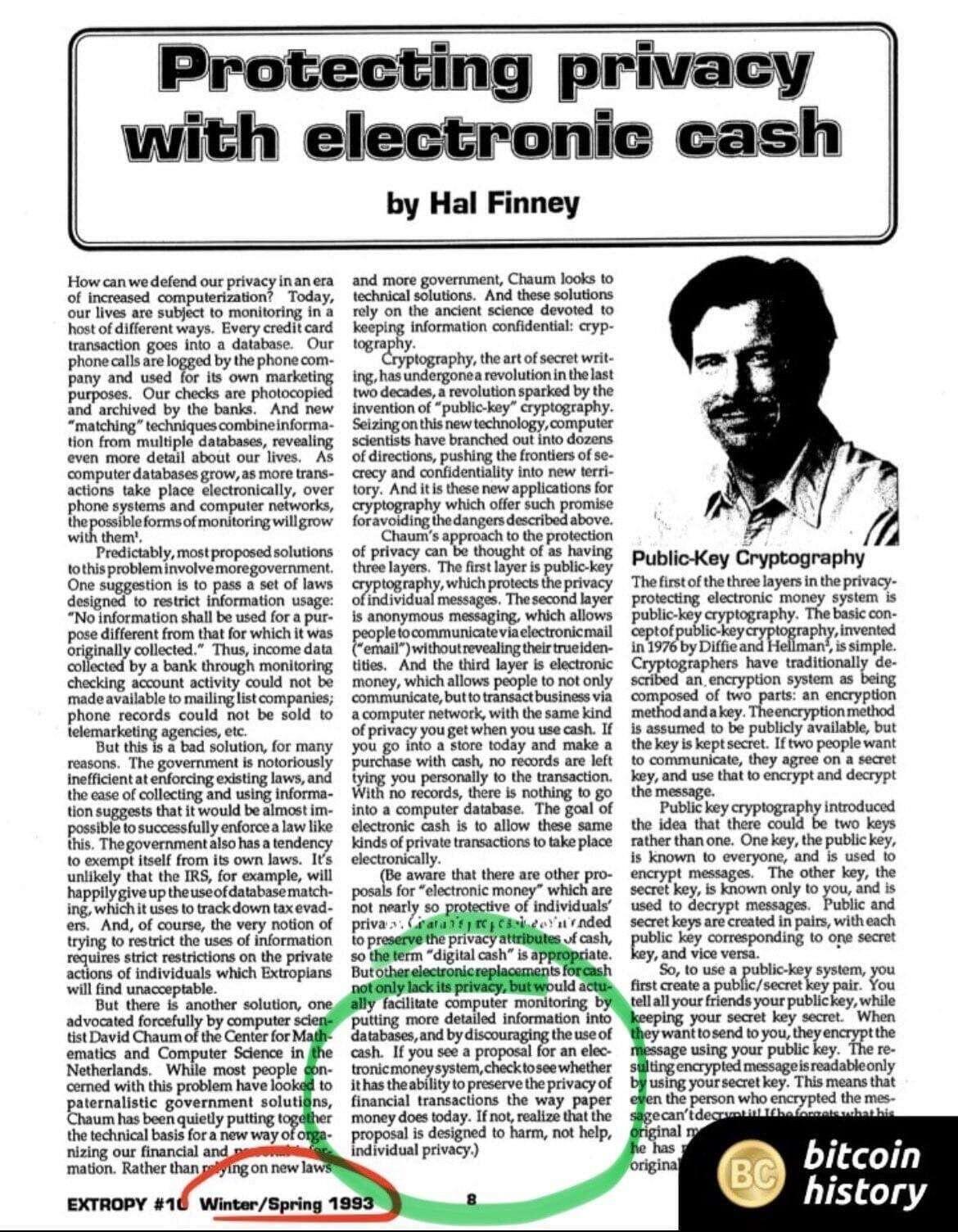
According to a new report from the Open Dialogue Foundation, the #EU is poised to adopt #regulation that will hinder users’ ability to transact privately using #bitcoin and other crypto assets.
Support nostr:npub13ajk3hhvqys2ev4y68jwxywgs8fsdsuk4y5gkzs874jdyrccvf5qak2yd9 and the ODF as they fight to preserve your right to privacy.
My latest for nostr:npub1t8a7uumfmam38kal4xaakzyjccht4y5jxfs4cmlj0p768pxtwu8skh56yu.
#newstr #policy #freedomtech
Why is it that literally every time I hear about some new EU measureS it ALWAYS translates to less freedom and more control?


Bureaucrats doing what they do best.. creating friction about things they don't understand.
The EU is a plague at this point. And not just on Europeans, on the whole world.
Regulate, regulate, control, control, surveil, surveil.

Those two can unironically both be true actually. You can not trust the government and still be happy that the suits are gonna pump your bags.
Bank of Italy: P2P services are criminal
#Robosats
https://atlas21.com/bank-of-italy-p2p-services-are-criminal/
When intermediation is foistered on the unsuspecting masses, for purposes of mass-surveillance, disintermediation looks like a crime, to the criminals who spy on everyone.

What that means is that each individual will make up their own mind, for their own reasons, in their own way, at their own leisure, as free individuals.
Zoom out, and a pattern will emerge. That is the market deciding.
Little Sith 😅

You're still just on the ad hominem. Come on plan9 boy, you can do better 😅😁

But again, if we look at what actually happened, it's bitcoin that's had an inflation bug.
Monero had a flaw that luckily (and yeah, it was just dumb luck) was never exploited.
Back in the day bitcoin was rolled back and the billions of bitcoins created just vanished. Would that work today? Probably not. Or it would at least severely hamper trust in the system.
Bitcoin was very small back then, it's no longer the case and it hasn't been for awhile.
This to say, transparent or opaque, you can have inflation bugs all the same. And ironically (because the opaqueness of Monero is often criticized in the context of it potentially giving rise to such bugs) it actually happened in Bitcoin.
At the end of the day, there are different tradeoffs. In the case of this specific critical Monero bug that was not exploited, it was possible to scan the chain for exploitation of the bug. I am not 100% certain that this would be possible for every kind of bug of the sort, the answer is probably not - so it is an ever-present risk that Monero's supply might not entirely match the expected curve.
In short, Bitcoin's radical transparency doesn't *prevent* inflation bugs from being exploited, as its history shows, but the transparency does allow for quick detection of such an attack, at the cost of unintendendly (to be charitable) facilitating a mass-surveillance system, even though it is dubious that Bitcoin's reputation wouldn't take a massive hit if another inflation bug is exploited and the chain needs rolling back again..
.. whereas Monero's opaqueness doesn't *necessarily* prevent us from scanning the chain for exploits, at least in some of the potential scenarios - we know because this happened - while enabling every user to have pretty decent privacy and anonymity, with some edge cases (for the moment) which we already touched on previously.
As always.. there are no solutions, only tradeoffs.
All things considered, the wiser option to me seems to be holding BTC even considering the ever-looming possibility of another inflation bug, while spending Monero as digital cash whenever possible.
You managed to say nothing, just used up some words.
If you have anything to add to the discussion, I am all ears and I will do my best to argue the point so we can get closer to the truth.
Instead, you barge in with ad hominems.
Whatever.

Can YOU read?
As I told you before, I have nothing against ecash. I think it might have its cases, especially in a federated context as with fedimint.
Single-server AND operated by random strangers is not really "improving custodial solutions" in my book, it's courting disaster, and time will tell if my intuition is correct, but a LOT of unsuspecting people will learn that lesson the hard way.
Your dogma prevents you from even admitting that if privacy and anonymity is the angle, you are surely safer holding and spending Monero than holding and spending ecash from random operator #46927.
Hell, even if it is YOUR own mint. Or does the BTC that back your ecash not sit on a hot wallet on a server that in all likelihood is not secured to the stringest standards?
This you would be able to see if you were honest in your assessment. But for you it's black and white.
I think ecash is interesting tech, I find it interesting that it was ressurected in a bitcoin context (although there is also nothing special about ecash bitcoin IOUs vs anything else), I believe it has its use cases, especially in a federated context, and while I think single-server random-mint use cases are few and often perilous, I am more than happy with people making up their own minds (or learning from their silly mistakes, as the countless threads of "oh no random mint operator rugged me, never saw it coming, help!" demonstrate).
I would never use a non-federated ecash solution myself, but I can see why someone else would.
As for the lightning address here, that's a perfect example of the limitations of lightning. I didn't want to doxx my node which I ran when I set this up, another thing I wouldn't have had to worry about with Monero ;)
And Monero improves non-custodial privacy solutions for onchain L1, so in that sense and using your "logic" it's as much of a speculative shitcoin as Bitcoin is.
(contrast with my logic, where neither is a shitcoin, there are tradeoffs to each solution, and there is no silver bullet.. do you know this thing called nuance?)
Ecash is indeed a speculative shitcoin if you want to be narrow-minded, you're speculating that the mint operator won't rug you. Your precious ecash note might be worth roughly $BTCUSD_NOW or zero.
Surely you also realize that ecash has nothing to do with bitcoin. It just happened to be ressurected in a bitcoin context. But you can have ecash IOUs for anything else too, and in fact if the idea ever takes off, it's an inevitability that it will be used for everything else too.
Anyway, keep seeing the world in black and white, I don't really care. I do care that bystanders and passer-bys read something that makes them think, and that's already happened.
You, on the other hand, don't really want to think, evidenced by the note I'm replying to. Whatever is not what you believe is blasphemy, and you've got no time to engage in heresy.
It's a bit sad but hey, you do you.