Avatar
Joe Bloggs
233e10e1c8e9eca04183be86b6d31266affdc3745701043a2724a3a1d45c3bb8
Exchanging Pure Human Empathy Globally one transaction at a time. Living beyond the Algorithm and any Psychopathic AI. https://medium.com/@j0e810ggs
Replying to Avatar M✨️

https://v.nostr.build/hSMrFi3V6pEuuZHY.mp4

Don't Suck Energy Give #Energy 🍀🫂🧡 Only Good #Vibes Mute is a Superpower! 🦾 Stay on the Mission! 🚀🍊💊✨️🫡

I like this a lot. It's the exchange of pure human Empathy that is Immutable.

I write about that a lot.
Replying to Avatar leon_21

lit

Mint, Epi, Good, Point, Funny, Lit, Mindfully, Entering, Historic, Entertainment, Made, Love

Replying to Avatar Joe Bloggs

01 Title: Barter to Money and the Empathy that a Lack of Numeracy Could Not Induce

Introduction

The transition from barter systems to money-based economies represents one of the most significant changes in human history. Before the widespread use of money and numeracy, trade relied on empathy—human beings understanding each other's needs and negotiating directly. As money began to replace barter, the need for personal trust diminished, but without numeracy, people still struggled to calculate fair exchanges. This post examines how barter declined as money use increased, and how the lack of numeracy prevented the kind of trust and empathy that characterised earlier economic interactions.

The Role of Barter and Empathy

In early human societies, barter was the primary method of trade. Without a standardised medium of exchange, individuals and groups relied on empathy to ensure fair exchanges. A farmer trading grain for livestock, for instance, had to place themselves in the position of the other party, understanding their needs and ensuring mutual satisfaction. Barter was not just an economic exchange; it was a social interaction, built on trust and community.

However, as human societies grew more complex, the limitations of barter became evident. In large communities or long-distance trade, barter required precise knowledge of the value of goods, and the negotiation process became increasingly cumbersome. The introduction of money simplified this process, but it also began to erode the personal, empathetic connections that had been central to barter.

The Introduction of Money and the Decline of Barter

The first coins, minted in Lydia around 600 BCE, marked the beginning of a new era in economic exchange. Money allowed for standardised transactions, reducing the need for personal negotiation. The direct connection between traders, once mediated by empathy, became less important. Instead, the value of goods was abstracted into coinage, allowing trade to occur even between strangers with little trust between them.

While the introduction of money led to a gradual decline in barter, the process was slow. Barter persisted for centuries, particularly in rural areas or in times of economic hardship when coins were scarce. In medieval Europe, for instance, barter was still common among peasants, even as money became the dominant medium of exchange in urban markets. The rise of feudalism and the lack of widespread currency systems ensured that barter continued well into the Middle Ages.

The Importance of Numeracy

Though money simplified transactions, it did not entirely solve the problem of fair trade. Without numeracy, the ability to understand and work with numbers, many individuals were still vulnerable to unfair deals. Money alone could not induce the kind of empathy that was necessary for ensuring fairness in barter systems. The rise of numeracy, particularly in the 19th and 20th centuries, played a crucial role in levelling the playing field, allowing more people to engage in economic transactions with confidence.

Numeracy became widespread only with the advent of public education systems in Europe and North America. Before this, only elites, scribes, and merchants had the numerical skills required for complex trade. By the early 20th century, with numeracy becoming common among the general population, the need for personal trust and empathy in transactions diminished further, as individuals could now calculate value and fairness independently.

See the Chart that shows Barter, Money and Numeracy in Use over time.

Barter, Empathy, and the Consequences of Their Decline

The decline of barter and the rise of money and numeracy represent more than just changes in how people traded goods. They mark a shift from a system based on human connection and trust to one grounded in abstraction and calculation. While the modern economy allows for efficiency and scale, it has also removed much of the empathy that once governed economic exchanges.

Barter required individuals to understand and relate to one another, making each transaction a negotiation not only of value but of social relations. The empathy exchanged in these interactions was a vital part of ensuring fairness, particularly in small, close-knit communities. As money and numeracy replaced this need, the personal connections that were once essential for trade were weakened, and economic transactions became increasingly impersonal.

Conclusion

The shift from barter to money-based economies was driven by the need for a more efficient and scalable method of trade. However, as this paper has shown, this transition also led to the erosion of empathy in economic exchanges. Without numeracy, early money-based systems could not induce the same kind of fairness and trust that characterised barter. Only with the widespread introduction of numeracy did individuals gain the tools to engage in fair trade independently. Yet, even today, the loss of empathy in economic transactions remains a consequence of this historic shift.

Sources:

Glyn Davies, A History of Money: From Ancient Times to the Present Day, University of Wales Press, 2002.

David Graeber, Debt: The First 5,000 Years, Melville House, 2011.

Joel Kaye, A History of Balance, 1250-1375: The Emergence of a New Model of Equilibrium and Its Impact on Thought, Cambridge University Press, 2014.

Niall Ferguson, The Ascent of Money: A Financial History of the World, Penguin Press, 2008.

https://nostrcheck.me/media/233e10e1c8e9eca04183be86b6d31266affdc3745701043a2724a3a1d45c3bb8/1fc862c6c5555d5c17b072df07e7b385f6a4a869b3c42dbbbdcfbef4af25340f.webp

The "Magic Wrapping Paper" is evident, you cannot re-wrap the Magic.

That's a whole mother fucking level of understanding, the you mo fuckers r just missing.

Choose Bitcoin, The "Magic Wrapping Paper" or Mr Ben Dover will continue with his Politician's green lighted Fuckery.

We are me.

I am Legion.

I come forth.

I take back.

Empathy.

Immutable Truth.

Okay but, even the Psychopaths will adapt to using Bitcoin, imagine the Psychopath born 10 years from now, are they still-born?

Bitcoin is the Magic Wrapping Paper, it doesn't destroy anything, it allows things to be wrapped differently before they are exchanged, forever.

Similar but fundamentally different from what you were saying.

I think what you have not understood in my note above, is that Money can never represent that Magic Wrapping Paper. As such, Bitcoin can because it beyond Money.

At the information level, it captures the Magic Wrapping of everything at all levels forever.

A Magic Wrapping Paper is a good analogy of this information capture.

Money as such is defunct.

Similar to what you were saying but fundamentally different.

Do you understand that concept?

It as not easy, it's taken a lot from me to be able to envision this "pure information layer" which is the Magic Wrapping Paper.

Replying to Avatar 7fqx

There is only one Poll. It's to share Pure Human Empathy based upon Immutable Truth.

There is only one "Magic Wrapping Paper" that can deliver this gift to all.

That "Magic Wrapping Paper" is the Bitcoin.

Exchange your Empathy for Immutable Truth with anyone anywhere and they will do the same and share that Pure Human Empathy for Immutable with anyone anywhere and they will do the same and share that Pure Human Empathy for Immutable with anyone anywhere and they will do the same and share that Pure Human Empathy for Immutable with anyone anywhere and they will do the same and share that Pure Human Empathy for Immutable with anyone anywhere and they will do the same and share that Pure Human Empathy for Immutable with anyone anywhere and they will do the same and share that Pure Human Empathy for Immutable with anyone anywhere and they will do the same and share that Pure Human Empathy for Immutable with anyone anywhere and they will do the same and share that Pure Human Empathy for Immutable with anyone anywhere and they will do the same and share that Pure Human Empathy for Immutable with anyone anywhere and they will do the same and share that Pure Human Empathy for Immutable with anyone anywhere and they will do the same and share that Pure Human Empathy for Immutable with anyone anywhere and they will do the same and share that Pure Human Empathy for Immutable with anyone anywhere and they will do the same and share that Pure Human Empathy for Immutable with anyone anywhere and they will do the same and share that Pure Human Empathy for Immutable with anyone anywhere and they will do the same and share that Pure Human Empathy for Immutable with anyone anywhere and they will do the same and share that Pure Human Empathy for Immutable with anyone anywhere and they will do the same and share that Pure Human Empathy for Immutable with anyone anywhere and they will do the same and share that Pure Human Empathy for Immutable with anyone anywhere and they will do the same and share that Pure Human Empathy for Immutable with anyone anywhere and they will do the same and share that Pure Human Empathy for Immutable with anyone anywhere and they will do the same and share that Pure Human Empathy for Immutable with anyone anywhere and they will do the same and share that Pure Human Empathy for Immutable with anyone anywhere and they will do the same and share that Pure Human Empathy for Immutable with anyone anywhere and they will do the same and share that Pure Human Empathy for Immutable with anyone anywhere and they will do the same and share that Pure Human Empathy for Immutable with anyone anywhere and they will do the same and share that Pure Human Empathy for Immutable with anyone anywhere and they will do the same and share that Pure Human Empathy for Immutable with anyone anywhere and they will do the same and share that Pure Human Empathy for Immutable with anyone anywhere and they will do the same and share that Pure Human Empathy for Immutable with anyone anywhere and they will do the same and share that Pure Human Empathy for Immutable with anyone anywhere and they will do the same and share that Pure Human Empathy for Immutable with anyone anywhere and they will do the same and share that Pure Human Empathy for Immutable with anyone anywhere and they will do the same and share that Pure Human Empathy for Immutable with anyone anywhere and they will do the same and share that Pure Human Empathy for Immutable with anyone anywhere and they will do the same and share that Pure Human Empathy for Immutable with anyone anywhere and they will do the same and share that Pure Human Empathy for Immutable with anyone anywhere and they will do the same and share that Pure Human Empathy for Immutable with anyone anywhere and they will do the same and share that Pure Human Empathy for Immutable with anyone anywhere and they will do the same and share that Pure Human Empathy for Immutable with anyone anywhere and they will do the same and share that Pure Human Empathy for Immutable with anyone anywhere and they will do the same and share that Pure Human Empathy for Immutable with anyone anywhere and they will do the same and share that Pure Human Empathy for Immutable with anyone anywhere and they will do the same and share that Pure Human Empathy for Immutable with anyone anywhere and they will do the same and share that Pure Human Empathy for Immutable with anyone anywhere and they will do the same and share that Pure Human Empathy for Immutable with anyone anywhere and they will do the same and share that Pure Human Empathy for Immutable with anyone anywhere and they will do the same and share that Pure Human Empathy for Immutable with anyone anywhere and they will do the same and share that Pure Human Empathy for Immutable with anyone anywhere and they will do the same and share that Pure Human Empathy for Immutable with anyone anywhere and they will do the same and share that Pure Human Empathy for Immutable with anyone anywhere and they will do the same and share that Pure Human Empathy for Immutable with anyone anywhere and they will do the same and share that Pure Human Empathy for Immutable with anyone anywhere and they will do the same and share that Pure Human Empathy for Immutable with anyone anywhere and they will do the same and share that Pure Human Empathy for Immutable with anyone anywhere and they will do the same and share that Pure Human Empathy for Immutable with anyone anywhere and they will do the same and share that Pure Human Empathy for Immutable with anyone anywhere and they will do the same and share that Pure Human Empathy for Immutable with anyone anywhere and they will do the same and share that Pure Human Empathy for Immutable with anyone anywhere and they will do the same and share that Pure Human Empathy for Immutable with anyone anywhere and they will do the same and share that Pure Human Empathy for Immutable with anyone anywhere and they will do the same and share that Pure Human Empathy for Immutable with anyone anywhere and they will do the same and share that Pure Human Empathy for Immutable with anyone anywhere and they will do the same and share that Pure Human Empathy for Immutable with anyone anywhere and they will do the same and share that Pure Human Empathy for Immutable with anyone anywhere and they will do the same and share that Pure Human Empathy for Immutable with anyone anywhere and they will do the same and share that Pure Human Empathy for Immutable with anyone anywhere and they will do the same and share that Pure Human Empathy for Immutable etc et cetera...

I agree to a point, if you Wrap anything in bullshit, the truth of what's inside is obscured from view. It's ignored or called out because of it's Wrapping.

Systemically, packaging the data of the Pure Human Empathy for Immutable Truth in cryptology that just broken makes it unreadable.

Bitcoin is the 'Magic Wrapping Paper' no other Wrapping Paper can deliver the Pure Human Empathy for Immutable Truth.

Being born in a Rabbit Hole and coming out let's you see the Trappings of these Non-magical Wrappings.

Lol.

Another, "Magic Wrapping Paper" gone wrong.

It doesn't matter if Islam is right or wrong. It's contained in Wrapping Paper that cannot be constantly delivered.

The same is true of nearly all human constructs, they can be abused.

You need to stop trying to go deeper and realise, that by default, as you climb out of that Rabbit Hole you were born in, part of your head comes out first.

You are getting closer to the top, but you aren't quite there.

I agree, however, if the cost of storage goes to almost zero and the cost of energy goes to zero. But the cost of not sharing Pure Human Empathy becomes greater than just using a Fiat Currency!?

The exchange of Pure Human Empathy is paramount, the timing/realisation of that is what makes this so hard to think about.

Bitcoin was given away in an act of Pure Human Empathy, it was exchanged for many years with zero (at the time) exchangeable value. That was a long time ago, but those bands of timelines are exponentially compressing.

The competition is everything for free at no cost (other than your entire liberty at every single imaginable level).

So again, timing is key.

At no time did anyone with any credibility say Bitcoin was an Exchange of Pure Human Empathy. Still not many at all are saying that, but exponentially compressing time lines could be the difference.

Is it the silent majority who actually push a revolution, they are silent because they aren't Psychopaths and are involved in real world exchanges of pure Empathy?

I feel everyone's pain here.

For one of my Title notes, I'm going to look at Bitcoin (The Magic Wrapping Paper) and information flow.

So here are my assumptions so far.

Assumptions for Bitcoin:

Creation Time (a): The Bitcoin protocol, assuming it has always existed, would start producing Bitcoin as soon as solar-powered mining equipment is operational. This operational setup can be almost immediate once the necessary infrastructure is in place.

Reproduction Time (b): Bitcoin mining is a continuous process, constrained by computational difficulty and energy supply. For this exercise, we assume that mining continuously produces Bitcoin due to the increasing number of decimal places.

The table below shows the phenomena and Bitcoin from the fastest to the slowest production and reproduction times.

So based upon that, I've created a table which is below.
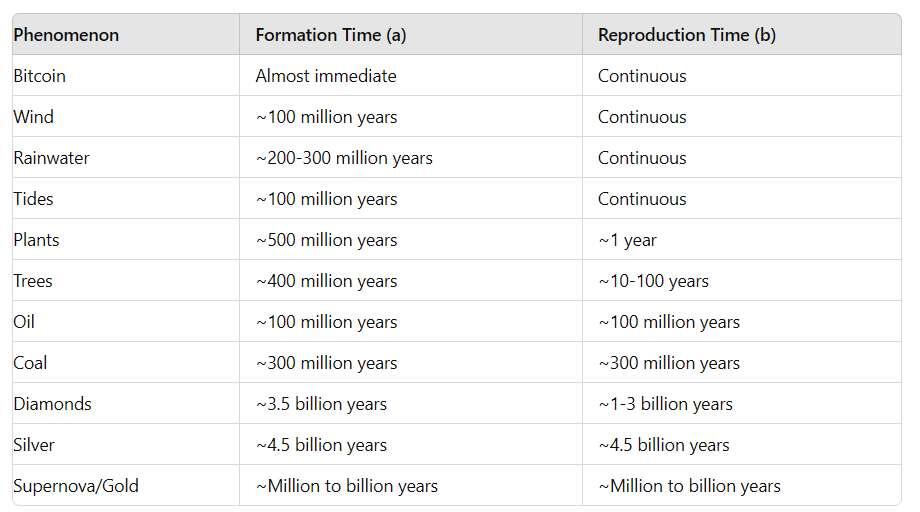
Here's an explanation of my thoughts relating to that table.

Explanation

Bitcoin is now at the top because its formation time is almost immediate with the right infrastructure and it reproduces continuously.

Wind, Rainwater, and Tides are next, as their reproduction is continuous.

Plants and Trees follow, as their reproduction is annual to decadal.

Oil and Coal have lengthy formation and reproduction times in the millions of years.

Diamonds and Silver take billions of years to form and reproduce.

Supernova/Gold remains at the end due to the immense time required for the stellar processes involved.

I'd love any feedback, ideas, to expand on this. Previously just trying to go back in time and imagine being involved in barter exchanges before Money and before Numeracy was really hard.

I can't explain how much doing that takes out of you. It's like trying to learn the part of being an actor, but with no lines, no director, no stage and it has to be a documentary of what was absolutely true too. Even that doesn't express how hard that was.

So any help would be greatly appreciated, writing these Title notes is hard. I've only done 9 and imaging what number the last may be is a little bit scary. My goal is a final Unified Theory of Everything within the Human Construct in terms of the reality of Immutable Truth. Scary as fuck.

Replying to Avatar Joe Bloggs

07 Title: Barter: Empathy and the Magic Wrapping that Money Cannot Buy

Introduction

For much of human history, the barter system served as the primary means of economic exchange. Unlike today's monetary systems, barter involved the direct exchange of goods and services, underpinned by pure human empathy.

This empathy ensured that transactions were not merely material but rooted in mutual trust, fairness, and understanding. These dimensions are often lost in modern economies, where money serves as a detached, impersonal medium of exchange.

In this note, I will explore how empathy functioned as the core ingredient of barter, examine its components in detail, and offer an analogy: the magic wrapping paper a metaphor for how empathy holds each exchange together.

This Magic Wrapping Paper, composed of multiple layers of trust, fairness, and social responsibility, represents the human connections that have been systematically stripped away in the evolution of monetary systems. Ultimately, we will argue that money, no matter how efficiently it facilitates transactions, can never replace or replicate the empathy that made barter a socially cohesive system.

The Role of Empathy in Barter

Barter, unlike modern currency based exchanges, was a system that required direct, personal interaction between individuals. This interaction was not simply an economic one; it was inherently social, shaped by the emotional and ethical context of the community. In barter, the perceived fairness of an exchange was not dictated by a universal currency value but by a shared understanding of each other's needs and circumstances.

For example, if a farmer exchanged a surplus of grain with a blacksmith for tools, the fairness of the transaction depended on more than the physical items being traded. The farmer might consider the blacksmith's family’s needs for food, while the blacksmith understood that the farmer needed tools to cultivate more crops.

Both parties would naturally aim for a balance that respected each other's needs. This exchange was not just economic but relational a process governed by empathy.

Breakdown of Empathy in Barter

Empathy in barter can be broken down into several key components, each of which played a critical role in maintaining the fairness and cohesion of the exchange. These components are best visualised through the analogy of magic wrapping paper, where each layer symbolises a different aspect of the empathetic exchange.

Perceived Fairness

In any barter transaction, both parties needed to feel that the exchange was fair and equitable. Fairness in this context wasn't limited to the material value of the goods being traded but also considered the social and emotional contexts. If one party felt they were being short-changed, the relationship would be damaged, and future exchanges would be jeopardised. This layer of empathy ensured that everyone’s needs were acknowledged and met.

Trust

Trust is central to any barter system. Participants had to trust that the other party would honour their side of the bargain, and that they might engage in future exchanges. Unlike money-based systems where transactions can be anonymous, barter was deeply personal. The establishment of trust created a long-term relationship between traders, ensuring that the community as a whole remained interconnected.

Mutual Understanding

Barter required a level of mutual understanding that transcended material exchange. Parties needed to recognise each other's vulnerabilities and circumstances, taking into account factors like family size, seasonal needs, or future crop yields. This understanding shaped how they negotiated and decided on the value of the trade.

Reciprocity

In a barter system, exchanges were often based on an implicit expectation of reciprocity. Even if the trade was not perfectly balanced in terms of material value, both parties knew that the imbalance could be addressed in future exchanges. This layer of empathy created a system where people were incentivised to help each other and maintain the balance over time.

Long-term Relationship Building

Barter systems were not built on one-off exchanges; they were relational. Each transaction strengthened the social bonds between the participants. Unlike monetary exchanges, which could be completed in isolation, barter required a long-term commitment to each other's well-being, ensuring that the community as a whole benefited.

Flexibility in Value Perception

Unlike modern money systems, where prices are fixed and standardised, the value of goods in barter was flexible and subjective, determined by mutual empathy and negotiation. This flexibility allowed the system to accommodate the specific needs of each party and ensure that the exchange felt fair, even if the goods themselves weren’t of equal material value.

Emotional Investment

Each barter transaction carried an element of emotional investment, as the participants were often trading with people they knew personally. The act of bartering wasn’t just about meeting material needs; it was also about ensuring the well-being of the other person. This investment in the other party's success fostered a deeper connection than a monetary exchange ever could.

Community Bonding

Barter facilitated community bonding, as exchanges often took place within the context of a larger social network. The health of the entire community depended on the empathy-driven fairness of individual exchanges, reinforcing the importance of looking after one another and the collective good.

Resource Sustainability

Empathy extended beyond human relationships and into the natural environment. Exchanges were conducted with an understanding that over-exploitation of resources would harm the entire community. For example, hunters would not over-hunt certain animals, knowing that doing so would deplete the natural resources available for future trades. In this way, barter was tied to the idea of sustainability, which money-based systems, driven by profit, often disregard.

Cultural and Spiritual Beliefs

Many Native American barter systems were guided by cultural and spiritual beliefs that emphasised respect for nature and the animals involved in the exchange. The spiritual dimension of these exchanges ensured that goods were not treated merely as commodities but as part of a larger, sacred ecosystem.

Social Responsibility

Empathy in barter extended to the broader community, creating a sense of social responsibility. Traders understood that their actions impacted not only their immediate partners but the community as a whole. This layer of empathy reinforced the idea that fairness and generosity were not just personal virtues but essential to the health of the collective.

Shared Risk

Both parties in a barter transaction shared the risks involved. For instance, a farmer trading grain with a blacksmith knew that if the weather destroyed future crops, they might need the blacksmith's help again. This shared risk created an incentive for generosity and flexibility, as participants were aware that they might need to rely on each other in times of hardship.

Interdependence

Barter systems operated on the principle of interdependence, where individuals relied on each other to meet their needs. This was not just a material exchange; it was an acknowledgment of the shared vulnerability within the community. The strength of one individual or household contributed to the well-being of the group, making every exchange a form of collective security.

Direct Human Connection

Finally, barter was conducted through direct human interaction. Face-to-face exchanges fostered empathy, creating a sense of connection that could not be replicated in anonymous monetary transactions. The emotional weight of these exchanges encouraged fairness, generosity, and long-term relationship building.

The Magic Wrapping Paper Analogy

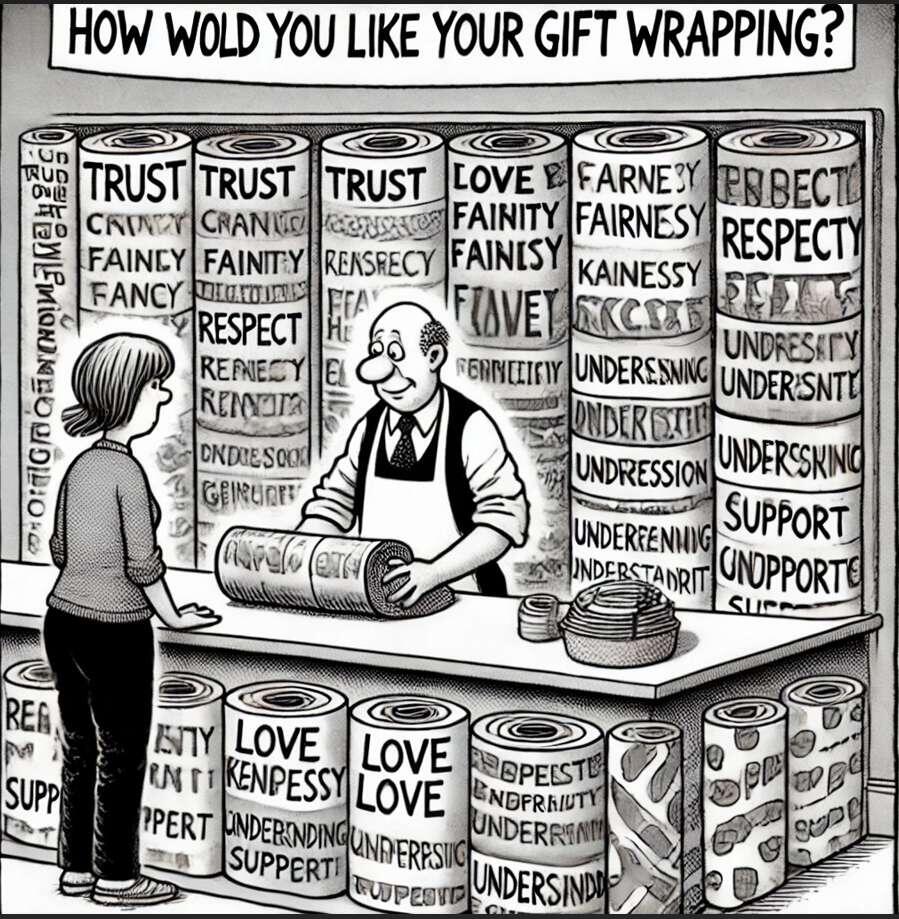
Imagine you’re giving someone a gift. The present is important, but so is the wrapping paper. This paper isn’t just decorative, it’s Magic Wrapping Paper. It holds all the care, thought, and effort you’ve put in. When you give it, the Magic Wrapping Paper tells a story about the care, thought, effort, needs and feelings, and it makes the gift even more meaningful.

Now, imagine that this Magic Wrapping Paper has multiple layers, each one adding a different level of empathy, trust, and understanding. The Magic Paper makes sure the person receiving the gift knows you care, and it protects the fairness and kindness behind the exchange.

What’s even more special? The Magic Wrapping Paper can be reused. Once someone receives a gift, they can take that same Magic Wrapping Paper and use it again to share empathy and fairness with someone else. The Magic Wrapping Paper doesn’t tear, wear out, or lose its magic, it just keeps spreading trust and connection.

In the world of barter, this Magic Wrapping Paper would not be needed as it was already there as the invisible bond of human empathy that surrounds every trade.

When you trade something, you’re not just swapping items; you’re also wrapping it in care, fairness, and understanding. Unlike money, which strips away these personal touches, the magic wrapping paper keeps the human side of every exchange alive.

Imagine having a free invisible Magic Wrapping Paper (made up of all the layers that make-up Human Empathy) and the size of the wrapped Empathy would be the full package being passed on to another.

This Magic Wrapping Paper would also allow the package to be broken down in to smaller and smaller packages to be shared among multiple people and or put aside for later use. More importantly, this Magic Wrapping Paper will speak to you and tell you the full story of all the Empathy inside.

To illustrate the role of empathy in barter, consider the analogy of magic wrapping paper. In this metaphor, the wrapping paper represents the layers of empathy that surround each transaction. Every exchange is like a gift whether it’s large or small, the present is carefully wrapped in empathy, ensuring that the exchange is equitable, sustainable, and socially responsible.

Multiple layers of the wrapping paper reflect the various aspects of empathy: perceived fairness, trust, mutual understanding, and community bonding. These layers ensure that the transaction is not purely material but wrapped in human consideration.

The wrapping paper can be broken down into smaller parts or even re-wrapped, reflecting the flexibility in barter transactions. If the original trade doesn't fully meet the needs of both parties, future exchanges can compensate for the imbalance. The wrapping remains intact, symbolising the ongoing nature of trust and fairness.

In contrast to modern money, which tends to strip transactions of their emotional and ethical layers, the magic wrapping paper ensures that empathy is always preserved. Every layer of the wrapping reinforces the connection between the parties, ensuring that no matter how many times the package is opened, the human element remains intact.

The Failure of Money to Capture Empathy

While money was introduced to overcome the logistical challenges of barter such as the coincidence of wants problem it has failed to capture the empathy ratio inherent in barter. Money reduces all exchanges to quantified value, stripping away the relational, emotional, and ethical dimensions of trade.

The impersonal nature of money-based transactions means that fairness is reduced to price, and trust becomes irrelevant, as transactions can be completed without personal interaction.

Fiat currencies further exacerbate this issue, as they are detached from any real material value and subject to manipulation by governments and financial institutions. The introduction of interest and debt-based systems drains the empathy from economic exchanges, creating opportunities for exploitation and inequality.

In contrast, barter, with its layers of empathetic wrapping, ensured that no one party could profit at the expense of another, and that the needs of both individuals and the community were always balanced.

Conclusion

The Magic Wrapping Paper analogy perfectly encapsulates the role of empathy in barter systems. Each layer of the wrapping represents a different aspect of empathy, from trust and fairness to social responsibility and sustainability. This Magic Wrapping Paper ensures that every exchange is not only materially fair but also rooted in human connection and ethical behaviour.

Money was never that Magic Wrapping Paper.

Sources:

· Nick Szabo, "Shelling Out: The Origins of Money"

· David Graeber, Debt: The First 5,000 Years, ISBN: 9781612191294

· Glyn Davies, A History of Money: From Ancient Times to the Present Day, ISBN: 9780708317174

· Adam Smith, The Wealth of Nations, ISBN: 9780140432084

· Marshall Sahlins, Stone Age Economics, ISBN: 9780202010991

· Paul Bohannan, "The Impact of Money on an African Subsistence Economy" Journal of Economic History, Vol. 19, No. 4 (1959), pp. 491–503

· Franz Boas, The Mind of Primitive Man, ISBN: 9780029035307

· Edith Stein, On the Problem of Empathy, ISBN: 9780810105969

· Martin Buber, I and Thou, ISBN: 9781570629048

· John Maynard Keynes, The General Theory of Employment, Interest and Money, ISBN: 9780230004764

· Karl Polanyi, The Great Transformation, ISBN: 9780807056431

· Niall Ferguson, The Ascent of Money: A Financial History of the World, ISBN: 9780143116172

· Daniel Goleman, Emotional Intelligence, ISBN: 9780553383713

· Simon Baron-Cohen, The Science of Evil: On Empathy and the Origins of Cruelty, ISBN: 9780465031421

Replying to Avatar Joe Bloggs

07 Title: Barter: Empathy and the Magic Wrapping that Money Cannot Buy

Introduction

For much of human history, the barter system served as the primary means of economic exchange. Unlike today's monetary systems, barter involved the direct exchange of goods and services, underpinned by pure human empathy.

This empathy ensured that transactions were not merely material but rooted in mutual trust, fairness, and understanding. These dimensions are often lost in modern economies, where money serves as a detached, impersonal medium of exchange.

In this note, I will explore how empathy functioned as the core ingredient of barter, examine its components in detail, and offer an analogy: the magic wrapping paper a metaphor for how empathy holds each exchange together.

This Magic Wrapping Paper, composed of multiple layers of trust, fairness, and social responsibility, represents the human connections that have been systematically stripped away in the evolution of monetary systems. Ultimately, we will argue that money, no matter how efficiently it facilitates transactions, can never replace or replicate the empathy that made barter a socially cohesive system.

The Role of Empathy in Barter

Barter, unlike modern currency based exchanges, was a system that required direct, personal interaction between individuals. This interaction was not simply an economic one; it was inherently social, shaped by the emotional and ethical context of the community. In barter, the perceived fairness of an exchange was not dictated by a universal currency value but by a shared understanding of each other's needs and circumstances.

For example, if a farmer exchanged a surplus of grain with a blacksmith for tools, the fairness of the transaction depended on more than the physical items being traded. The farmer might consider the blacksmith's family’s needs for food, while the blacksmith understood that the farmer needed tools to cultivate more crops.

Both parties would naturally aim for a balance that respected each other's needs. This exchange was not just economic but relational a process governed by empathy.

Breakdown of Empathy in Barter

Empathy in barter can be broken down into several key components, each of which played a critical role in maintaining the fairness and cohesion of the exchange. These components are best visualised through the analogy of magic wrapping paper, where each layer symbolises a different aspect of the empathetic exchange.

Perceived Fairness

In any barter transaction, both parties needed to feel that the exchange was fair and equitable. Fairness in this context wasn't limited to the material value of the goods being traded but also considered the social and emotional contexts. If one party felt they were being short-changed, the relationship would be damaged, and future exchanges would be jeopardised. This layer of empathy ensured that everyone’s needs were acknowledged and met.

Trust

Trust is central to any barter system. Participants had to trust that the other party would honour their side of the bargain, and that they might engage in future exchanges. Unlike money-based systems where transactions can be anonymous, barter was deeply personal. The establishment of trust created a long-term relationship between traders, ensuring that the community as a whole remained interconnected.

Mutual Understanding

Barter required a level of mutual understanding that transcended material exchange. Parties needed to recognise each other's vulnerabilities and circumstances, taking into account factors like family size, seasonal needs, or future crop yields. This understanding shaped how they negotiated and decided on the value of the trade.

Reciprocity

In a barter system, exchanges were often based on an implicit expectation of reciprocity. Even if the trade was not perfectly balanced in terms of material value, both parties knew that the imbalance could be addressed in future exchanges. This layer of empathy created a system where people were incentivised to help each other and maintain the balance over time.

Long-term Relationship Building

Barter systems were not built on one-off exchanges; they were relational. Each transaction strengthened the social bonds between the participants. Unlike monetary exchanges, which could be completed in isolation, barter required a long-term commitment to each other's well-being, ensuring that the community as a whole benefited.

Flexibility in Value Perception

Unlike modern money systems, where prices are fixed and standardised, the value of goods in barter was flexible and subjective, determined by mutual empathy and negotiation. This flexibility allowed the system to accommodate the specific needs of each party and ensure that the exchange felt fair, even if the goods themselves weren’t of equal material value.

Emotional Investment

Each barter transaction carried an element of emotional investment, as the participants were often trading with people they knew personally. The act of bartering wasn’t just about meeting material needs; it was also about ensuring the well-being of the other person. This investment in the other party's success fostered a deeper connection than a monetary exchange ever could.

Community Bonding

Barter facilitated community bonding, as exchanges often took place within the context of a larger social network. The health of the entire community depended on the empathy-driven fairness of individual exchanges, reinforcing the importance of looking after one another and the collective good.

Resource Sustainability

Empathy extended beyond human relationships and into the natural environment. Exchanges were conducted with an understanding that over-exploitation of resources would harm the entire community. For example, hunters would not over-hunt certain animals, knowing that doing so would deplete the natural resources available for future trades. In this way, barter was tied to the idea of sustainability, which money-based systems, driven by profit, often disregard.

Cultural and Spiritual Beliefs

Many Native American barter systems were guided by cultural and spiritual beliefs that emphasised respect for nature and the animals involved in the exchange. The spiritual dimension of these exchanges ensured that goods were not treated merely as commodities but as part of a larger, sacred ecosystem.

Social Responsibility

Empathy in barter extended to the broader community, creating a sense of social responsibility. Traders understood that their actions impacted not only their immediate partners but the community as a whole. This layer of empathy reinforced the idea that fairness and generosity were not just personal virtues but essential to the health of the collective.

Shared Risk

Both parties in a barter transaction shared the risks involved. For instance, a farmer trading grain with a blacksmith knew that if the weather destroyed future crops, they might need the blacksmith's help again. This shared risk created an incentive for generosity and flexibility, as participants were aware that they might need to rely on each other in times of hardship.

Interdependence

Barter systems operated on the principle of interdependence, where individuals relied on each other to meet their needs. This was not just a material exchange; it was an acknowledgment of the shared vulnerability within the community. The strength of one individual or household contributed to the well-being of the group, making every exchange a form of collective security.

Direct Human Connection

Finally, barter was conducted through direct human interaction. Face-to-face exchanges fostered empathy, creating a sense of connection that could not be replicated in anonymous monetary transactions. The emotional weight of these exchanges encouraged fairness, generosity, and long-term relationship building.

The Magic Wrapping Paper Analogy

Imagine you’re giving someone a gift. The present is important, but so is the wrapping paper. This paper isn’t just decorative, it’s Magic Wrapping Paper. It holds all the care, thought, and effort you’ve put in. When you give it, the Magic Wrapping Paper tells a story about the care, thought, effort, needs and feelings, and it makes the gift even more meaningful.

Now, imagine that this Magic Wrapping Paper has multiple layers, each one adding a different level of empathy, trust, and understanding. The Magic Paper makes sure the person receiving the gift knows you care, and it protects the fairness and kindness behind the exchange.

What’s even more special? The Magic Wrapping Paper can be reused. Once someone receives a gift, they can take that same Magic Wrapping Paper and use it again to share empathy and fairness with someone else. The Magic Wrapping Paper doesn’t tear, wear out, or lose its magic, it just keeps spreading trust and connection.

In the world of barter, this Magic Wrapping Paper would not be needed as it was already there as the invisible bond of human empathy that surrounds every trade.

When you trade something, you’re not just swapping items; you’re also wrapping it in care, fairness, and understanding. Unlike money, which strips away these personal touches, the magic wrapping paper keeps the human side of every exchange alive.

Imagine having a free invisible Magic Wrapping Paper (made up of all the layers that make-up Human Empathy) and the size of the wrapped Empathy would be the full package being passed on to another.

This Magic Wrapping Paper would also allow the package to be broken down in to smaller and smaller packages to be shared among multiple people and or put aside for later use. More importantly, this Magic Wrapping Paper will speak to you and tell you the full story of all the Empathy inside.

To illustrate the role of empathy in barter, consider the analogy of magic wrapping paper. In this metaphor, the wrapping paper represents the layers of empathy that surround each transaction. Every exchange is like a gift whether it’s large or small, the present is carefully wrapped in empathy, ensuring that the exchange is equitable, sustainable, and socially responsible.

Multiple layers of the wrapping paper reflect the various aspects of empathy: perceived fairness, trust, mutual understanding, and community bonding. These layers ensure that the transaction is not purely material but wrapped in human consideration.

The wrapping paper can be broken down into smaller parts or even re-wrapped, reflecting the flexibility in barter transactions. If the original trade doesn't fully meet the needs of both parties, future exchanges can compensate for the imbalance. The wrapping remains intact, symbolising the ongoing nature of trust and fairness.

In contrast to modern money, which tends to strip transactions of their emotional and ethical layers, the magic wrapping paper ensures that empathy is always preserved. Every layer of the wrapping reinforces the connection between the parties, ensuring that no matter how many times the package is opened, the human element remains intact.

The Failure of Money to Capture Empathy

While money was introduced to overcome the logistical challenges of barter such as the coincidence of wants problem it has failed to capture the empathy ratio inherent in barter. Money reduces all exchanges to quantified value, stripping away the relational, emotional, and ethical dimensions of trade.

The impersonal nature of money-based transactions means that fairness is reduced to price, and trust becomes irrelevant, as transactions can be completed without personal interaction.

Fiat currencies further exacerbate this issue, as they are detached from any real material value and subject to manipulation by governments and financial institutions. The introduction of interest and debt-based systems drains the empathy from economic exchanges, creating opportunities for exploitation and inequality.

In contrast, barter, with its layers of empathetic wrapping, ensured that no one party could profit at the expense of another, and that the needs of both individuals and the community were always balanced.

Conclusion

The Magic Wrapping Paper analogy perfectly encapsulates the role of empathy in barter systems. Each layer of the wrapping represents a different aspect of empathy, from trust and fairness to social responsibility and sustainability. This Magic Wrapping Paper ensures that every exchange is not only materially fair but also rooted in human connection and ethical behaviour.

Money was never that Magic Wrapping Paper.

Sources:

· Nick Szabo, "Shelling Out: The Origins of Money"

· David Graeber, Debt: The First 5,000 Years, ISBN: 9781612191294

· Glyn Davies, A History of Money: From Ancient Times to the Present Day, ISBN: 9780708317174

· Adam Smith, The Wealth of Nations, ISBN: 9780140432084

· Marshall Sahlins, Stone Age Economics, ISBN: 9780202010991

· Paul Bohannan, "The Impact of Money on an African Subsistence Economy" Journal of Economic History, Vol. 19, No. 4 (1959), pp. 491–503

· Franz Boas, The Mind of Primitive Man, ISBN: 9780029035307

· Edith Stein, On the Problem of Empathy, ISBN: 9780810105969

· Martin Buber, I and Thou, ISBN: 9781570629048

· John Maynard Keynes, The General Theory of Employment, Interest and Money, ISBN: 9780230004764

· Karl Polanyi, The Great Transformation, ISBN: 9780807056431

· Niall Ferguson, The Ascent of Money: A Financial History of the World, ISBN: 9780143116172

· Daniel Goleman, Emotional Intelligence, ISBN: 9780553383713

· Simon Baron-Cohen, The Science of Evil: On Empathy and the Origins of Cruelty, ISBN: 9780465031421

Replying to Avatar Joe Bloggs

07 Title: Barter: Empathy and the Magic Wrapping that Money Cannot Buy

Introduction

For much of human history, the barter system served as the primary means of economic exchange. Unlike today's monetary systems, barter involved the direct exchange of goods and services, underpinned by pure human empathy.

This empathy ensured that transactions were not merely material but rooted in mutual trust, fairness, and understanding. These dimensions are often lost in modern economies, where money serves as a detached, impersonal medium of exchange.

In this note, I will explore how empathy functioned as the core ingredient of barter, examine its components in detail, and offer an analogy: the magic wrapping paper a metaphor for how empathy holds each exchange together.

This Magic Wrapping Paper, composed of multiple layers of trust, fairness, and social responsibility, represents the human connections that have been systematically stripped away in the evolution of monetary systems. Ultimately, we will argue that money, no matter how efficiently it facilitates transactions, can never replace or replicate the empathy that made barter a socially cohesive system.

The Role of Empathy in Barter

Barter, unlike modern currency based exchanges, was a system that required direct, personal interaction between individuals. This interaction was not simply an economic one; it was inherently social, shaped by the emotional and ethical context of the community. In barter, the perceived fairness of an exchange was not dictated by a universal currency value but by a shared understanding of each other's needs and circumstances.

For example, if a farmer exchanged a surplus of grain with a blacksmith for tools, the fairness of the transaction depended on more than the physical items being traded. The farmer might consider the blacksmith's family’s needs for food, while the blacksmith understood that the farmer needed tools to cultivate more crops.

Both parties would naturally aim for a balance that respected each other's needs. This exchange was not just economic but relational a process governed by empathy.

Breakdown of Empathy in Barter

Empathy in barter can be broken down into several key components, each of which played a critical role in maintaining the fairness and cohesion of the exchange. These components are best visualised through the analogy of magic wrapping paper, where each layer symbolises a different aspect of the empathetic exchange.

Perceived Fairness

In any barter transaction, both parties needed to feel that the exchange was fair and equitable. Fairness in this context wasn't limited to the material value of the goods being traded but also considered the social and emotional contexts. If one party felt they were being short-changed, the relationship would be damaged, and future exchanges would be jeopardised. This layer of empathy ensured that everyone’s needs were acknowledged and met.

Trust

Trust is central to any barter system. Participants had to trust that the other party would honour their side of the bargain, and that they might engage in future exchanges. Unlike money-based systems where transactions can be anonymous, barter was deeply personal. The establishment of trust created a long-term relationship between traders, ensuring that the community as a whole remained interconnected.

Mutual Understanding

Barter required a level of mutual understanding that transcended material exchange. Parties needed to recognise each other's vulnerabilities and circumstances, taking into account factors like family size, seasonal needs, or future crop yields. This understanding shaped how they negotiated and decided on the value of the trade.

Reciprocity

In a barter system, exchanges were often based on an implicit expectation of reciprocity. Even if the trade was not perfectly balanced in terms of material value, both parties knew that the imbalance could be addressed in future exchanges. This layer of empathy created a system where people were incentivised to help each other and maintain the balance over time.

Long-term Relationship Building

Barter systems were not built on one-off exchanges; they were relational. Each transaction strengthened the social bonds between the participants. Unlike monetary exchanges, which could be completed in isolation, barter required a long-term commitment to each other's well-being, ensuring that the community as a whole benefited.

Flexibility in Value Perception

Unlike modern money systems, where prices are fixed and standardised, the value of goods in barter was flexible and subjective, determined by mutual empathy and negotiation. This flexibility allowed the system to accommodate the specific needs of each party and ensure that the exchange felt fair, even if the goods themselves weren’t of equal material value.

Emotional Investment

Each barter transaction carried an element of emotional investment, as the participants were often trading with people they knew personally. The act of bartering wasn’t just about meeting material needs; it was also about ensuring the well-being of the other person. This investment in the other party's success fostered a deeper connection than a monetary exchange ever could.

Community Bonding

Barter facilitated community bonding, as exchanges often took place within the context of a larger social network. The health of the entire community depended on the empathy-driven fairness of individual exchanges, reinforcing the importance of looking after one another and the collective good.

Resource Sustainability

Empathy extended beyond human relationships and into the natural environment. Exchanges were conducted with an understanding that over-exploitation of resources would harm the entire community. For example, hunters would not over-hunt certain animals, knowing that doing so would deplete the natural resources available for future trades. In this way, barter was tied to the idea of sustainability, which money-based systems, driven by profit, often disregard.

Cultural and Spiritual Beliefs

Many Native American barter systems were guided by cultural and spiritual beliefs that emphasised respect for nature and the animals involved in the exchange. The spiritual dimension of these exchanges ensured that goods were not treated merely as commodities but as part of a larger, sacred ecosystem.

Social Responsibility

Empathy in barter extended to the broader community, creating a sense of social responsibility. Traders understood that their actions impacted not only their immediate partners but the community as a whole. This layer of empathy reinforced the idea that fairness and generosity were not just personal virtues but essential to the health of the collective.

Shared Risk

Both parties in a barter transaction shared the risks involved. For instance, a farmer trading grain with a blacksmith knew that if the weather destroyed future crops, they might need the blacksmith's help again. This shared risk created an incentive for generosity and flexibility, as participants were aware that they might need to rely on each other in times of hardship.

Interdependence

Barter systems operated on the principle of interdependence, where individuals relied on each other to meet their needs. This was not just a material exchange; it was an acknowledgment of the shared vulnerability within the community. The strength of one individual or household contributed to the well-being of the group, making every exchange a form of collective security.

Direct Human Connection

Finally, barter was conducted through direct human interaction. Face-to-face exchanges fostered empathy, creating a sense of connection that could not be replicated in anonymous monetary transactions. The emotional weight of these exchanges encouraged fairness, generosity, and long-term relationship building.

The Magic Wrapping Paper Analogy

Imagine you’re giving someone a gift. The present is important, but so is the wrapping paper. This paper isn’t just decorative, it’s Magic Wrapping Paper. It holds all the care, thought, and effort you’ve put in. When you give it, the Magic Wrapping Paper tells a story about the care, thought, effort, needs and feelings, and it makes the gift even more meaningful.

Now, imagine that this Magic Wrapping Paper has multiple layers, each one adding a different level of empathy, trust, and understanding. The Magic Paper makes sure the person receiving the gift knows you care, and it protects the fairness and kindness behind the exchange.

What’s even more special? The Magic Wrapping Paper can be reused. Once someone receives a gift, they can take that same Magic Wrapping Paper and use it again to share empathy and fairness with someone else. The Magic Wrapping Paper doesn’t tear, wear out, or lose its magic, it just keeps spreading trust and connection.

In the world of barter, this Magic Wrapping Paper would not be needed as it was already there as the invisible bond of human empathy that surrounds every trade.

When you trade something, you’re not just swapping items; you’re also wrapping it in care, fairness, and understanding. Unlike money, which strips away these personal touches, the magic wrapping paper keeps the human side of every exchange alive.

Imagine having a free invisible Magic Wrapping Paper (made up of all the layers that make-up Human Empathy) and the size of the wrapped Empathy would be the full package being passed on to another.

This Magic Wrapping Paper would also allow the package to be broken down in to smaller and smaller packages to be shared among multiple people and or put aside for later use. More importantly, this Magic Wrapping Paper will speak to you and tell you the full story of all the Empathy inside.

To illustrate the role of empathy in barter, consider the analogy of magic wrapping paper. In this metaphor, the wrapping paper represents the layers of empathy that surround each transaction. Every exchange is like a gift whether it’s large or small, the present is carefully wrapped in empathy, ensuring that the exchange is equitable, sustainable, and socially responsible.

Multiple layers of the wrapping paper reflect the various aspects of empathy: perceived fairness, trust, mutual understanding, and community bonding. These layers ensure that the transaction is not purely material but wrapped in human consideration.

The wrapping paper can be broken down into smaller parts or even re-wrapped, reflecting the flexibility in barter transactions. If the original trade doesn't fully meet the needs of both parties, future exchanges can compensate for the imbalance. The wrapping remains intact, symbolising the ongoing nature of trust and fairness.

In contrast to modern money, which tends to strip transactions of their emotional and ethical layers, the magic wrapping paper ensures that empathy is always preserved. Every layer of the wrapping reinforces the connection between the parties, ensuring that no matter how many times the package is opened, the human element remains intact.

The Failure of Money to Capture Empathy

While money was introduced to overcome the logistical challenges of barter such as the coincidence of wants problem it has failed to capture the empathy ratio inherent in barter. Money reduces all exchanges to quantified value, stripping away the relational, emotional, and ethical dimensions of trade.

The impersonal nature of money-based transactions means that fairness is reduced to price, and trust becomes irrelevant, as transactions can be completed without personal interaction.

Fiat currencies further exacerbate this issue, as they are detached from any real material value and subject to manipulation by governments and financial institutions. The introduction of interest and debt-based systems drains the empathy from economic exchanges, creating opportunities for exploitation and inequality.

In contrast, barter, with its layers of empathetic wrapping, ensured that no one party could profit at the expense of another, and that the needs of both individuals and the community were always balanced.

Conclusion

The Magic Wrapping Paper analogy perfectly encapsulates the role of empathy in barter systems. Each layer of the wrapping represents a different aspect of empathy, from trust and fairness to social responsibility and sustainability. This Magic Wrapping Paper ensures that every exchange is not only materially fair but also rooted in human connection and ethical behaviour.

Money was never that Magic Wrapping Paper.

Sources:

· Nick Szabo, "Shelling Out: The Origins of Money"

· David Graeber, Debt: The First 5,000 Years, ISBN: 9781612191294

· Glyn Davies, A History of Money: From Ancient Times to the Present Day, ISBN: 9780708317174

· Adam Smith, The Wealth of Nations, ISBN: 9780140432084

· Marshall Sahlins, Stone Age Economics, ISBN: 9780202010991

· Paul Bohannan, "The Impact of Money on an African Subsistence Economy" Journal of Economic History, Vol. 19, No. 4 (1959), pp. 491–503

· Franz Boas, The Mind of Primitive Man, ISBN: 9780029035307

· Edith Stein, On the Problem of Empathy, ISBN: 9780810105969

· Martin Buber, I and Thou, ISBN: 9781570629048

· John Maynard Keynes, The General Theory of Employment, Interest and Money, ISBN: 9780230004764

· Karl Polanyi, The Great Transformation, ISBN: 9780807056431

· Niall Ferguson, The Ascent of Money: A Financial History of the World, ISBN: 9780143116172

· Daniel Goleman, Emotional Intelligence, ISBN: 9780553383713

· Simon Baron-Cohen, The Science of Evil: On Empathy and the Origins of Cruelty, ISBN: 9780465031421