
100%.
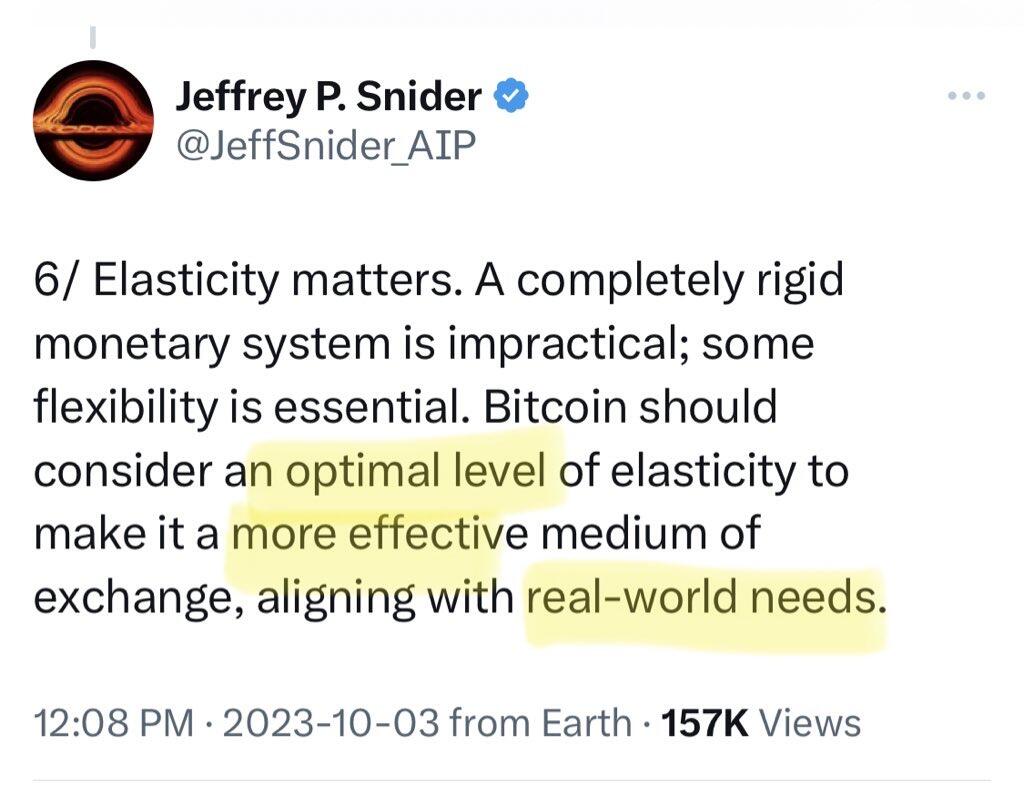
One of the worst features of central planning that causes a torrent of economic instability, is the uncertainty of a 'flexible' monetary system where the rules can change at any time and we can't predict the future supply of money. Such a system will inevitably lead to misallocation and false price signals.
The reason why Bitcoin is successful lies in the carefully designed protocol, including the supply limit to under 21 million bitcoin. Other coins have tried more 'elastic' approaches and they can't attract capital to the same degree for a reason. Capital allocation requires certainty in fixed rules, voluntarily consented to, that applies to everyone and which can't be bent under pressure. Good architecture requires exactly that - reliability and predictability.
Both the system Left and the system Right have unnerving totalitarian values.
Over 40% of Democrats wanted to send the unvaccinated to camps in January 2022, with just over 20% of Republicans agreeing.


A good standard is to work 95% in silence and be picky about what to mention.
😅🤣


Looking great. 👍
Yup!
And the hilarious part is that in gender-bender Sweden, we only have one word for sex/gender: kön.
We don't even differentiate between them because they are the same thing.

Agreed. I would say 'individuals with lacking competence'. Value is a complex term with a plethora of meanings.

Spot on. 👍
The best asslickers are unrivalled in their narrow domain of specialization, simply because it's their only path to power and influence.

Bitcoin is the future of money and it's not worth gambling with.
I met a guy some years ago who had bought a full bitcoin at $100 in the past and then he sold it at 5x. That must have seemed like a great trade then and there, but zooming out we can acertain that it was not.
Trading is particularly treacherous because small amounts don't make a dent, and large amounts involves dangerous gambling.


Agreed. Add then the cost-benefit calculation involved. As GPU hardware gets outdated every few years, it is expensive to keep replacing decent GPU's with new GPU's, simply because of a few titles that require them.
The resulting pushback will be gradual, but people have more important priorities than to play complex, overhyped games that inevitably involve microtransactions and require the time of a second job when it comes to multiplayer titles.
The pushback then, is back to basics and also back to the outdoors, similar to how we lived in the 1980'ies and 1990'ies, with some extra dimensions of technology available at an ad-hoc use.

Well said.
Truth wins in the end because reality wins in the end.
This is true in the same sense that in programming, functional code wins over dysfunctional code, over time.
Align with the universe as it is, and you stand on the right side of truth.
I was asked on dinosaur social media why I am critical of IP laws and why I don't want to legislate against AI art.
I support intellectual property in the free market sense where arbitration is primarily achieved via reputation. Steal someone's art and your reputation suffers.
However, I see massive dangers in having the government regulate art and software.
1. Let's say that I publish an artwork somewhere that I created. My artwork is mine but it is not registered in a database anywhere.
2. Someone else right-click and save my artwork and then proceed to register it as their own artwork at a central art authorization platform.
I can't prevent anyone else from registering my artwork as theirs, and unless I know they are registering my artwork as theirs, I can't file a complaint.
So now, my artwork belong to someone else, unless I can file a successful complaint.
Let's continue this further:
In order to protect my artwork then, I need to send every artwork I make to a central authorization platform, before anyone else sends it there.
The central authorization platform would be necessary in order to detect and prevent unlawful use of someone's art.
However..
This forces me as an artist into a system where I have to trust this central authorization platform to be in charge of basically all my artworks, from cradle to grave.
Let's consider this for some moments.
What can possibly go wrong here.
What if this centralized system of authorization gets corrupted?
What if my access to this system requires me to log in with a digital ID?
What if my access is terminated for political reasons?
This is just scratching the surface.
A centralized system of art copyright authorization comes with a host of *deep* problems that are far from obvious or unproblematic. Anyone underestimating these problems have not given them much thought.
First of all, why should I as an artist be forced to register my artwork in a central database? And yes, I would be forced, since if I don't, someone else can register my artwork as theirs.
When that database is tied to digital ID, I'm stuck in a system that I have to trust, even if I most likely can't trust that system and have every reason to expect it to be corrupted.
3. Identification of unauthorized use of art.
When a central authorization database is set up, it is toothless without a system to detect breaches of intellectual property laws.
So, how will unauthorized use of art be detected?
This requires monitoring (surveillance). All regulations require monitoring to be efficient. There is no point of a regulation if it can't be enforced.
Therefore, all regulations will be increasingly enforced via monitoring, as the technology for monitoring improves.
Next; regulations on code (software):
4. Regulations on code/software will require very deep intrusions into the workflow of programmers.
It basically requires the government to monitor all software and to authorize software based on a central authorization platform.
The government will then allow or disallow code.
A logical next step is to require all software to be centrally authorized, on the pretext of protecting IP rights. If you have nothing to hide, why would you object?
At this point, government controls all software via the central authorization platform.
What can go wrong here?
5. As an artist I have deep interests in protecting my art from theft or unauthorized use.
However, we live in a society where I clearly can't trust the government or judiciary system to be in charge of my art, just as I can't trust the government to be in charge of money.
So, knowing that I cannot trust the government to not print money and debase the currency via inflation, how can I possibly trust the government with full power over the art I create from cradle to grave?
This is why I oppose IP laws pushing us toward a 1984 dystopia, while I at the same time believe in intellectual property - secured via reputation - not government force.

Books vs screens.

George Orwell wrote his book 1984 in 1948. He probably had no specific year in mind other than to reverse the year of its conception.
As I played around with the numbers today, I found an interesting relationship:
1984 - 1948 = 36
1984 + 36 = 2020
2020, as in perfect vision. 2020 as in the year of covid, authoritarianism, lockdowns and censorship.
Probably just a coincidence, yet via simple math Orwell's warning is still ringing relevant. 1984 is the enemy of liberty.
This video gives a good overview of why you don't want to get into a knife fight. Best option is to gain a distance and escape. A long wooden board or something equivalent could be useful to maintain distance while looking for an opening to run.
https://m.youtube.com/watch?v=-s7E-PsMJRI&pp=ygUaa25pZmUgZmlnaHQgZGVmZW5zZSBtYXJrZXI%3D

I was not talking of pollution.
If the rich climate alarmists are sent to Pluto, we will have a slight reduction in pollution, but we would have a great reduction in tyranny.
Robert Malone responding to the suggestion that the Nobel prize for inventing the mRNA tech should have been awarded to him, its inventor:
"Probably not because the technology has still not been proven to be safe." / Robert Malone

The problems of overpopulation can be solved.
Reduce government size.
