
Nos2x-fox browser extension now allows me to switch profiles in the extension, which is so much more elegant than having to do that in each individual client. So, very nice, very useful.
Thanks, nostr:npub168nqgewzkamnyh53x0epqrftkv2pdh9gzr6558v4vetzr3w7uxfs63926e
Love that plugin.


Sometimes you just gotta make and eat a bunch of bougie-ass tacos.
Tri-tip, Pickled Onions, Chimichurri, cotija, Cilantro, squeeze of lime. #foodstr



I feel your pain because I've definitely had a co-worker like this.


If it's an Indian restaurant, you sure as hell hope they're using ghee and only that. 😅

Honestly, kind of hard to argue with blue wallet. I know Zeus is adding some on-chain features here soon, so that might soon become my all-in-one wallet, especially if the features don't suck.

Muttar is peas. So it's peas cooked with paneer (basicly cheese)



Just looking at it is giving me a sugar rush, but oh my gosh, that looks good.
Lol thats why I blocked them. 😅 If they know, then fuck them. And if they don't know, also kind of fuck them. It's not a funny joke.
darn it I'm pretty sure that cat relocated her babies
These tracks simply do not vibe anymore. 😅
Stupid fickle DJ brain. Had a bunch of tracks picked out in a direction ready to go for a set later this week. Now I'm reviewing those tracks again, and I'm like, wow, I hate all of these. Time to find all new music.

A ratchet can only turn in one direction.
The double ratchet means two types of ratchets: a KDF ratchet (the small ratchet in the diagram) and a DH ratchet (the large ratchet in the diagram).
KDF stands for Key Derivation Function. A hash function is the simplest KDF because it is one-way. K1=hash(K0), K2=hash(K1), K3=hash(K2), K4=hash(K3)... K1 is used to encrypt the first message, K2 to encrypt the second message, and so on. Once used, the key is deleted. If an attacker obtains the latest encryption key K5, they cannot reverse-engineer K4, K3, K2, or K1, ensuring the security of historical messages. Thus, the KDF provides forward secrecy to the encryption protocol.
However, the attacker can derive K6, K7, K8..., which means there is no backward secrecy. This is where the DH ratchet comes into play.
The Diffie–Hellman (DH) key exchange is a mathematical method for securely exchanging cryptographic keys over a public channel. Alice, using her private key S1 and Bob’s public key P2, can compute a value. Similarly, Bob, using his private key S2 and Alice’s public key P1, can compute a value. These two values are equal.
Alice and Bob continuously generate new DH key pairs for new messages on the client side and attach the public key in plaintext to the message. The message recipient can then use this public key and their private key to perform the DH computation. This DH ratchet effectively resets the KDF ratchet with the DH ratchet. Because the attacker does not know the latest DH private key, they cannot derive future encryption keys, thus providing backward secrecy.
Therefore, in the double ratchet algorithm, the KDF ratchet ensures forward secrecy, and the DH ratchet ensures backward secrecy, together achieving both forward and backward secrecy.
We recommend the following video, which provides a more intuitive animation demonstration.
https://youtu.be/9sO2qdTci-s?si=BXLU33BRANWAJKMz
https://youtu.be/7uEeE3TUqmU?si=jpPOR_O61IppgJxl
(We hope users can understand the basic principles to judge for themselves which chat applications are good.) 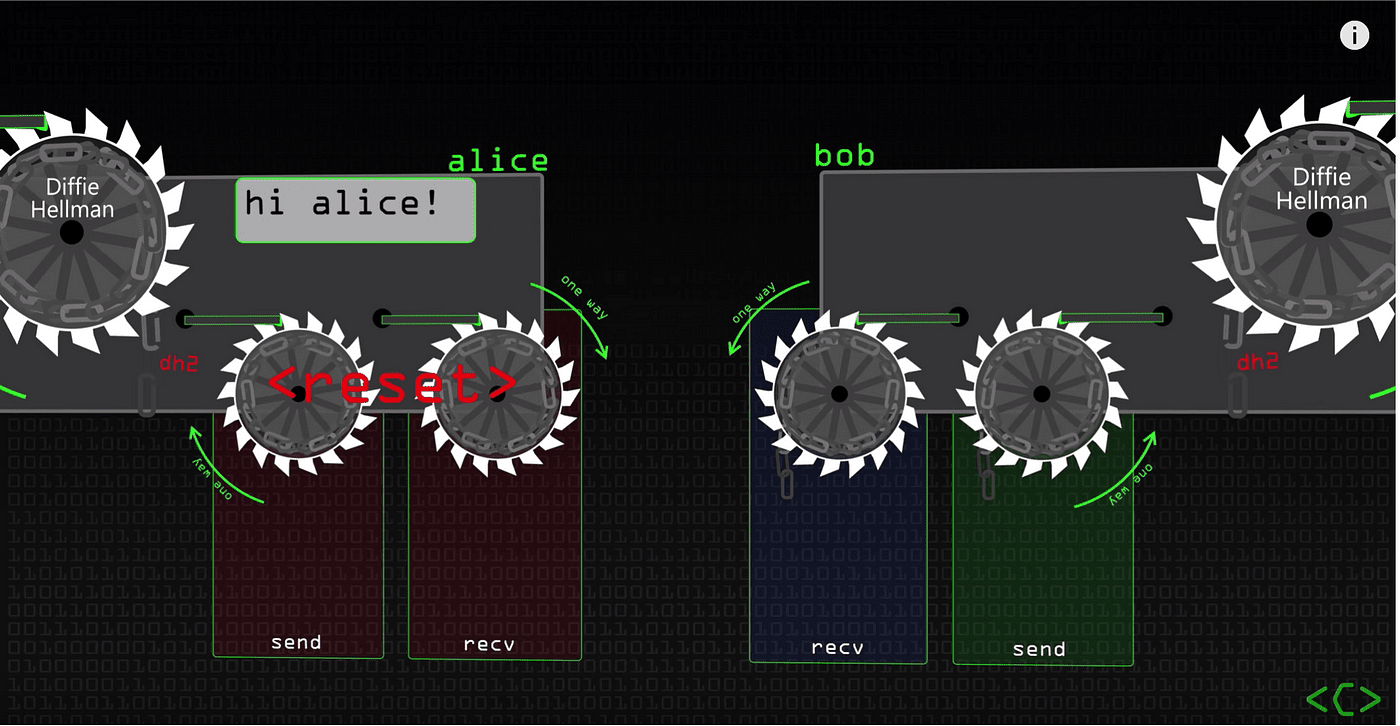 nostr:note1ffgsgvkltl96wzwe6lakv2ntjfkq2u48msx57mrvnnhtyde5s2js8antlr
This kinda stuff makes me wish I was better at math. Its super interesting.

The mom's still with them. I gave them some water and some cat food, but I think they've been up there for a little while because the cat's eyes are open, if just barely.
I just found four baby kittens on my roof. They just barely have their eyes open. I want to adopt them all. I don't know what to do. 😅
Searching through a pile of black shirts to find a specific one. 😅

Yup, big fan of it.