
Europe is taken over by a suicide cult

I know. It sounds crazy. A suicide cult huh? Isn't that a bit much?
I think it explains a lot though...
This "cult" isn't something that anyone asked for. It's not a traditional cult with a leader who "designed it".
Rather, it is an emergent phenomenon - just an inevitable end result of multiple different extremely harmful ideas.
These ideas are so disconnected from reality, that when you apply them in practice, the end result is slow death and destruction.
It is exactly what happened with the Soviet Union.
Before Gorbachev died, he said that the EU resembles Soviet Union more and more every day.
You need to have some kind of a connection with base reality - common sense!
When this alignment with reality gets out of whack, the more you act, the farther away you drift from anything you actually wish for.
It's the definition of crazy.
That's exactly what's going on in Europe.
A slow, unintended cultural and societal suicide that nobody really wants to happen, but which will keep happening until people understand how & why things went wrong.
If they don't get this, things will keep going downhill, no matter what the politicians try to do.
When I say "nobody wants this to happen", I mean that nobody wants the end result of what this all will lead to (the slow death).
The problem is that European people have such a deep belief in the basic tenets of the suicide cult that they WANT to act in ways that keeps that slow suicide going.
What are these suicidal ideas exactly? There are many, but I'll list the main ones.
-Because CO2 is bad, all energy use is bad
-All cultures and people are the same
-When you import foreign cultures, they will automatically assimilate
-The state is the source of all welfare
There is also a fifth problem, one that isn't an idea, but rather a lack of understanding: the money is deeply broken.
I'm not just talking about the Euro, but rather the fiat financial system in general.
When something can't go on forever, it will stop - sooner or later. The fiat financial system is so unsustainable and has gone on for so long, that we are in the "later" phase.
This is a global problem, but one that Europe is very ill-equipped to meet.
How has Europe gone this far downhill? Again, for many different reasons, but mainly because of the "democratic short-circuit".
For democracy to function well even in theory, it would need to rely on a well-educated populace and a state-independent media.
We have neither: the legacy media is effectively a state propaganda machine.
The population is forced through government schools where they are taught that the state is the source of all welfare, and that entrepreneurship is something complicated, foreign and scary.
Of course that's rarely, if ever, said out loud directly.
Instead, those beliefs are implicit in the education plan and the structure of the whole system.
It's just what you take for granted after you go through that machine - and basically everyone does.
All of the above harmful ideas are so deeply ingrained in the population of Europe that any kind of change is far from obvious.
While the rest of the world is moving forward to a better future, Europe is loudly demanding to go down with slow ideological and cultural suicide.
Not everyone in Europe thinks that way, but too many do.
I'm optimistic that there are solutions, but I'm quite pessimistic about the short / medium-term outlook.
How can we solve this? I have some ideas coming in a later post. What are your thoughts on this?
Probably not many people are aware of this, but bitcoin (lightning) payments are just now starting to be on par with credit card payments.
The biggest hurdle until now has been that bitcoin doesn't natively support pull payments, which has made otherwise basic things like subscription payments impossible.
nostr:nprofile1qqsyv47lazt9h6ycp2fsw270khje5egjgsrdkrupjg27u796g7f5k0s8jq7y6 has recently solved this with ZapPlanner: https://zapplanner.albylabs.com/
It allows merchants to request recurring payments from an NWC compatible wallet. The user doesn't have to accept every payment as long as they are within the budget set by the user originally when accepting the subscription.
This alone is huge!
Right now, even bitcoin services and apps such as nostr:npub1v5ufyh4lkeslgxxcclg8f0hzazhaw7rsrhvfquxzm2fk64c72hps45n0v5 are only offering their subscriptions on credit cards because ZapPlanner or nothing like it used to exist (the Fountain guys are already looking into this).
However, the payment amounts are defined in sats, and bitcoin isn't yet a unit of account. This limits the usefulness of this otherwise great system, as the sat amounts will need adjusting as the purchasing power of bitcoin goes up.
Alby itself has already ran into this problem once, as there was Nostr drama about their sat-defined subscription prices getting out of hand when we suddenly got near $100k...
It would be great to be able to define the payment amount in fiat and just do the fiat/sat conversion on the fly. I'm hoping this gets solved somehow.
There is some discussion in GitHub on this topic: https://github.com/getAlby/ZapPlanner/issues/44
To speed things up, I wrote this comment there:
----------------------
From a user perspective, if/when they can trust that the sat amount will be defined by the fiat price, higher budget shouldn't be an issue.
There are a couple of issues though: flash crashes (or glitches with the price feed), and short-term dips.
Flash crashes could be solved by using average prices instead of spot prices (averaging from multiple exchanges might not be enough, as arbitrage bots can temporarily spread the crashes from one exchange to others).
If the fiat amount was defined by an average bitcoin price, for example "previous 24h average", then flash crashes would have no effect. Dips would still matter, and it might be annoying if a large monthly subscription hits on a temporary low dip day.
Therefore, I think it would be great to have a "fiat price dollar cost average" as a pricing option. Using a monthly average for monthly subscriptions would solve both flash crashes and short-term dips.
This would mean having three different ways to calculate the sat amount:
1. Spot price according to whatever source (Dangerous! At least some basic sanity checks should be in place.)
2. Short-term average, let's say the previous 24 hours
3. Long-term average price, probably defined by the subscription length, ie. the previous months average price
Having the user decide between these different options is not a great user experience. This adds friction when compared to credit card payments: users don't need to think about these things.
Bitcoin is different though and SOME choice needs to be made. Spot is simple but not great. I think maybe the best option would be for the merchant to suggest a default (with perhaps the subscription length average being the default?), and this could be overridden by the user if they so wish.
-----------------------
Long post, I know, sorry... any thoughts on how you would like to see automatic sat/fiat conversion to work with subscriptions? :)

From nostr:npub1wl39ydk5rpecvtrzhq67afl9ykn2ty2xdxdkfmyan0rss3f3ma5sndznlx:
The Crypto Asset Reporting Framework – what does this mean for Bitcoin in the UK?
How will it affect your personal safety and security if it’s implemented as planned?
We have today released a research paper and delivered this to HMRC with commentary on recommended changes to the draft legislation.
What’s being proposed? Under the Crypto Asset Reporting Framework or CARF, it’s proposed that tax authorities worldwide will gather and have access to information on cryptocurrency transactions, allegedly to combat tax evasion and ensure compliance with tax laws.
What’s wrong with it? The amount of personal and transaction data that will be gathered and shared is truly staggering. This won’t just be shared with your domestic tax authorities, but with others across the globe. It will include your name, address, date of birth, amount of Bitcoin held or sold or transferred. This is a highly dangerous level of intrusion into your personal and private life, particularly given the increasing frequency of data breaches (examples in our paper) and also the risk of violent physical attacks against Bitcoiners whose details are leaked to or obtained by bad actors. Additionally, the UK’s new draft regulations fail to make clear that none of these reporting requirements will fall upon the developers of free and open source software, as such persons cannot be in a position to comply.
How should it be changed? We recommend two simple changes – that the information being gathered on Bitcoin and cryptocurrency users is severely limited and in a way proportionate to the high risk of personal harm, and that the regulation clarifies that it cannot and shall not apply to the developers of free and open source software.
More details on our Substack👇
https://bitcoinpolicyuk.substack.com/p/the-cryptoasset-service-providers
I fear that these problems with the legislation are a planned feature, not an oversight. Still, it's important to make the problems known, if only so that later there's no way for them to say "we didn't know this could happen".
They know, and this is already implemented in the EU. The supra-national forces will push this through as is.
I hope you can prove me wrong!

💯.
Two things that brought it home for me 👇
1) This nostr:nprofile1qqsx45yrjtgm4glklaafgz0z4309gs6cwfja3d99s8rqvlvgagcptpqprpmhxue69uhhqun9d45h2mfwwpexjmtpdshxuet54gjttu article: https://svetski.medium.com/bitcoin-is-not-democratic-pt-1-6ce622c90e8f
2) The very first episode of nostr:nprofile1qqsyx708d0a8d2qt3ku75avjz8vshvlx0v3q97ygpnz0tllzqegxrtgpzemhxue69uhkummnw3ex2mrfw3jhxtn0wfnj7l329qg's podcast: https://fountain.fm/episode/effg0sSzpMvrYmxMxlaj
Indeed, "democracy" is just another great-sounding word that ends up screwing the people.
Yes. It's a scam, yet another on the long list of lies that people have been brainwashed to believe in.
https://www.sovereignlanding.com/high-future-preference/democracy-power-from-people-the-fix/

INDIA IS WORSE THAN YOU IMAGINE
Most Westerners know little about India beyond vague ideas about Hinduism, yoga, gurus, and perhaps a touch of Bollywood. For these people, this article will be a harsh awakening.
I grew up in Bhopal, in central India. From as early as I can remember, I was working at my father's printing press. I studied engineering in the nearby city of Indore and went to Manchester Business School in Britain to pursue an MBA. I returned to India to open a subsidiary of a British company, which turned out to be a major success. While living in Delhi, I wrote for major Indian media outlets. I've traveled extensively across India and around the world.
I came back to India with the idea of improving it, but after 11 years, I realized that India is a sinking ship, with increasingly shameless corruption, degraded people, and a society that is falling apart. I never met an honest bureaucrat or politician there. I applied to emigrate to Canada, and my application was approved in a record time of three weeks.
Today, I consult for East Asian and Western companies on investments in India. Most of what I tell my clients sounds exaggerated, unreal, and unbelievable. After much drama, lost money, and hard lessons, they begin to believe what I tell them. However, this learning is never institutionalized because of the refusal to understand India. This is a facet of political correctness, a poison corroding the core of Western values.
When I was a child growing up in India, I learned that "power determines what is right." Power was often abused, with those in control acting as if they had a God-given right to exploit and dominate others. Displays of authority could be so extreme that questioning them or expecting those in power to fulfill their duties could lead to retaliation. Authorities seemed to believe that their positions were not to serve others but for personal gain.
People who showed respect seemed to have humbly accepted an inferior and subservient position. Kind-hearted people had to hide their compassion, as being nice was seen as a weakness.
In India, I rarely saw anyone in a position of authority take the initiative to solve a problem they were responsible for. When I was in university, a minor working in the kitchen was raped and sodomized by caretakers. I reported the case, but not only did no one in authority do the right thing – something completely within their reach – but the authorities and my peers also threatened me with severe consequences if I pursued the case further. Lacking empathy, they mocked both the boy and me.
Yes, there is an element of sadism here. There is some degree of pleasure that Indians derive from the suffering of others. The attitude of the authorities was like that of the Delhi bureaucrat who told me his Black Label whiskey tastes so much better because he knows most Indians cannot afford to drink it.
This confuses Westerners. If they had power, even if they were corrupt, in a situation where there was nothing to gain or lose – no bribe to receive since both parties were poor, and no risk of offending someone well-connected – they would do the right thing and report the alleged rapist. These Indians would do nothing, not even lift a finger unless there was a reward: money or sex. Their apathy was infinite.
https://video.nostr.build/b961e25f184bc2fff6a5968bbdfae17fb021008ce2e43118d12da1f11558ffa8.mp4
Doing your job might be considered effeminate by those above you. If you can dodge responsibility, you are seen as macho. In this culture, there is rarely pride or honor in doing the right thing. If you call a plumber for repairs, he may think he has failed unless he messes something up. He might deliberately do shoddy work, even if doing it right would not take any extra time. A complex web of arrogance, selfishness, servility, casteism, tribalism, and magical thinking drives this behavior. He demonstrates his disdain for you and gets the better of you by leaving a mess. His client, as the flip side of the same coin, may very well despise and exploit someone who has done good work.
If you do poor work, does it mean you won't be called back? That doesn't matter to people who lack standards and don't think about the future. There is little positive feedback for those who aim to do a good job, be fair, or make better products.
Fairness, justice, trust, empathy, and impartiality are foreign concepts to many Indians. They struggle to distinguish between right and wrong. They remain indifferent, even when there is no cost to being fair. Moreover, even if they could do good at no personal expense, they might still avoid doing it because it could be perceived as a sign of weakness.
Indians are indoctrinated to be submissive. This indoctrination runs so deep that Indians address those slightly above them in authority as "sir." They tend to be servile, sycophantic, and obsequious. This should not be mistaken for respect, as respect is alien to Indians. When they call you "sir," it reflects their view of you merely as the stronger figure in the interaction, consistent with their belief that power determines what is right. They will demean you the moment you are in a weaker position.
You are either superior or inferior—therefore, you are either the abuser or the abused. Equality is impossible. A visitor quickly learns that saying "please" and "thank you" is seen as a sign of weakness and is reserved for those willing to debase themselves.
https://video.nostr.build/a2c0beef73b8f6dd687d91c9e853d76fe7446375879138f4c3feba67bea203fe.mp4
Indians cannot sustain the institutions established by the British. These institutions have been hollowed out and corrupted, becoming predatory. The constitution and laws hold little value. The only forces driving these institutions are bribes and connections. Whether dealing with the highest political leaders or the pettiest bureaucrats, they openly and shamelessly demand bribes.
Street-smart tricksters are highly valued, and criminals who escape justice are celebrated. A relative of mine, full of pride, once told me he would never pay rent for the house he had rented. He had bribed local authorities to make it impossible for his landlord to evict him.
In a society where no one trusts anyone, those who are cheated rarely seek justice against the fraudster. Instead, they cheat others. Men abuse women, women abuse children, and children abuse animals. Animals attack whatever they can. Upper-caste Indians abuse lower-caste Indians, while lower-caste people fight among themselves to determine who is superior. It’s a perpetual cycle of mistrust and arbitrariness.
Westerners often discuss a system of four or five castes formalized by the British. This oversimplifies and distorts the issue, giving an exaggerated sense of structure. In reality, there are 1.4 billion castes in India. Every interaction revolves around evaluating you. You either oppress others or are oppressed. So-called lower-caste individuals are often more conscious of caste than upper-caste individuals.
Most caste-related issues in India are described in the news in passive voice. Someone was oppressed and abused. Yes, the victim is a lower-caste person, but the oppressor is often from an equally low caste. When a lower-caste person rises to power, they relish flaunting it before those of higher castes. What better way to display power than by abusing others and getting away with it—or, if you’re a plumber, by leaving a mess? Different people exhibit power according to what they can get away with.
https://video.nostr.build/76484f7af64de56ae6fbd2bfd9d73d7e44cb58ae4678c7307d4d80d342fb878f.mp4
Many people lie blatantly. Everyone knows that everyone lies, yet they lie anyway. Many Indians convince themselves of their lies to the point where they can no longer distinguish between fact and fiction. Even if you don't need or want to, you have to exaggerate and lie because you know your listener will calibrate based on what you say. Conversations are often driven by personal material gain. Every transaction is a zero-sum game—or perhaps a negative-sum game, as sadism can be part of the equation.
You might think you're safe working with family members, but they can become your greatest enemies, as even they will betray you. Honor is not part of the social code. Indians are atomized people and do not understand loyalty. Indians hide gold in their own homes and don't even tell family members about it.
I have never (and I use the word deliberately) had an honorable contract in India. When you bribe, you must do it skillfully. If you have a legal dispute, the judge and police will accept bribes from both sides of the case. Your lawyer will conspire with the opposing side and the judge right in front of you to maximize bribes. This may seem unbelievable, but that doesn’t change the reality.
Words for most virtues come from Persian, Turkish, or English, not the native languages of India. But just because these words entered the language doesn't mean Indians have embraced these virtues; they were and remain a façade for old habits.
https://video.nostr.build/2099b72ab8973d6222fa688c594c9cf156872e9dd38cccb64bca7d61b3c05353.mp4
Everyone builds tall, solid fences around their property. They do this the day they buy a property because their neighbors will encroach on their land if they can. After moving to the West, it took me years to understand why people don’t build fences.
When I first traveled to the UK, I was amused to find that animals were neither afraid of nor aggressive toward people. I was surprised that those in power did not expect servility or reverence. For years, I felt uncomfortable, as though I wasn’t fulfilling my part of the transaction unless I paid bribes.
My grandparents and my father were financially honest and maintained a high standard of self-respect—an anomaly in India. There are good, sane, moral, and rational people in India, but I have more fingers than the total number of such Indians I’ve met; yet, in just one morning, I can encounter many honest Americans. By Indian standards, our family was decent and well-connected. This shielded me from much depravity and made it possible to ignore the stories I heard.
Among ordinary Indians, conversations revolve around slander, gossiping about friends, discussing celebrities, superstitions, and animosity toward other groups. Hindus hate Muslims, Muslims hate Hindus, and Sikhs hate Hindus. These groups fight among themselves, leaving everyone atomized, but their hatred for other groups superficially unites them.
I don’t think I understood the concepts of honor and loyalty until I lived in Britain for a year. During that time, someone told me not to exaggerate when speaking positively about the organization I worked for. For the first time, I began to see that people wanted to tell the truth simply for the sake of truth. I had always known the word “truth” existed, but for the first time, I began to grasp its essence.
The fundamental principle for understanding India is that it is an amoral and irrational society devoid of values. Any values you try to instill will slide off like water on a duck’s back.
https://video.nostr.build/538e2ad7bc551613ce4dbc6136cfe35557d2c4656acf996d00e41edb239afdde.mp4
I have witnessed a continuous decline in Indian society. Any grace and civility that Christian missionaries and European colonizers instilled in Indians have been slowly eroded.
I clearly remember my first day outside India. On a train ride from Heathrow Airport to Manchester, I saw what I initially thought were monotonous-looking houses, clean waterways, and fresh air. The lack of hustle and bustle and the calmness of the train journey left me disoriented and depressed. I didn’t know how to handle a situation where there were no constant assaults on my senses.
Over time, I realized that for most Indian immigrants, this led to a compulsive need to recreate India in the ghettos they moved to. They sought familiar smells, noise, and constant agitation. They recreated endless emotionalism, fruitless conflicts, chaos, and intellectual inbreeding.
When we were granted unrestricted access to schools in Manchester and later to the offices where I worked, my fellow immigrants and I often wondered if the British were so naive as to trust us so readily. What would stop us from stealing everything in sight? Most immigrants never truly understand the meaning of “trust” and “gratitude.” Worse, they discover that complaining often leads to benefits—the only thing they genuinely care about in the multicultural West. Humanist and civilizational values never truly resonate with them.
https://video.nostr.build/ff46fd97421d7fffee884a104f7f98eb458b69b224baec25859848c712c014d2.mp4
One time, a friend and I went for a walk in Manchester. After having a few drinks, he ran a red light and was stopped by the police. I was astonished by the respect with which the officer treated him. In India, the police would have humiliated and extorted even the passengers. My friend was taken to the police station, and since I accompanied him there with an officer, I explained how we would have been treated had this happened in India.
At that time, I lived in a high-crime area of Manchester, and the police occasionally followed me as I returned home. I asked an officer why they never stopped or questioned me. He told me they followed to ensure my safety and didn’t have the authority to detain me without legitimate cause. For the first time, I began to understand the British respect for personal space, another value that was starting to take root in my mind.
The officer made my friend sit for an hour or two until he sobered up and then let him go without pressing charges. I began to realize that those in power in Britain could enforce the law with flexibility, considering the spirit behind it; in India, laws were merely excuses for predation.
Of course, Britain is no longer what it once was. Over the years, policing has evolved to accommodate the challenges introduced by the lowest common denominator brought in by Third World immigrants.
Statistics do not resonate with the Indian psyche. There’s no sense of a gray area; everything is black or white, with no appreciation for nuance. This lack of proportionality leads to indecision and an inability to value things. In the end, unbridled emotions drive life. I carried a part of this same mentality with me. Realigning my thinking with reason, morality, and Western values was a difficult task.
https://video.nostr.build/cc57c0bdb39aa137f45395a840a379ee7fc29aeb2dd562e2e57939257674ee65.mp4
Attending one of the best engineering colleges in India, I believed myself to be creative, decisive, and well-grounded. Yet, when I began witnessing social interactions and behaviors in Britain, I realized I lacked confidence. Even the corner store owner seemed more confident and self-assured. I came to understand that my mind was clouded with confused thoughts and conflicting motivations.
Even my privileged education in India had embedded within me layers upon layers of a muddled worldview and dishonest, calculating behavior. Despite my best efforts, shedding these patterns and reshaping my thinking took decades. Each false belief I recognized and attempted to change clashed with other deeply ingrained convictions and mental habits. It was like trying to replace a broken brick in the castle of my cognitive structures without destabilizing the entire edifice. At times, I had to get drunk just to experience a fleeting sense of clarity.
Over time, I noticed I began sleeping better and feeling mentally freer. Even my body started to change, and the mental fog that clogged my thoughts began to clear. A comforting sense that those around me supported me was immensely helpful. The confused and contradictory thoughts that caused chronic stress started to fade.
My grandmother used to say two things that I once dismissed as outdated but now find some truth in. She believed that some people needed to remain on the brink of hunger because, if they received more, they would cause problems. Despite being one of the most egalitarian people I knew—befriending her driver and tailor—she often reminded me that not everyone deserved a seat at the table unless they were prepared for it.
https://video.nostr.build/de5d98b9f74d6014dedb8674ddab830a8ce12ef285f9c91920abe6d1ed83939f.mp4
"Human Rights" is a Western concept that is incomprehensible to most Indians. They cannot understand respect for the individual. Talking to them about "rights" only leads to confusion. They cannot differentiate between "negative" and "positive" rights. For example, when taught about property rights, they learn to protect their property, but they do not recognize the rights of others. Women, when taught that rape is a violation, may begin to see it in all situations and use it as a tool to exploit men. As they are introduced to the concept of rights, they stop accepting their miserable lives and adopt a resentful, victim mentality.
You cannot teach anything good to people until they have the fundamentals of morality, rationality, causality, and other Western values. Without these foundations, the fruits of Western civilization serve only to turn people's often hidden hedonistic tendencies into something more malevolent. Every civilizational fruit—education, Western clothing, prosperity, Western institutions—has been perverted in India.
The institutions left by the British have been emptied, becoming purely predatory and sadistic. This happened because, in post-British India, those in power value taking advantage and acquiring wealth as the only purposes in life. Today’s India lacks even the vague rule of law that existed before the Europeans arrived. This is why it will be an improvement when India eventually collapses, and the pre-British authoritarian system similar to the Taliban rises from the ashes.
Without Western missionaries in charge, Christianity has been "fed" by Indian superstitions and magical thinking and has become voodoo. Grammar has been forgotten, and English often turned into pidgin.
Western education and clothing were adopted with a colonial cult mentality. The focus is on obtaining certificates and wearing suits, as if these external symbols alone confer status and material benefits. Similarly, education is not seen as a means to promote intellectual growth or evolve into a better human being. Instead, driven by animalistic desires, convenience, and unethical resource-seeking, most Indians despise the idea of self-improvement.
Education applied to an irrational mind that processes information through magical thinking becomes burdensome, making these people worse than their uneducated counterparts.
The Indian mind should have become moral and rational and imbued with honor, discipline, respect, and integrity before being formally educated and provided with the fruits of Western civilization. Unfortunately, this would have been, at best, a process of millennia.
In economics, there is a concept of the "middle-income trap." I prefer to call India's situation the "low-income trap." Unlike the beliefs of professional economists, these traps have cultural foundations; it is virtually impossible to escape.
Prosperity has not led to social peace or intellectual and spiritual growth. Indians do not understand the concept of comfort. Most rich Indians build extravagant houses not for comfort but to display wealth and control the weaker ones. Worse, the easy prosperity of recent decades, which is essentially the result of Western technological advances, has derailed the pursuit of rationality and morality. Social media is a platform for the exchange of myths, superstitions, and pornography. The IT revolution does not bring enlightenment to the poorer parts of the world!
https://video.nostr.build/ea0fe16aed9e6647df6d3fd46cf292b7350af3650d63e148482683124cb3ec62.mp4
Today, India is more entrenched in magical thinking and superstition than in the past. Hedonism is rampant, and families are falling apart.
When elevated to high positions, most Indians become arrogant and sadistic. This is more of a genuine belief that arrogance and sadism define power and class than a desire to mask their incompetence and psychological weaknesses. It also serves as a way to cope with the deeply ingrained inferiority complex instilled by their culture. Any grace and civility that were once imbued in Indians by the colonizers have been eroded.
Wealth created by the West hypnotizes Indians. However, they fail to understand the foundations of that wealth. They equate the West to Hollywood stereotypes: short skirts, promiscuity, drinking and drugs, flaunting wealth, working in luxurious offices, and controlling others. This is the true Indian soul, once obscured by Victorian morality and Islamic restrictions. It is a return to a pre-colonial, pre-Victorian hedonistic culture.
The British were a gift from God. Without them, the situation would have continued to worsen. India will eventually nullify all the benefits it gained from the West and return to its pre-colonial ways. It will crumble, and I wouldn't be surprised if much of its population falls victim to war and famine and diminishes to the level it was at before the Europeans arrived.
Most Indians cannot think of anything beyond money, sex, and survival – exactly what you would expect from a society with an average IQ of 77. Every Western value given to them has been caricatured and corrupted for these purposes. Indians have no Ten Commandments. They are so unaware of these values that they remain indifferent, even when forcefully presented to them. There is nothing you can do about it except try to understand what immigration from India and the rest of the Third World will do to the West.
https://video.nostr.build/1d954def80a06ec2cc9421f0fc91f0276405447c26db6e759c366a67926333f6.mp4
This is a good explanation for my experience in India during my month-long trip in 2016, and what I've experienced since then online.
When I arrived in Delhi, I was immediately taken for a scam ride. There were a lot of roadblocks (these seem to be a permanent feature for some reason?) and the riksha driver told me that road to my hostel is blocked.
Instead, he took me to his scammer buddies who tried to forcibly sell me a way overpriced holiday.
I was having none of it and exited the office they took me to. The driver, waiting outside, refused to take me anywhere until I bought into their scheme.
Fortunately there was a police car next to the office, and I explained to them that I was being scammed. Unfortunately, they were in on the scam and just laughed at me, telling me that maybe I should buy something.
Welcome to India!
Long story short, I was getting more and more resolute in not giving anyone there any money, and ultimately they figured out that they would only get trouble from me.
Eventually, after several hours, I managed to get the driver to just take me to my hostel. Fortunately the scam attempts I encountered after that were minor in comparison.
This was May and the hot season, so I decided to head to the mountains where I found things to be quite tolerable (even the tap water was drinkable!).
I think the fact that they have an actual winter there has a local civilizing effect. It forces you to think ahead, and weeds out those who don't.
If I ever visit India again, it will definitely be back to the Himalayas - with a private pre-arranged transport immediately from the airport with minimal stops in-between.


Possible in theory!


I think so too. People in X are up in arms because IMF, but Bukele isn't stupid.

I heard somewhere that even rainwater is not good to drink nowadays if not filtered because of the poisonous forever chemicals that have spread everywhere globally. I don't have any details but I would look into it if drinking rainwater, I'm sure they can be filtered out.
Apparently a large part of the population isn't even capable of critical thinking.
That's why a functioning society should be there to provide them with more or less reliable "default options", but we don't exactly have a reliable society... if there ever was one.

Thanks for building Alby. I run my own node(s), have done so for years, and will continue to run them, but there's no substitute for good UX and a wide set of tools.
Keep on doing what you're doing!
https://youtu.be/C-4PkLPYTeE?list=RDEMgXuiWW21Fcf5UPiJyu_9sQ
Ummet Ozcan is an amazing ethno-techno musician
#musicstr #throatsinging #turkish #mongolian #techno #ethnotechno
This is one of my go-to tracks
I've been getting this error a lot more often recently nostr:npub12vkcxr0luzwp8e673v29eqjhrr7p9vqq8asav85swaepclllj09sylpugg
Not sure why or what it means. It usually fixes itself after a couple refreshes, but thought I'd pass it along

Same here, weird connection issues and notes not loading when opened in new tabs, difficulty publishing notes, etc. Tried a couple of different browsers too. Having to reload so much is starting to get annoying.
This would be understandable with random free relays, but with Primal Premium, there's no technical reason why the experience shouldn't be just as snappy as with any centralized social media.
I've already reached out to Primal on this, let's see what their research comes up with.

Try Slashdot next 😄
In the earliest of days, bitcoin was often discussed in Slashdot, and a lot of the tech folks dismissed it because of any random technical quality they found lacking.
Boy have those folks been salty for a long while...

I haven't read the draft and don't particularly care to read too much between the lines. I'm trying to look at the big picture, which is this:
"The government will ban bitcoin" narrative has been quite strong for the whole existence of bitcoin, and it hasn't been completely made up.
While a complete ban would of course be unenforceable, even with the Biden administration there have been quite strong attacks on bitcoin and there are powerful forces that would like to see it go away.
Bitcoin would have survived any ban, but those people wouldn't have been afraid to throw bitcoiners in jail.
Now, instead of banning bitcoin, the government is ADOPTING bitcoin. Sure, it won't be done 100% perfectly from the get-go, but please take the win when it is offered.
Have more faith in the ability of bitcoin to fix things!


Had to check this out 😝
It seems they're mainly in the business of selling expensive convenience (cabin hosts are a red flag, don't need 'em).
If I had enough sats to even consider flying private, I'd be chartering. It's a bit more hassle to organize but will get you flying for much less than a whole coin.
And now I'll get back to trying to find the cheapest economy tickets...

I'd like to see the world move more into that general direction, yes.

Thoughts on the Roger Ver/Tucker Carlson interview
First, let me be clear, I've had a somewhat combative history with Roger [1], but the man does not deserve to be in prison. The US Government's contention that a non-citizen can be guilty of tax evasion is just laughable on its face.
That said, there are a whole lot of lies and half-truths in that interview. First, Roger still seems to be giving himself credit for Bitcoin's early success. Yes, he promoted it a lot on different platforms, and indeed he was known as "Bitcoin Jesus" for a bit for his almost incessant proselytizing. But he wasn't the reason for Bitcoin's success and it was this belief that led him to say "I made Bitcoin what it is today and I'll do the same with Bitcoin Cash." Years of languishing BCH price (literally the same price as it was 2017 and that's not taking inflation into account) hasn't humbled the guy one bit.
He also shilled a lot of different altcoins, mostly focused around privacy. One of his goals on the show seems to have been to pump his bags and for him, it's probably not very different than his early Bitcoin advocacy. He's still a classic altcoin promoter and despite his utter lack of success the last 7 years, he continues down this path.
But the most egregious lie is this idea that his new book is the reason why everything is happening to him, implying that he has something so important to say that the US government must shut him down. The suggestion is that somehow Bitcoin was taken over by the US government and that they needed to suppress his book for the sake of government policy.
The lie wouldn't be so egregious if he sincerely believed it. But I don't think that's the case. Why? Because he still owns Bitcoin. The man is a salesman first, and his public pronouncements are almost always spin to get other people to buy what he's selling.
Personally, I don't think his arguments were compelling and he kept saying "cryptocurrency" which grated on my ears, but who knows how many people will be convinced by him? But then again, I always thought CSW was a fraud, but there were a surprising number of people that fell for his claims (including Ver, at least for a time).
Regardless, I don't think this presages some sort of Roger Ver comeback as he's been irrelevant for a long time. Yes, he may go to prison and become something like a celebrity cause, and he certainly has enough money to promote his suffering. And yea, he may get some fame from being something like political prisoner of the deep state. But it won't make his opinions any more palatable because they're demonstrably dumb.
[1] https://jimmysong.medium.com/bitcoin-cash-is-a-fiat-money-39626c002f77
Thanks for saving me from having to watch that!

I know this is 100% besides the point but I'll say it anyway:
Just owning a US LLC does not make you personally liable for taxes in the US. You do need to file an "informational" tax return for the LLC, but that doesn't mean having to pay taxes (just on its own, there might be other reasons that may mean you need to pay).

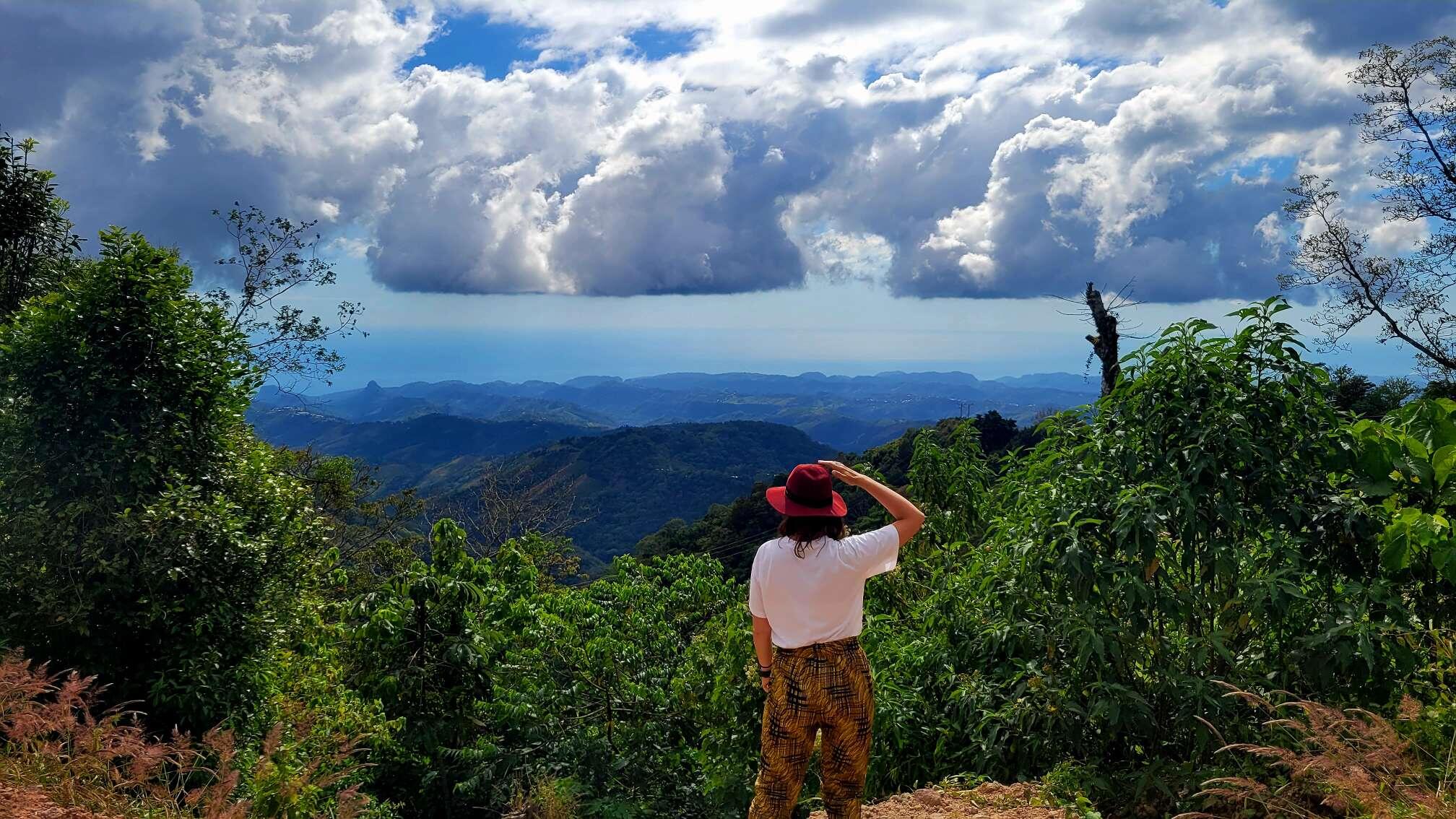
Yes. This is from my 2023 trip, facing towards the Guatemalan border. At the middle, you can see Volcán de Fuego,130km away, puffing smoke.

