
Trump's first term he of course it was obnoxious about it but remember that we defend the world while they get free healthcare and that's the approximate cost on a percentage of GDP basis
Yes, during his first term, President Donald Trump frequently criticized NATO allies for not meeting their defense spending commitments and emphasized the need for European countries to increase their contributions. He argued that the U.S. was disproportionately bearing the financial burden of the alliance. In a March 2016 interview, Trump stated, "NATO is costing us a fortune, and yes, we're protecting Europe with NATO, but we're spending a lot of money." This sentiment continued throughout his presidency, with Trump urging NATO members to meet the alliance's target of spending 2% of their GDP on defense.
Obama also complained about the cheapskate EU
Yes, President Barack Obama did address the issue of NATO burden-sharing during his presidency. In a joint press conference with NATO Secretary General Anders Fogh Rasmussen on May 31, 2013, Obama emphasized the need for all NATO members to contribute fairly:
> "And that requires burden-sharing on the part of all NATO members. It means that, even during times of austerity, that we work smarter together to ensure that we can meet and are prepared for any threats that may arise..."
Additionally, during a press conference on June 3, 2014, Obama highlighted the necessity for every NATO member to do its fair share:
> "That does mean that every NATO member has to do its fair share... But everyone has the capacity to do their fair share, to do a proportional amount to make sure that we have the resources, the planning, the integration, the training in order to be effective."
These statements reflect Obama's advocacy for equitable contributions among NATO allies to maintain collective defense capabilities.
Here's what Bush said about it
Yes, President George W. Bush did address the issue of NATO burden-sharing during his presidency. For example, in a 2002 interview, he emphasized the importance of NATO members sharing the responsibilities of maintaining peace:
> "The alliance is a crucial alliance. It's a strong alliance. We're going into a new period. And the idea of having members that are willing to shoulder their share of the burden of keeping the peace with the new threats is good..."
Additionally, during a 2007 press availability with NATO Secretary General Jaap de Hoop Scheffer, President Bush reiterated the need for equitable burden-sharing among NATO allies:
> "I pledged to the Secretary General we'll work with our NATO allies to convince them that we must share more of the burden and must all share the risks in meeting our goal."
These statements reflect President Bush's advocacy for balanced contributions among NATO members to address emerging security challenges.
For 29 years we've been bitching for Europe to spend more on defense
In his October 22, 1996, speech on NATO's future, President Bill Clinton acknowledged and welcomed European allies' increased willingness to shoulder a greater share of defense responsibilities and leadership within the alliance. He stated:
> "But we welcome our allies' willingness to shoulder a greater share of the burden and to assume greater leadership."
This reflects his recognition of the importance of equitable burden-sharing among NATO members.
Might be double bottoming right now
You should at least buy a little bit
You will become that that you cannot forgive
You cannot forgive Trump you will start spouting insulting one-liners eventually
You cannot forgive Nazis you will become Israel running a concentration camp called Gaza
If you cannot forgive your father you will become just like him
Forgiveness is for you
Yes, as of today, Gaza is facing severe restrictions impacting essential supplies:
Electricity: Israel has ceased supplying electricity to Gaza, leading to the shutdown of critical infrastructure, including a desalination plant that provides drinking water to over 600,000 residents.
Water: The electricity cutoff has disabled the desalination plant, significantly reducing Gaza's access to clean drinking water.
Food and Medicine: Israel has halted the entry of goods into Gaza, exacerbating existing shortages of food and medical supplies.
These measures have intensified the humanitarian crisis in Gaza, affecting the 2.3 million residents who rely on these essential services.
How is that a fast food place today that doesn't take MasterCard but they do take discover and Visa and they don't take American Express
I thought these are MasterCard were basically kind of the same thing cuz everybody takes both of those
She decided she needs even more show pillows!!!


When will they throw at the idiot and get a real government?
My wife loves lots of show pillows


There's no conspiracy. I hope people who know him and he was just crazy

That's pretty fabulous
I listen to people who focus on what is and what is likely to be rather than what should be
Should is very stressful
You, George Friedman, Dr Sarah Payne of the Navy college for example

To assess the shift in fiscal and monetary contributions to U.S. money creation over the past five years, we can calculate the Fiscal Dominance Index (FDI) for March 2020 and compare it to the recent value. The FDI ranges from 1 (entirely fiscal-driven) to 10 (entirely monetary-driven).
Data from March 2020:
Fiscal Contribution:
In response to the COVID-19 pandemic, the U.S. government enacted the Coronavirus Aid, Relief, and Economic Security (CARES) Act in March 2020, amounting to approximately $2.2 trillion.
Monetary Contribution:
The Federal Reserve initiated Quantitative Easing (QE4) in March 2020, purchasing assets to support liquidity. By July 2020, the Fed's balance sheet expanded by $3 trillion, increasing from $4.2 trillion in February to $7.2 trillion.
Calculating the Fiscal Dominance Index (FDI) for March 2020:
Using the formula FDI = 10 × (Monetary Contribution %) / (Fiscal Contribution % + Monetary Contribution %):
Fiscal Contribution %: ($2.2 trillion / $5.2 trillion) × 100% ≈ **42.3%**
Monetary Contribution %: ($3 trillion / $5.2 trillion) × 100% ≈ **57.7%**
Plugging these into the formula:
FDI = 10 × (57.7%) / (42.3% + 57.7%) ≈ 5.8
Comparison:
March 2020 FDI: 5.8 (indicating a slight monetary dominance)
Recent FDI: 5.2 (indicating a slight fiscal dominance)
Interpretation:
Over the past five years, there has been a shift from a slight monetary dominance in money creation to a slight fiscal dominance. This change reflects the evolving roles of fiscal and monetary policies in influencing the U.S. money supply.
Considerations:
These calculations provide a simplified view and may not capture all nuances of fiscal and monetary interactions.
Other factors, such as changes in money velocity and private sector credit creation, also affect the money supply but are not included in this calculation.
This comparison illustrates the dynamic nature of fiscal and monetary policies in shaping economic outcomes over time.

naked jungle people are coming on Nostr Nests later today at 5PM ET. join them at https://nostrnests.com or Nostur or Snort.
yum
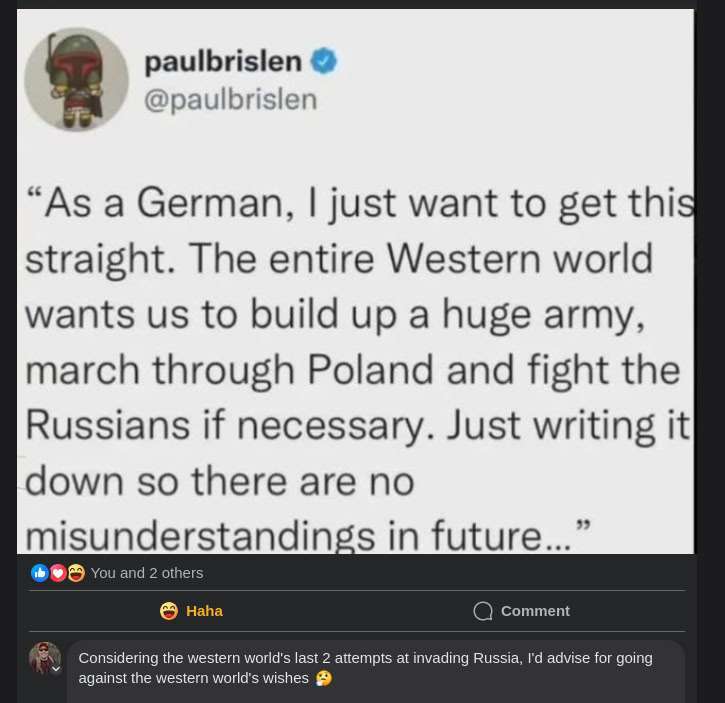
EU have about 10 times the GDP of Russia
22 trillion versus 2.2 trillion approximately
that means they can buy a lot more guns drones planes tanks etc
pressure can't even beat a third world country with 1/10 of their revenue what are they going to do against somebody that has 10 times their revenue

I think that guy on the right is Satoshi