
"Whenever destroyers appear among men, they start by destroying money, for money is men's protection and the base of a moral existence. Destroyers seize gold and leave to its owners a counterfeit pile of paper."

Will Drivechain Centralise Bitcoin? with Shinobi ( nostr:npub1xapjgsushef5wwn78vac6pxuaqlke9g5hqdfjlanky3uquh0nauqx0cnde ) (SLP512)

"I wish it need not have happened in my time," said Frodo.
"So do I," said Gandalf, "and so do all who live to see such times. But that is not for them to decide. All we have to decide is what to do with the time that is given us."

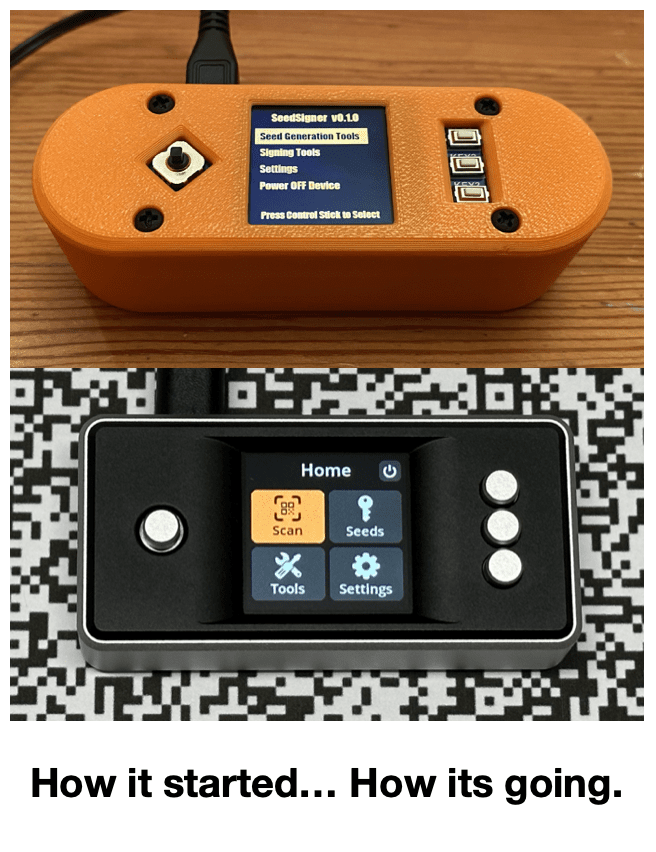


It's a meticulous process.
PoW 😁

Thanks for sharing. Would love to hear all about it🙏
You hit the nail on head though. I think the change you're describing is unfortunately a byproduct of broader adoption. New network participates enter the network and adopt it with different values than the original cypherpunk origins. Consensus naturally shifts and steers the project away from the philosophical underpinnings that were the impetus of the origin.
Sadly I think that most people really don't want a separation of money and State, but rather an adoption of Bitcoin by the State.

Johnathan, are you speaking about the change in the development community specifically or the larger Bitcoin community more generally?
Thanks for sharing your insights James. I definitely don't think it's boring. 🙏
I'm interested in doing more research into how hierarchy, as a coordination mechanism, naturally arises from decentralized / spontaneous order systems. Bitcoin as a project is indeed an experiment in how hierarchy emerges spontaneously absent a clearly defined leadership structure. Do you think there should be more effort within the community to promote spontaneous hierarchy instead of dismissing it as destructive centralization?
You mentioned competing implementations and I wonder if we could ever see private implementations competing with one another if the project ever gains substantial global adoption. 🤔
Thanks again ✌️
It's that time of year when my wife bakes peanut butter apple pie 🤤



We're committed to funding existing and new builders who can help extend and re-enforce Bitcoin's tools and ecosystem. What will the next decade of infrastructure building bring?
Looking Ahead, by nostr:npub1e0z776cpe0gllgktjk54fuzv8pdfxmq6smsmh8xd7t8s7n474n9smk0txy
https://opensats.org/blog/bitcoin-infrastructure-this-decade
It's important that the tech we build supports Bitcoin's core values: self-sovereignty through the preservation of anonymity, accessibility, and decentralization. Together, these values build us a system where trustless financial transactions without intermediaries are a tangible reality for all, not an imagined ideal.
Either humans deal with one another voluntarily, through civil society and markets, or they deal with each other using compulsion, through crime or government. Economic means or political means, the age old choice remains the same.
There is a deeper and more satisfying reason for us to be optimistic. The state is not only fiscally unsustainable, it's intellectually unsustainable as well. We should be optimistic because we're living at the beginning of what Hans- Hermann Hoppe calls a "bottom-up" revolution. Bottom-up because it starts at the individual and hyper-local level. Bottom-up because it relies on radical decentralization and political secession. Bottom-up because it bypasses politics and traditional power structures. Bottom-up because it bypasses state schools, state intellectuals, and state media.
Governments, and the political classes who run them, are facing a nonviolent revolution of ideas that was scarcely imaginable just twenty years ago. And this revolution will strike at the heart of these states' only true asset: their legitimacy in the eyes of those they would govern. The bottom-up revolution is based on informed individuals who increasingly don't need elites, political, academic, or scientific, to run their lives. It is based on the recognition that national and global governance schemes have failed to solve, or even address, huge structural problems like hunger, medical care, energy, and economic development. It is based on radical decentralization, political and otherwise, because the vast diversity of individual interests demands an end to top-down government edicts and bullying by 51 percent of the electorate.
This can happen - and is happening - without even a tacit acceptance or understanding of liberty among the majority of people necessarily. They simply see with their own eyes that the state doesn't work, so naturally they seek another way.
Jeff Deist
If you believe the state is harmful rather than benevolent; if you believe that the state threatens individual rights and property rights, rather than protects them; if you believe that the state decreases our chances for peace and prosperity; if you believe, in sum, that the state is an overwhelming force for ill in our society, a force that makes all of us far worse off, why in the world is it unrealistic to work toward its elimination?
Notice that the charge of being unrealistic, impractical, or overly idealistic is never applied to medicine or crime prevention. Nobody says to the cancer researcher, "you should be more realistic, cancer and infectious disease will always exist. Why not just work on making the common cold a bit less severe?" Nobody says to the criminal investigator, "gee, organized crime and violence are just part of human nature, it's useless to try to prevent them. Maybe you should just focus on reducing bike thefts."
So why should we be apologetic or timid or less than fully optimistic in our fight against the state? We should not. Like the cancer researcher, like the crime fighter, we should be bold, we should be optimistic, and we should be vigorous in our opposition to government.
Jeff Deist
True Utopians are the central planners who believe they can overcome human nature and steer human actors like cattle. To quote Murray Rothbard: "The man who puts all the guns and all the decision making power into the hands of the central government and then says, 'Limit yourself'; it is he who is truly the impractical utopian." In Rothbard's eyes a libertarian world would be better, not perfect. So while our revolution is indeed intellectual, it is also optimistic and pragmatic. We should talk about liberty in terms of first principles, and how those principles make for a better society precisely because they accord with the innate human desire for liberty. Let the statists explain their grand schemes, while we offer a realistic vision of a world organized around civil society and markets.
Jeff Deist