Profile: 5dcd8ebc...

Still need more progress on "separation of school and state".
... the fulfilling of the law.
Gödel threw the world of mathematics into turmoil with his Incompleteness Theorem. He proved that there was no possible algorithm, even in princple, to iterate over the (infinite) set of true theorems. Legalistic religious systems suffer from a similar defect. No finite set of rules can codify righteous behavior in every circumstance. There will always be new situations not covered by the rules. The Talmudic approach was to extend a set of auxiliary rules to cover these situations. Hmm, the Law of Moses says "do not boil the kid in his mother's milk". What about cheese burgers? The Law says, "do not light a fire on the Sabbath". Can you drive your car to synagogue? Can you push a button that completes or interrupts an electrical circuit?
But the Law is a school teacher. It shows you your own corruption, but does not provide the power to do what is right, or even prescribe the right thing to do in every possible situation. Thus both Moses and Jesus summarize the law as "Love the Lord your God with all your heart and with all your soul and with all your strength." And Jesus adds, and the second is like unto it, "Love your neighbor as yourself." These are not detailed prescriptions. They cannot be followed consistently by hearts tainted by sin.

The wars between Catholic and Protestant were mostly over the Authority of the Pope - who had become in effect Emperor of the World during the wars to push back the Moslem conquest of Europe ("Crusades"). The German princes seized on Luther as a religious leader to gain the support of the people to rebel against the Pope - this was more of a political than a theological issue.
Other issues resulting in localized violence was persecution of the Anabaptist sects. These did not believe in infant baptism, and their members were rebaptized. This was seen by mainstream churches as claiming their baptisms were invalid (kinda true). Heresy (perceived or real) often gained a death penalty. Sadly, even this was not a deep disagreement. Catholics first dealt with the death of martyrs under Roman persecution before baptism by proclaiming it a "baptism of blood". Then what about still born babies, or infants who died before baptism. If the parents intended to baptize the child, this was called a "baptism of desire". Anabaptist believers intended to baptize their children, and did so when the child could communicate their desire to do so. This is in effect a "baptism of desire".
The arguments are not over the canon (mostly, Orthodox have 88 books, Catholic have 72, Protestant 66, Jewish have OT only - progressively tighter criteria for canonicity). As R.C. Sproul put it, "we have a fallible canon of infallible books". While Catholics/Orthodox complain about Protestants "throwing out" books (actually, they are read in church, used in Bible study, but just not regarded as canon), I think it is a good idea to start with the subset agreed on by absolutely everyone. Note that Catholic/Protestant/Orthodox all agree on the New Testament canon - although Luther considered ditching e.g. James ("an epistle of straw!") because the content didn't fit neatly with his preaching.
Many of the arguments are not even real arguments - but a failure to listen to the other side. For instance, the Protestant slogan "sola fide" (faith alone) is entirely acceptable to Catholic/Orthodox if modified to "sola fide formata". The issue is that "faith" or "belief" is used in two senses in the NT canon. Fide informis (intellectual assent) vs Fide formata (action based on faith). In fact, the phrase "sola fide", or "faith alone" in English only appears one place in the NT, in James, where he says, "therefore a man is justified by works, and not by faith alone". But there James is talking about fide informis. As he says shortly before, "You believe that this is one God? The demons also believe and tremble." One way of qualifying in English is "believing that" vs "believing in".
Charles Blondin was a famous French acrobat known for walking a tight rope across dangerous terrain. On his US tour, he walked across Niagra Falls. At each performance, he would ask the crowd, "Do you believe I can walk to the other side and back on that tightrope?" "Yes!" the crowd would reply. And after working the excitement to a satisfactory pitch, he would proceed to do exactly that, often adding additional stunts en route.
One time, he asked the crowd, "Do you believe I can carry a man on my back to the other side and back on that tightrope?" "Yes!" the crowed screamed, excitement building as usual. "I need one brave soul to volunteer for the trip!" Crickets. Finally, his business manager volunteered, and the feat was performed as promised. The crowd believed THAT he could do it. The business manager believed IN the ability of Charles to do so.
Prophets from Enoch (quoted in Jewish/Protestant canon both New and Old Testament) to Jesus Himself to John (Revelation) all proclaim an end to the world. Enoch prophesied the end of the pre-flood world by water. Even the time frame was prophesied - he was directed to name his son "Methuselah" (when he dies, it will come). From the record, the flood came the very year Methuselah died, and there are hints it was the same week.
There are numerous remains of the pre-flood world. Establishment explanations are total B.S. I won't go into it here. I recommend a young guy "Bright Insight" who has made it his mission to use crowd sourced funds to travel around the world and take high quality video of his tours of ancient sites. He often finagles access to areas off limits to tourists. Look for him on Rumble and probably still Youtube.
Prophets from Enoch to Peter to John proclaim a fiery end to the present Earth (as opposed to a watery end to the previous Earth). I actually think it will be an end to the entire present universe - but I could be convinced otherwise.
This is all part of the remedy for sin. How do you redeem creations with corrupted body, soul, spirit, while preserving their free will and personhood? "The heavens are the work of Your fingers" but "salvation is the work of Your strong right arm." Our bodies die, and are resurrected (everyone, the righteous and the wicked). We die to our self and are recreated as a new life in Christ. The world meets a fiery end, and is recreated as "the new heavens and the new earth". (New heavens is why I think the entire universe is slated for demolish and rebuild.) Jesus says, "I go to prepare a place for you." The new world is being made (completely different time line/fabric, so "is made" is probably accurate as well) ready for us.
If you don't trust translations, learn Hebrew. Or use many tools, online, proprietary, and open source, to automate the equivalent of a Hebrew Bible Dictionary. I like biblehub.com for an online version (annoying popup ads, but gotta pay for it somehow). I also use the open source Sword project for offline tools, including Xiphos (Greek for sword) gui.
There are almost no differences between texts for Old Testament books accepted in the Jewish and Protestant canon. That is one criterion for the canon. (Additional candidates, like Enoch, have widely varying texts - I like the Ethiopic text for Enoch.) Scribes used a checksum method when copying a scroll - each line has a checksum. Unfortunately, they did not think of checksumming the checksums for a group of lines. So, e.g. Jeremiah 27:1 seems to be a dup of Jeremiah 26:1. Context (e.g. 28:1) makes it clear that 27:1 is the dup.
Physical light is not inherently good. Storm troopers use laser guns too. Early Church fathers thought of angels as beings made of (material cause) light - like that Star Trek episode were the Enterprise encounters the light people. Satan is also described as appearing as an angel of light.
A modern mapping of Gen 1 to current scientific model ("6 day creation") understands the separation of light and darkness as quark confinement, where light is literally separated from darkness (matter) and the vibrations on the surface of the "deep" at that instant are still visible in the map of the CMB (Cosmic Microwave Background).
I like the "6 day" model, because while other argue over whether the universe is 14 billion years old or 6000 years old, I ask what frame of reference are we using to measure said age? Earth frame of reference did not exist for most of the period under discussion. When they respond, "so how old do you think the earth is?" I say, well, in the frame of reference of the CMB, which is uniquely visible from anywhere in the universe, the universe is ~5.5 days old. (CMB FoR days become progressively shorter as the universe expands and the frequency of the CMB decreases).
The 14 billion yr estimate is based on the CMO (CoMoving Objects) FoR, which is a cluster of galaxies moving with roughly the same direction and speed as ours, and afaict is equally valid, but not nearly as interesting.
Doesn't seem like it. Oh well. Url syntax sure looks like AP urls.
However, truthsocial.co.in is in the fediverse!

Agree. Nothing wrong with repurposing. It's just that since Trump created it to *increase* his reach after getting canceled from Twitter, a walled garden is the wrong way to go - IMHO of course. Wait - is it still a walled garden? Can I follow truth social people from another domain now?
Good to know. That is a completely acceptable situation IMO. I just need to explain it to new users. It is a feature, not a problem. "Spam" is truly defined by the individual.
truth.social is a mastodon fork made into a walled garden. (I actually think that was a tactical error, but I don't run a big business.)


Google translate is not very coherent: "I said that pack-and-orange is the best solution for egg lentin. That's just a lie."
I recommend an egg cooker. Yes, it is a dedicated appliance, but much more compact than, e.g. a rice cooker. Very water and power efficient compared to stovetop methods for boiled eggs. They last almost forever (one my mom got when first married is still going, and I'm 65). Very simple operation: eggs sit on a tray, measure a Tbs or so of water based on number of eggs and doneness (soft,medium,hard). Eggs get steamed to perfect doneness and a simple bimetal thermostat turns it off when water all boils away.
If you must cook them in a microwave, beat them like for an omelette first. Leave plenty of room for expansion. However, why not just pour the beaten eggs on a hot greased griddle or wok instead? On a flat griddle, you get a French omelette. (Not sure what the result in a wok would be - scrambled?)


We all have corrupted biology. And even if you did it to yourself (or someone else) intentionally ("sex change" or mRNA anyone?), you can repent.
It doesn't seem to be the first time. In Genesis 6, fallen angels mess with human genetics, and 6:9 says Noah was תָּמִים (tamim: complete,sound) in his generation (like gen Z or gen X). As is typical for Hebrew, tamim is somewhat ambiguous and elsewhere refers to moral purity in some places and to genetic (seed) purity in others.

Meanwhile in America, Christians are jailed for praying silently too near an abortion clinic.

And this is why when the Earth is destroyed this time, "the elements will melt with a fervent heat".


🚨🚨EMERGENCY TFTC RIP🚨🚨
I sat down with Jason Brett to discuss the targeting of the bitcoin mining industry by the EIA & Department of Energy.
Discrimination against a single industry like this has never been seen before. Important rip.
https://tftc.io/federal-government-attack-on-bitcoin-mining-jason-brett/
Apparently, BitCoin is "over the target".

"For every complex problem there is an answer that is clear, simple, and wrong."
H. L. Mencken

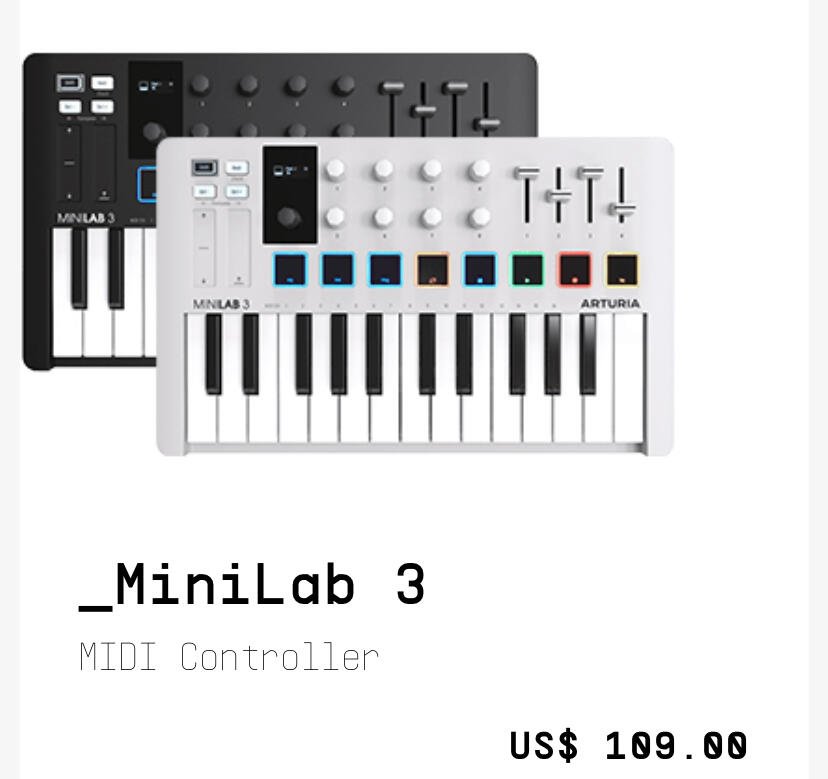
I have the MiniLab 2 (sliders on the right are more knobs). I use it all the time, especially for entering a tune. I use ABC notation (which makes it easy to self publish songbooks). I am on Fedora 38, and use software like Qsynth, Ardour, and VMPK as well as abcMIDI, timidity and abcm2ps. I recently installed Sooperlooper and hope to try using it for something like what Kiffness does. I use a full sized keyboard for actual performance and recording.
The pads are typically mapped to drumkit stuff. They are a little hard (have to hit them hard to get a response) for my taste. Maybe you're supposed to use a drumstick (which I don't have). I haven't figured out what to do with knobs yet. Probably intended for volume of tracks on a looper.
The keys are organ feel (no weights or snap). They are reduced size: 14.5 cm / octave (full size is 16cm / octave).
It is plug and play on linux. There is no synth or audio in the unit - it is strictly a compact MIDI input device that can sit next to your laptop.