

No, not really.


You're mixing up different things. The World bank and IMF are mostly the same I agree. And add ECB to this bankster clique.
Other organizations have different backgrounds and history. Especially the UN, was funded after the WW2 with a single goal - that no such war would ever break out again.

⚡️🇵🇱🇪🇺 NEW - Polish presidential candidate Grzegorz Braun trampled the EU flag and then burned it.
He stated that Poland would not display the symbols of what he called a hostile organization.
"This is Poland, not Brussels."
https://blossom.primal.net/16a4069dc7c6af73a6ad6ebb34040412b5e81be6f4da88f209f283159f0fa39f.mp4
https://blossom.primal.net/6cf2b602fb74ae604acc6b40084a758be7986a3988126d6cc0f4136e491ca876.mp4
omfg. Sure, Poland can always simply leave the EU. But then what?

Trump on Iran:
“This is really crunch time. I would tell you for Iran and, for their country, this is a very important time for Iran. This is the most important time in the history of Iran for Iran, and I hope they do what's right. I'd love to see a peace deal, a strong peace, so they cannot have a nuclear weapon. But I would say that this is the single most important period in the history of Iran, which is a long history, and we want it to be a great country.
Let it be a tremendously successful rich country. They have everything you need. The people are incredible. They have vast amounts of oil and assets. We want it to be a successful country.
We don't wanna do anything that's gonna get in the way of that, but they can't have a nuclear weapon. And if they choose to go a different route, it's gonna be a very sad thing. And and it's something we don't wanna have to do, but we have no choice. They're not gonna have a nuclear weapon. They're not gonna have a nuclear weapon.”
https://video.nostr.build/f3704ea39e870369d4d612058a9e7ca4bb457d0eca5645339e79cd67b7b4f7e0.mp4
why does he speak like a retard repeating everything 2x or 3x? A condition maybe?
⚡️🇮🇱 NEW - Israel's Minister of Finance Bezalel Smotrich: "The time has come to pounce on Gaza Occupy it. Establish military government, take territory from them, and implement President Trump's plan to remove 1.5-2 million Gazans from Gaza." #Palestine
https://blossom.primal.net/6e69b0900c7f870c6b71520be7d97abe8bc35b09fd2e19929758f1e4ba9f30b0.mov
Is this guy suggesting genocide on 1.5m people? Hague still has some room for him.

Among those, only Russia, Pakistan and India posses working nukes. And among those most won't even launch, because they're not maintained. And then nukes are mostly smaller tactical nukes to be used on the battlefield and not to wipe out whole cities. So it's all bullshit when someone starts threatining to nuke the planet.
⚡️🇾🇪🇮🇱🇵🇸 NEW - Yemenis after waves of massive Israeli bombings over two days, striking more than 20 times across 10 sites today alone:
“We will not leave Gaza, we will not leave Gaza. We will not abandon Gaza.
Even if all of Yemen is wiped out. Let nuclear weapons come, We will not leave Gaza, we will not leave Gaza!”
https://blossom.primal.net/dab5a73aa1e21ab927b554b8c8ed6205b84bdd918e4364d61b61eeef73d25492.mp4
what does this guy smoke?


That's not an actual issue if you're targeting the OP_RETURN debate. You don't really need full history, just utxos to confirm new transactions. And OP_RETURN doesn't increase utxo, because it's unspendable anyway.
⚡️🇺🇲🇩🇪 NEW - President Trump on Nord Stream blasts: "I think a lot of people know who blew it up."
https://blossom.primal.net/1287dfbee4624d43e93b327518263539d731c48348e6a1dfd03ed11d0b7e310d.mp4
But he doesn't 🤣
⚡️🇺🇸 WATCH - Jeffrey Sachs: "I'll tell you a sad truth...99% sure...my view based on extensive work over the past 4.5 years is that COVID came from the university of North Carolina..."
https://blossom.primal.net/e5d9f99a8f1c03fade77faf089030a262f0e57d1439068b8ec7457a61cffd3c3.mp4
That guy is so full of shitty lies 🤦♂️ Did anyone ask him recently how is Putin holding and his special military operation against evil Ukrainian nazis and biolabs? Those rats then suddenly disappear and are nowhere near when caught on lie.
⚡️🇺🇲🇨🇦🇩🇰 NEW - Trump says he rules out military intervention against Canada, but says invasion of Greenland is possible
https://blossom.primal.net/30418731ba0260a36ab2406fb246d3cde6d9ed8b8bcfe1453af20e314828850e.mp4
Chill out dude. You do realize Denmark is a member of Nato, right?
sure you can have some kind of bot protection on the relay api level, no?

I still remember back in 2000s using it for video calls on Linux. Based on Qt 4.x, running flawlessly. And then on Nokia N900 Maemo. Pure joy.
And then enters Microsoft... 🤬

Car manufacturers. If they can't make money with factories on US soil due to regulation or expensive workforce despite robotization, then they will not produce cars there nor import them. They will simply move out of the US making less choice for consumer resulting in higher car prices.

regarding bullet 3. Where will you raise up your kids? In rural Mexico? 🤔


In 2015, an eccentric millionaire placed bitcoins in weak addresses.
For years, the prize has been contested by bots, GPUs, and in the future, it is expected to be the first target of quantum attacks.
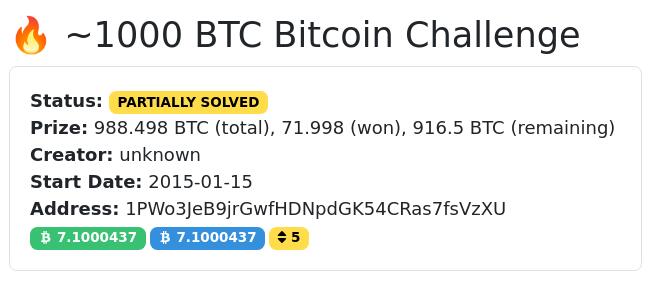
The individual's goal was to monitor the advancement of computational power capable of breaking Bitcoin keys.
These keys have up to 256 bits of entropy, which can be understood as the difficulty of discovering them. They are simply large numbers, on the order of 2²⁵⁶.
He then created 160 addresses, each with fewer bits of difficulty, from 1 to 160, and placed a few satoshis in each one, doubling the amount in the next.
The total prize reached nearly 1,000 BTC. There are still 916 BTC left to be claimed.
https://mempool.space/tx/08389f34c98c606322740c0be6a7125d9860bb8d5cb182c02f98461e5fa6cd15
The first few dozen addresses were quickly looted. There are bots monitoring the blockchain and stealing UTXOs that have some vulnerability — such as low entropy in the generation of the private key.
https://mempool.space/tx/0eb5b5c103e68eb0931430e7786cf1b6962f9eed5a2cb5271d4dd1699b77e86f
It was only at the end of 2015 that one of the owners of these bots noticed that the source of the bitcoins all came from a single transaction. He decided to share the discovery on the Bitcointalk forum, and that’s when more people began competing for the remaining prizes.
https://bitcointalk.org/index.php?topic=1306983.0
In 2019, the creator exposed the public keys of some addresses (those with indexes ending in 0 or 5). This is done simply by moving the coins—the key appears in the transaction. With it, other methods can be used, making it easier to crack.
https://mempool.space/tx/17e4e323cfbc68d7f0071cad09364e8193eedf8fefbcbd8a21b4b65717a4b3d3
One of these methods is a very old algorithm from 1978:
Pollard's Kangaroo Algorithm — a clever trick used to find private keys when part of the keyspace is known. Imagine two kangaroos jumping across a number line, one tame and one wild, eventually landing on the same spot. It’s a classic in cryptography, and now it's being used to chase Bitcoin prizes.
Since then, several programs and even participant "pools" have emerged, all trying to crack the next address. "kowala24731" secured an investment in the hundreds of thousands of dollars to rent GPUs and managed to break addresses #67 and #68 in early April.
Yesterday, someone, probably a beginner, cracked address #69 but didn’t secure the spending properly and exposed the public key.
In a few seconds, some bots cracked the key and replaced the transaction, battling for the balance. The last one paid a total fee of 1.2M sats.
https://mempool.space/tx/a52c5046f3097a8c2bd3b9889df2fb47b104d47a16cc679d3357feec003db753
The time to crack these addresses — discovering the private key from the public key — is quite short. A GPU can do it in less than a minute.
That’s why those who crack the keys can't publish it to the network; they must send it directly to a miner to include it in a block (like Mara).
Among the addresses with exposed public keys, the record was 130 bits of entropy, set by "RetiredCoder," who also cracked other keys.
These addresses are likely serving as "canaries in the coal mine" for the attacks Bitcoin may face. As long as there are still hundreds of BTCs sitting in them, yours should be safe.
I don't get it. Since when is finding a private key corresponding to the public one so trivial?
or they simply shut down their business and do sth else?
Trump was doing peace efforts? How so? By helping Putin?

Do you believe Europe's government-enforced demographic replacement of Europeans with Africans/Indians/Muslims is Negative, Neutral, or Positive for Europe's culture and future? #AskNostr
https://video.nostr.build/1ab406838ca8834b3f0736d0fe2ca5a8af204ad762f0148b88406aa2cd100bf0.mp4
Wtf, it's a subway. That's for students and the poor. Normies are 20m higher.
Personally, I don't have issues with muslims and Indians on the video. As long as they pay taxes and play by the rules they are most welcome.
And for Ireland, the richer the country/city, the more attractive it is for migrants. You won't find many in rural Ireland lol 😉