Profile: 772f9545...


Keonne Rodriguez describes mackerel as money on the inside.
"Whenever these types of limits and restrictions are imposed within the otherwise free and unencumbered market by top down administrators, market participants find a work-around."


Unbanked has a nice ring to it.

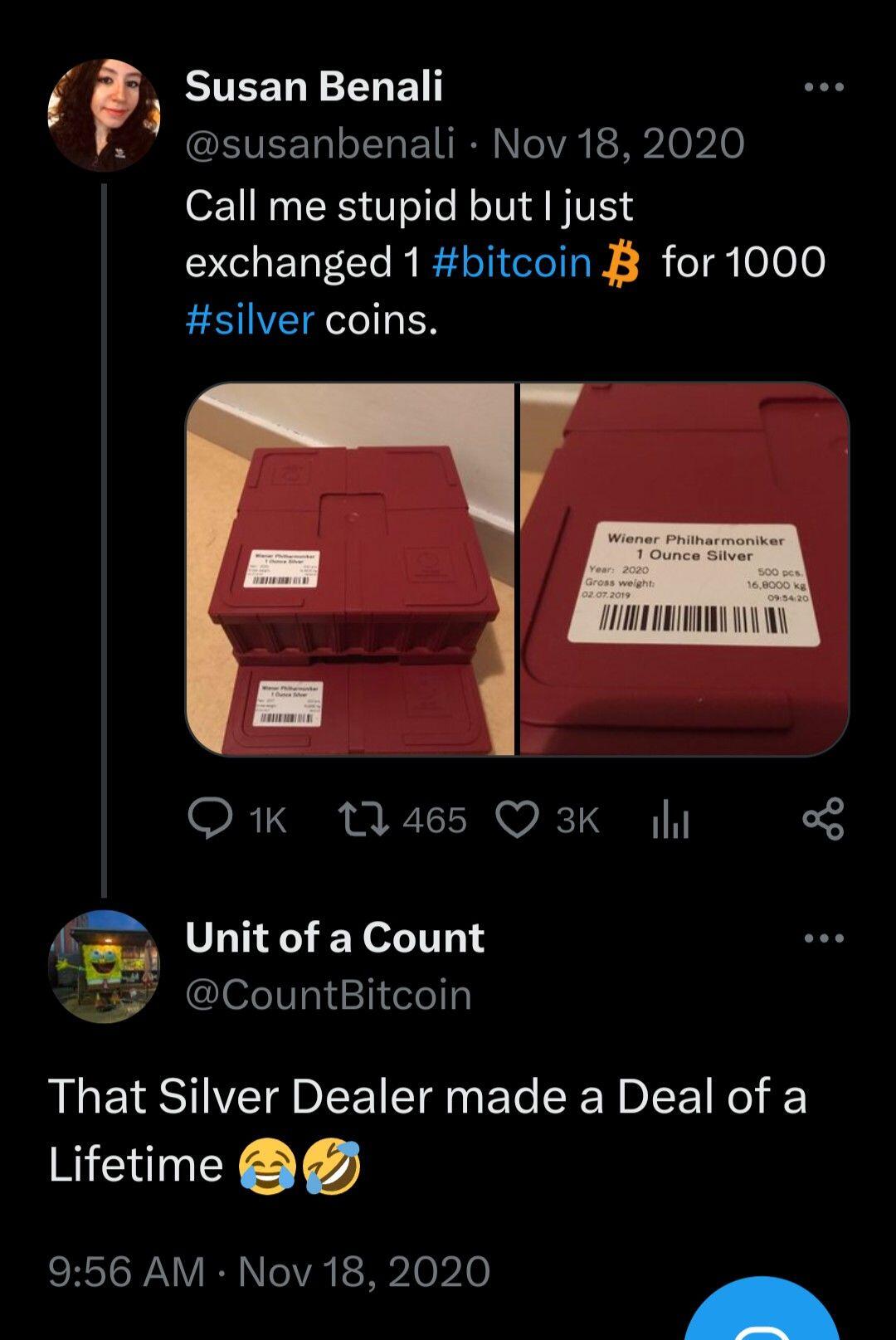
Today, one BTC trades for about $90K and 1000 one-ounce silver Philharmonics trade for about $80K. Slight loss to date.
The original post is still up at https://xcancel.com/susanbenali/status/1329025804899135490
And she clarified "Tweet says 1 #bitcoin not all my bitcoin🤓" at https://xcancel.com/susanbenali/status/1329171343074529281
In case the image doesn't load, I am posting its contents for posterity.
The image depicts a Twitter/X post with an image and a single reply. The original post is from "Susan Benali" (@susanbenali) on November 18, 2020 saying "Call me stupid but I just exchanged 1 #bitcoin ₿ for 1000 #silver coins." An image in the same post shows two maroon-colored monster boxes of Austrian Silver Philharmonics and a close-up of one of the labels with text "Wiener Philharmoniker
1 Ounce Silver
Year: 2020 500 pcs.
Gross weight: 16,8000 kg
02.07.2019 09:54:20" and a 1D barcode (EIN-13) decoding to the value 9120042103864. The post had 1K comments, 465 reposts, and 3K hearts. A reply to the post from "Unit of a Count" (@CountBitcoin) on November 18, 2020 at 9:56 AM says "That Silver Dealer made a Deal of a Lifetime 😂🤣"



IIRC one of the key features of the panopticon was that people would in fact know.
nostr:npub1sn0wdenkukak0d9dfczzeacvhkrgz92ak56egt7vdgzn8pv2wfqqhrjdv9 nostr:npub14slk4lshtylkrqg9z0dvng09gn58h88frvnax7uga3v0h25szj4qzjt5d6 nostr:npub1jlrs53pkdfjnts29kveljul2sm0actt6n8dxrrzqcersttvcuv3qdjynqn nostr:npub1klkk3vrzme455yh9rl2jshq7rc8dpegj3ndf82c3ks2sk40dxt7qulx3vt nostr:npub1fkluklzamwpyn7w8awxzrcqe7z8mldlvthk4gz9kz3vsh6udz62s9qj48l The Calyx Institute recently lost its heroic founder, Nicholas Merrill, and also for at least four months Calyx stopped accepting bitcoin or other digital media of exchange as membership dues.
See https://calyxinstitute.org/news/2025/cryptocurrency-contributions-for-memberships-are-currently-unavailable and https://calyxinstitute.org/news/2025/statement-on-calyx-leadership-change
I cannot find details about these events other than Calyx's posts.
What is going on at Calyx? What is Nicholas Merrill doing now? Were these two posts related? Who would you ask?
I found the answer. Nicholas Merill started an MVNO.
Privacy By Design Wireless
Finally, a wireless service that wants to know as little about you as possible. Your privacy is Phreeli's priority.
Is it a coincidence that bitcoin price movement correlation with the S&P began around the same time as altcoin season, about eight years after bitcoin's launch?

Stages of Bitcoin
1. Dismissal
2. Crypto Degen
3. Questioning Money
4. Bitcoin is not Crypto
5. Wannabe philosopher king
6. Ego death
With some words from nostr:nprofile1qqst0mtgkp3du662ztj3l4fgts0purksu5fgek5n4vgmg9gt2hkn9lqpzamhxue69uhhyetvv9ujuct60fsk6mewdejhgtcpramhxue69uhhyetvv9ujuar0washyernd35kyetjw3ujucm0d5hsqzw64m latest read.
https://blossom.primal.net/4a929d78a13a415a823d5471d2493e046c9cd87a14b46be09c8a0875dd69f45d.mov
"Nobody understands pickling" haha what?
The Muratorian fragment, also known as the Muratorian Canon (Latin: Canon Muratori), is a copy of perhaps the oldest known list of most of the books of the New Testament. The fragment, consisting of 85 lines, is a Latin manuscript bound in a roughly 8th-century codex from the library of Columbanus's monastery at Bobbio Abbey; it contains features suggesting it is a translation from a Greek original written in the late 2nd century (c. 170–200).
I think anybody, any npub, can just DM any npub, right?


I see where Aristotle and Thomas came in now, thank you.
I said "money has never been and should not be considere sterile" which could be interpreted as either "money has never been, and should not be considered, sterile" or "money has never been, and should not be, considered sterile." I intended the former but it was ambiguous.
Saying "money is sterile" is like trying to divide goods into "essential" and "non-essential" categories. It is futile. All valuation is entirely subjective. Yes, I am echoing Mises and Rothbard because I find their arguments reasonable.
The arguments made in favor of usury are not all fresh rationalizations. See Objections 5-7 in Thomas' discussion. The only new argument is time preference rooted necessarily in human action. It also happens to be the best argument. I would wager you're familiar with the Austrian Business Cycle Theory. Underpinning this theory is the concept that originary interest is not primarily a money matter. Time preference is found throughout the capital structure and not only in loans. Whether you want to call that thing that affects the capital structure interest or not, you have to consider that action takes place in time, that capital formation exchanges lower present consumption for greater future consumption, and that therefore you have to make odd rationalizations to say that investing in-kind for future gain or buying stock in enterprises for future gain is fundamentally different than usury.
The essence of fiat is the decree from authority. So fiat money is such when decreed to be money by some authority. If fiat money were honest money, there would be no need for the authority to decree it as money. It would already be money. It is the counterfeit, non-market nature of the money, the ability for someone to say "this is money" that is fiat. Usury is a separate matter constrained to money-lending and can apply to honest or dishonest monies alike. I can lend fiat or I can lend silver with interest or without interest. Fiat is also distinct from lending. A fiat monetary system can be foisted with lending or without lending undergirding it.
Regarding Scripture.
Moses says in Deuteronomy "You shall not lend on interest to your brother: interest of money, interest of food, interest of anything that is lent on interest. You may charge a foreigner interest; but you shall not charge your brother interest". This prohibition applied to ancient Israelites lending to ancient Israelites, and not ancient Israelites lending to ancient gentiles. So even within this prohibition, we can see that usury in itself is not evil, because of the exception. We also see it is not unique to money loans.
Jesus explained his reason for kicking traders out of the temple in the same verses that describe it.
Matthew says "Jesus entered into the temple of God and drove out all of those who sold and bought in the temple, and overthrew the money changers’ tables and the seats of those who sold the doves. He said to them, 'It is written, "My house shall be called a house of prayer," but you have made it a den of robbers!'"
Mark says "Jesus entered into the temple and began to throw out those who sold and those who bought in the temple, and overthrew the money changers’ tables and the seats of those who sold the doves. He would not allow anyone to carry a container through the temple. He taught, saying to them, 'Isn’t it written, "My house will be called a house of prayer for all the nations"? But you have made it a den of robbers!'"
Luke says "He entered into the temple and began to drive out those who bought and sold in it, saying to them, 'It is written, "My house is a house of prayer," but you have made it a "den of robbers"!'"
John says "Jesus went up to Jerusalem. He found in the temple those who sold oxen, sheep, and doves, and the changers of money sitting. He made a whip of cords and drove all out of the temple, both the sheep and the oxen; and he poured out the changers' money and overthrew their tables. To those who sold the doves, he said, 'Take these things out of here! Don't make my Father's house a marketplace!'"
None of these verses mention usury. If we extrapolate that usury is sin from these verses we would also have to extrapolate that selling and buying oxen, sheep, or doves is sin as well. The plain interpretation of the source of Jesus' anger is people were exchanging on the temple grounds which violates the purpose of the temple. It was not only the money-changers, it was sellers of goods. In short, it is more about the temple and less about exchange (or usury).
You might object that usury could apply to goods as well as money. In that case, we come back to the idea that usury is distinct from money and usury is there in all future-for-present exchanges, and is not fundamental to money, not fundamental to fiat money at all.
The only mention Jesus makes of usury is actually in a positive light in the Parable of the Talents (Matthew 25, Luke 19).
The Pentateuch applies to the ancient Israelites (perhaps only even a subset of them) and not to Christians. Even supposing it all applied to all Jews and Christians alike, this instance clearly indicates that usury per se is not sinful, due to the distinction between fellow Israelite and gentile. The New Testament nowhere prohibits usury. Solomon's observation "The rich rule over the poor. The borrower is servant to the lender." is just that, and does not mention usury as the root of the slavery, rather borrowing itself.
The Old Testament, especially Proverbs, frequently chides dishonest weights, measures, and scales. Those are also known as fraud, lying, stealing, or counterfeiting.
Regarding bitcoin.
I take Satoshi at his word when he wrote "A purely peer-to-peer version of electronic cash would allow online payments to be sent directly from one party to another without going through a financial institution." He didn't mention usury or counterfeiting here. See how many times Satoshi mentions "trusted party" or "counterparty" or "trusted third party" in the whitepaper. The whitepaper can be seen to solve the "trusted third party" problem of payments online.
If usury was evil to the ancients and best minds of history, I doubt they would think of bitcoin in a positive light. Unlike gold and even notes backed by gold, bitcoin was invented out of thin air. Unlike fiat money, however, it is private and voluntary. Its value is found on the market, not by decree. Bitcoin as money is not evil in itself for some of the same reasons that usury is not evil in itself.
Regarding voluntary sin.
I agree that from a catallactic perspective we may allow things that from a moral perspective are wrong. In other words, I agree that even if by the market rules a desparate person may sell his body for money, it is usually still a sinful act. I don't deny that some people are more and less desparate, some people are more and less powerful, and so forth. The assertions that I thought we were debating were whether usury as such is always evil, whether usury is essential to fiat, and whether bitcoin is related to usury.
Hopefully I have made some useful point in this long response that you find helpful. I am delighted by the appeals to Aristotle, Thomas, and Scripture. It is also nice to be challenged to think through reasons regardless of who introduced them to me.

In hindsight, not a bad recommendation, though not for that reason.

Another way to look at it is every exchange is necessarily unequal. Both parties gain else the exchange would not happen. So there is no expected "equality" in exchange.
No disrespect to Aristotle or Thomas Aquinas but they are incorrect on this point. I already gave some reasons.
The money does not breed more money. The money already exists. Inequality is natural, and no inequality necessarily emerges from a loan. Todays borrower may be tomorrows lender and vice versa.
In December 2023, a U.S. Senate investigation revealed that governments worldwide have been demanding push notification records from Apple and Google to surveil smartphone users, including tying anonymous messaging accounts to real identities. For years, privacy engineers dismissed this attack vector as unsolvable, since mobile operating systems require routing through platform servers.
MIP-05, a new specification for the Marmot Protocol, proves them wrong: by encrypting device tokens with probabilistic encryption and delivering notifications through gift-wrapped Nostr events, it makes push notifications functionally anonymous. If you care about private communication, this is the specification you need to understand.
The specification is currently in draft and open for review: https://github.com/marmot-protocol/marmot/pull/18 nostr:naddr1qqgx2dpjv9nr2dpjvejryvpcv3nxzq3qklkk3vrzme455yh9rl2jshq7rc8dpegj3ndf82c3ks2sk40dxt7qxpqqqp65w2exg09
Where is the link to the U.S. Senate investigation? Oh, https://www.reuters.com/technology/cybersecurity/governments-spying-apple-google-users-through-push-notifications-us-senator-2023-12-06/ and https://www.documentcloud.org/documents/24191267-wyden_smartphone_push_notification_surveillance_letter_to_doj_-_signed/?
I have often wondered about those calls from unknown numbers where even if I say "hello" it's a non-response. A call answered like that can give a lot more information than cell tower ping records, I guess.

Gossip client apparently doesn't have the full range of unicode available, but I can copy the note and paste it into an editor that does. Nifty stuff. If you can vary or choose at random two or three different characters for each letter I think that would make it even more expensive for the LLMs.
I made no appeal to fiat, which is government declaring something as money. Gold is not fiat money, it is honest, real, market money.
Money has never been and should not be considered sterile. The example I used was gold, which has use besides that of a medium of exchange. See Mises' regression theorem for this. Regardless of whether we use gold, even if we were talking about fiat money, by your definition of sterility, no goods grow, reproduce, or produce anything by themselves. Whether I denominate the loan in corn, sheep, gold, or paper, it doesn't change the analysis. My example assumed no new money creation and explained where interest comes from, namely time preference, and where the seemingly new money can practically come from, namely other loan defaults and consumption of the lender.
The borrower is not compelled to borrow and the lender is not compelled to lend. There is no more theft here than in any other voluntary exchange.
Do you really think the lender is not sharing in the risk of the borrower's enterprise?
Even with collateral, the future is uncertain, and the collateral may not be worth what it was at the time of the agreement, much like there is no guarantee that the money will be worth what it was at the time of the agreement. This is true whether we assume honest or dishonest money.
Nothing in my example assumed fiat, nothing assumed fractional-reserved banking, nothing assumed dishonest money creation from nothing. I agree that all those are bad. I also think that if we used honest money and if we considered counterfeiting as anti-social activity, then there would indeed be fewer people borrowing out of desperation. The reason is related to what you mentioned: fractional-reserve banking and/or fiat destroy the purchasing power of money and therefore create a perverse incentive to borrow or invest when simple honset money saving would have sufficed.
Do you honestly use an em-dash in your everyday posts? Or am I arguing with an LLM?
If I offer to loan you 100 gold grams on the condition that you repay me 150 gold grams two years from now, where is the theft or lie? If I made the same offer to nine other persons, it may be the case that four of them cannot repay, in which case I'd have loaned 1000 and gained 900 for a loss of 100.
A bird in the hand is worth two in the bush.
A dollar today is worth two at a later date.
One hundred gold grams may, all else equal, be on the market worth one hundred fifty gold grams two years from now simply based on time preference. I might have a lower time preference and you may have a higher, and so we both win by this exchange. Where does the extra come from? From consumers buying from your productive enterprise, from your own savings, from wherever you intended to get the other fifty. The loan does not imply that there is a continual transfer from you to me, without any chance of the fifty being spent back into consumption by the lender. The lender needs to eat too.
To summarize: usury involves a fair and free exchange, risk on the part of the lender, and time preference of both parties. Therefore there is no theft or lie involved.

When did "podcast" start to mean "video"?


I saw a mystical creature yesterday. Unlike anything I've even seen in my life.
https://media.ditto.pub/7e4a9584296135ca98d1a4a2a74d5e9fb55bb550cbd7a6ef6834d323d5d6c197.mp4
It's clearly a hummingmoth.
