
The tsunami hit about two hours after high tide. Happily, the sea state has been calm for a couple days so it didn't amplify the existing waves.

Cops just evicted everyone from the surf beach in Hilo.

Massive traffic congestion is being reported across Hawaii as both residents and tourists rush to evacuate coastal zones ahead of expected tsunami waves. Authorities warn that waves between 3 and 12 feet could strike around 7:00 PM HST.
https://video.nostr.build/03584a6d803d656851fc36a91a076e08ecef0b503a0d8269f8f772f4f7dff6c8.mp4
Hawaii resident here, can confirm also on Big Island. Thanks for covering this!


I'd ask AI to write simple-to-understand code to virtually replicate how you rolled the dice a few billions of times and then calculate how many of the results matched what you saw. Then review the code to see if it seems to match what you expect and run it.
Even when I calculate odds myself, I often write a quick script to brute force an approximation for assurance. CPU cycles are cheap.



In the back, your odds of surviving a flight stay go from 0.9999998 to 0.9999999 but your odds of getting off the plane within 5 minutes of arriving at the terminal go from 0.99 to 0.05.
NB: I made up these numbers.



Dune. I wish I could read it the first time again twice. Once again like I did when I was a kid and took it at face value, being simply impressed by its depth and scope. Then once again like when I was older and realized that the book was really about the abuse of power, not just of the obvious villains but also of those whose seize power to defeat the villains but, in doing so, cause far more harm than the nominal villains ever did.

What did I say that you're debating? I'm guessing it was something about JM being serverless or P2P?

Can't tellwhether this is an allusion to scifi or ancient fortifications.

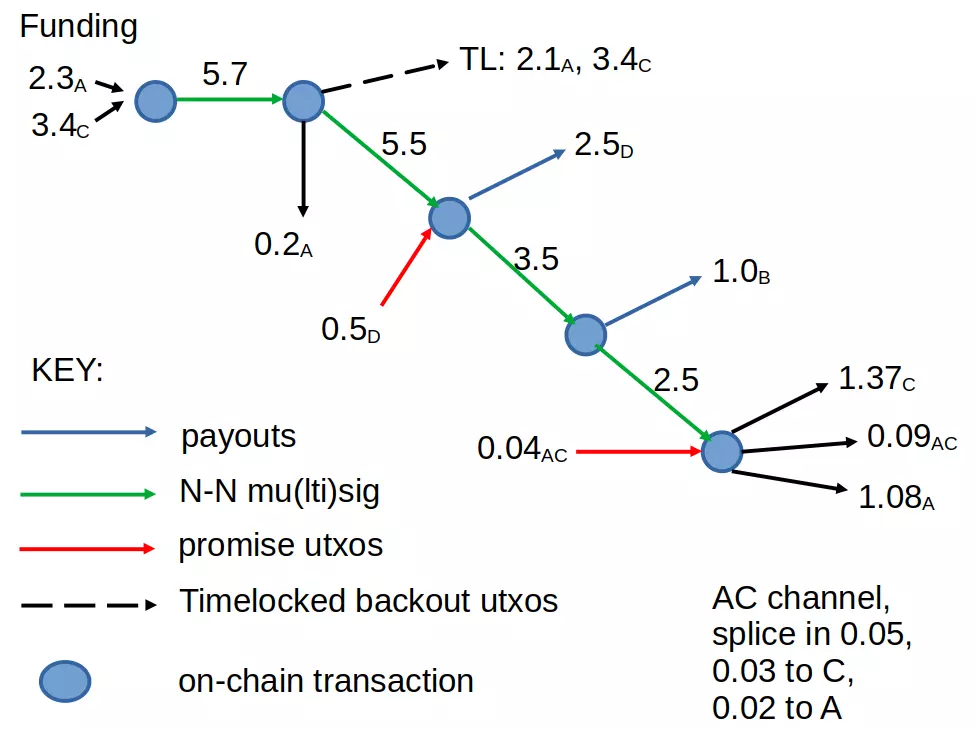
That's Timeout Trees, right? I'm not aware of a non-fork version of Timeout Trees. Do you have a link? The attached article by shinobi says Timeout Trees rely on CTV.
It also says the admin must regularly kick everyone out of the current channel factory and put them in a new one. My design tries to make that optional and atypical rather than required.
It sounds like another main difference is that Timeout Trees would use CTV to allow the admin to open channels for his users noninteractively. My design assumes we don't have CTV, so opening the channels happens during a signing ceremony scheduled by the people who want to enter a coinpool together.
https://bitcoinmagazine.com/technical/timeout-trees-a-solution-to-scaling-lightning-network-lsps
No, I'm talking about his Tunable Penalty Protocol. My summary here with links: https://bitcoinops.org/en/newsletters/2023/03/29/#preventing-stranded-capital-with-multiparty-channels-and-channel-factories
Why not use BIPs? What's the value of standardizing them elsewhere?
How does it compare to John Law's factory designs that also don't require soft forks?

If Bitcoin is successful, that will have to happen eventually. There's only 300,000 sats per person in the world (less than that if we assume some BTC have been lost). People have already tried to address that perceived insufficiency through things like millisats. When we fix it at the consensus layer, which will practically require a hard fork, it would be nice to address the problem forever by allowing arbitrary precision, e.g. allowing output amounts to be defined as a fraction of MAX_MONEY. If that happens, the idea of base units goes away
If you assume that we'll never add inflation to Bitcoin, then the monetary constant is the supply, not the fraction of it that we currently transact in.
Doesn't changing it once imply that it might be changed again? I don't want to spend the rest of my life listening to people arguing back and forth about whether it's time to redefine the basis again---that doesn't seem very clean to me.

Other nodes will continue following the most PoW valid chain but old Knots will reject that chain and instead accept backdated blocks on a lower PoW chain.
Pretty sure LND uses it for both simple taproot channels and the latest version of their swap service, Lightning Loop.
The hardest Optech newsletters to write are those where we summarize unresolved disagreements, e.g. for or against CTV+CSFS. When everyone ends up in agreement, at least mostly, we can skip describing any arguments and jump to the conclusion.
But when there's no resolution, we have to get into the details, try not to miss anything important, and be careful not to summarize in a way that misstates someone's key argument or attributes to them an opinion that they don't actually hold. On top off that, there are arguments that seem weak to me but which probably warrant describing in case I'm missing something. All that extra work is important but it's not my favorite.
Also, it makes for long and hard to read newsletters, so sorry about that for next week.

What crucial role do they play? (Honest question.) For content creators, I think it's probably better to convert readers into subscribers (e.g. BOLT12 recurring invoices), in the patreon model. For content consumers, the patronage model is also probably better at intelligently funding the kind of stuff that's good for you rather than a dopaminergic ad hoc process of zapping.
For algorithms, my understanding is that zaps are just an unverifiable statement between two people, e.g. you and I could sign a zap saying that one of us paid the other 1M BTC without even a single sat changing hands. If they were verifiable, they'd seem to give algorithmic advantage to rich people and that doesn't particularly interest me.
AFAIK, zapping currently requires using LNURL, and I'm not interested in either self hosting that infrastructure or outsourcing it. When BOLT12 zapping (perhaps through BIP353 addresses) becomes a thing, I may set it up.
Tbh, though, mixing money and social interactions doesn't excite me. I'm not opposed to it, but to me the currency of a good conversation isn't money---its acknowledgement in the form of smiles, laughs, retorts, and the like.
Controlling your own key on Bitcoin comes with significant costs, from the cost to create a UTXO, to the eventual cost to spend it, to the potentially high cost of losing your key and the money associated with it.
On nostr, controlling your own key has basically zero cost. It's one of my favorite things about nostr. If widespread control of personal keys can be made to work here, there's hope for widespread control of personal keys on Bitcoin. But if nostr fails, then I think it weakens the standard case for Bitcoin.
That may sound negative, but I think it's great to be able to test individual properties of Bitcoin separately from the heavy confounding factor of it being money.
You would not believe how normie this situation is. My wife and I are buying a home and the escrow company required the final deposit to be made by wire transfer. However, I use the same local bank as the escrow company and they don't allow internal wires.
Working around that situation has required multiple emails, multiple calls, an in person bank visit, and both my wife and I to sign a specially prepared document. Everyone has been really nice but also acting like they're doing me a favor. I've managed not to shout at any of the clerks who had nothing to do with failing to anticipate this obvious edge case, but I had to vent somewhere.
I fucking hate dealing with banks.
Most days if you ask me why I work on Bitcoin, I'll probably say something about eliminating the temptation for the state to print money, with all of its disastrous effects.
But every time I have to deal with a bank and must grovel to use my own fucking money, I feel the urge to hoist the black flag and start slitting throats. On days like today my work writing about Bitcoin technology is fueled entirely by rage and spite.
What's the best non-custodial Lightning wallet for Android for a U.S.-based user? I love Phoenix but they withdrew from the U.S. and it's time for me to move on.

This is possible on Bitcoin (without anything more fancy than merkle trees), see Utreexo.


I live on Big Island and a crazy thing is that even though the major islands are 20 to 30 miles apart, they're also massive and tall, so you can easily see at least the next isle over if not several islands. I love coming around a corner and seeing Haleakala on East Maui in the distance, or visiting a friend on Maui and being able to see home.

CD147: TAX PLANNING AND NEW IRS RULES WITH SATOSHI PACIOLI
- nostr:npub1drlw0wmu9tq37usx4qt3u6u4zj44mrf3zsfa6xhcdyrh3n4wpmgqr4rfg0
https://cdn.satellite.earth/6997ecb26e2271ecd9dfe37c7f0de29d24f619b9bad51c9730214923cdbbc60c.mp4
I thought I had this figured out but it was good hearing my assumptions confirmed by professionals. Thanks!

Very thorough writeup on debanking, in the western context in general and more specific for crypto companies. If you have four hours to listen to a Joe Rogan guest rambling about this topic and think you actually care, you have no excuse not to read this.
https://www.bitsaboutmoney.com/archive/debanking-and-debunking/
I skimmed parts but thought the rest was very good. Learned a few things.
nostr:npub1zsu6h4pfsyt9atxv6prt64j645vlyv22jwkeh5y6mqlrxs47ex0svkk4em nostr:npub1syluunzwwmc70d85d9alzqc2jrc6pdur7xrax2vqpfxas6tljavsa46ksu does brink have a lightning address for receiving donations? I set up nostr:npub10pensatlcfwktnvjjw2dtem38n6rvw8g6fv73h84cuacxn4c28eqyfn34f on https://zapplanner.albylabs.com and want to spread the love.
Brink accepts LN donations, see https://brink.dev/donate , but I don't think there's an LNURL address. nostr:nprofile1qqspgwdt6s5cz9j74nxdq34a2ed26x0jx99f8tvm6zdds03ng2lvn8cprpmhxue69uhhyetvv9ujuumwdae8gtnnda3kjctvqy2hwumn8ghj7etyv4hzumn0wd68ytnvv9hxgqgdwaehxw309ahx7uewd3hkc2zf4ja might know more
Each morning when I check nostr, there's plenty of content in my timeline but it's almost all low-key stuff. It's not boring, but it's also not exciting. I love it.
Currently reading the Gossip v 1.75 proposals by Elle Mouton on delving/github (pr 1059 on lightning/bolts). In the PR there's a lot of discussion about gossip v2 and 'overcommit' but I've failed to much other than the original 2019 note from nostr:npub179e9tp4yqtqx4myp35283fz64gxuzmr6n3yxnktux5pnd5t03eps0elz4s on gossipv2 and also https://lists.linuxfoundation.org/pipermail/lightning-dev/2023-July/004014.html which is some meeting notes. Is there anything else I can read to get up to speed on these ideas about channel/node announcements?
Related: has LN mailing list "gone to delving for now", but not really (i.e. it's mostly just github)? Or?
(Guess I'll ping nostr:npub1e0z776cpe0gllgktjk54fuzv8pdfxmq6smsmh8xd7t8s7n474n9smk0txy and Matt Corallo .. uh if i could find his nick!)

JUST ADDED: “The Mental Accounting Barrier to Micropayments” (1996) by Nick Szabo
https://nakamotoinstitute.org/library/the-mental-accounting-barrier-to-micropayments/
I think this has been the most influential piece of Szabo's on my thinking about Bitcoin, LN, and related tech.

Looks like LMNT is about 1/35th the amount of salt as seawater.
The rule against drinking ocean water is for long-term hydration. If you ingest excess salt, your body purges it by purging water. Seawater is about 3.5% salt. Saline used for human transfusion is about 0.9% salt and that's roughly the max rate at which your body can purge water. So if your drink 1 liter of seawater while your blood sodium is already balanced, you will need to pee or sweat about 3.5 liters of water. Obviously that's going to quickly lead to dehydration. A quick search says LMNT is 1 gram salt, or about 0.1% if added to a liter (kilogram) of water, so even if your blood sodium is fully balanced, your body will only need to purge about 10% of that liter. That allows you to hydrate while replenishing any salt you sweated out during exercise.

Thanks! I didn't actually see that in my quick search. That's a decent price.