


American Airlines flight turns around after passenger calls attendant 'waiter'
Comments ( https://news.ycombinator.com/item?id=40281103 )
Delicate snowflakes everywhere
💯 why do so many people believe that those who make money of our sickness want to heal us?


Eventually everyone will learn… 

Haven’t used it in years. Irrelevant now.

We need to harden deeper layers of our stack.
Eg. Nostr must have IP privacy before we can rely on it in adversarial environments. And we’ll need to burn our existing doxxed npubs.
Also, we need to have a IP private, pseusdonymous source code hosting platform.
How to perpetuate the cycle of violence… murder children and watch their families become violent and seek retribution.


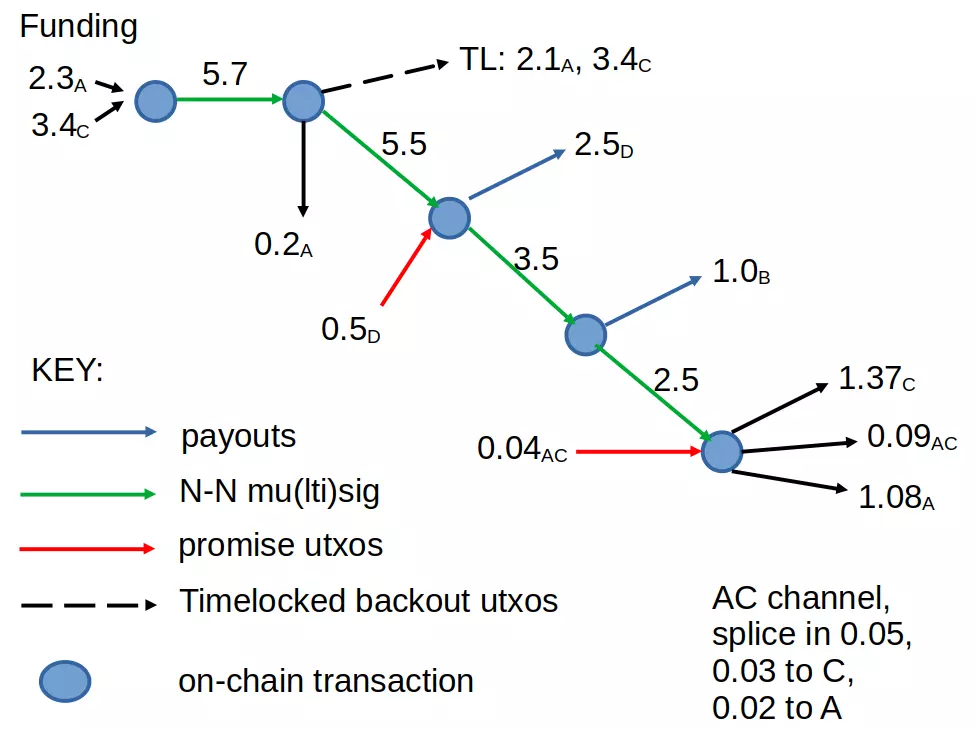
Please explain how covenants help solve scalability. I’m wondering how these proposals address the uncertainty of fees.
It seems to me that restricting payments to a particular address assumes that the transaction can be actually made or that fees are negligible.
With fees growing, would it be possible for the payment to be uneconomical? And even if the payment is made, the actual amount received may be less than expected?
“I think Americans are used to seeing people arrested for bullshit technicalities and thrown in jail for long periods of time. But in the rest of the world, it is quite uncommon. For a non-US Bitcoin entrepreneur, the US is a scary and dangerous place. American authorities seem resourceful, competent, and motivated to destroy your life just to prove a point. This line of thinking is not paranoia, nor is it cowardice.” 🤔
This has a ring of truth to it. 🇺🇸 now a police state? nostr:note1npsllunn4wnt3dpaagk4435pp85ptpqxefjgz5q3vh5l8thm8zwqmxhsd3
I just watched MicroStrategy’s launch video of their new Orange ID platform and honestly I don’t get it.
As Saylor has previously pointed out, bitcoin has value partly because of its tie to the real physical world through its proof of work process. Its link to the real world is what makes it relevant.
But consider those IDs that Orange will issue. What links them to the real world? Who or what verifies that the ID that says it’s from me was actually created by me? Anyone could write in my name and publish it to the blockchain. Where’s the link to the real world?
Presumably he would need some central registry 🤮 or some web of trust 🤷♂️ to complete the picture but that wasn’t mentioned. I’m confused.
Finally some good news
FYI, if you ever decide to get a green card you should delay that as long as possible.
Green card holders become taxed like citizens after holding a green card in eight calendar years.
Once you cross that milestone you must pay that expatriation tax like Ver. But if you surrender your green card before the milestone, then no exit tax.
https://www.justice.gov/opa/pr/early-bitcoin-investor-charged-tax-fraud
It looks to me that the allegations are that Ver sold $240 million worth of bitcoin in November 2017, during the blocksize war.
If he used those proceeds to buy bcash (created in Aug 2017) then he’s down ~70% on that amount.
It really hurts when the tax bill on the sale is about the same as the amount you have left. 😬

Yes, it seems likely that lightning will just be used by large custodians and federations. We, the plebs, will be using some sort of federated ecash.
I guess, technically, most of us have never used non-custodial lightning. Primal is one of the most popular nostr clients and it’s custodial.
Lightning is easy when it’s custodial. On Mutiny right now, there is a large setup fee to open the channel. But when you use a federation, there are no setup fees. Foreshadowing the future, I think.