

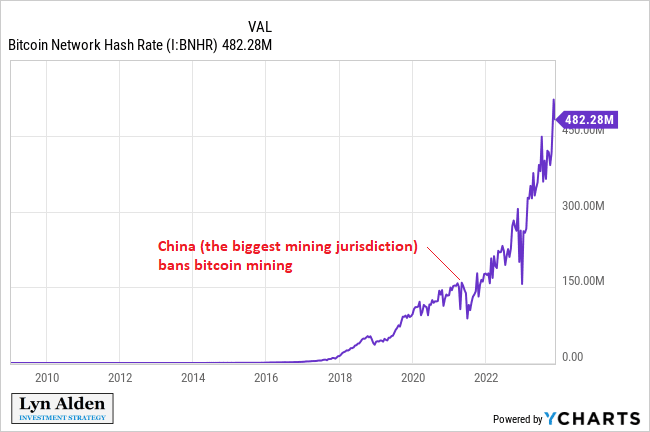
The most hope-inspiring part is that there's still a good deal of hashrate over there. That people find ways around the ban and manage not getting caught. I live in Sweden and I suspect that the EU will crack down hard on all kinds of freedom tech, given that they have just passed a bill that will give all EU citizens "the possibility" of a digital ID (eIDAS), which isn't too hard to imagine will slowly morph into a requirement, and at the same time require browsers to implement bad security, possibly backdoors, (QWACs), and are in the process of discussing mandating client-side scanning "against CSAM" (Chat Control 2), which will no doubt expand to anything and everything they don't like if passed.
I think I will have to begin this note with a disclaimer: It is not intended to disseminate FUD, but as legitimate questions that I want answers to.
If the suspected false-flag / allowed-it-to-happen cyberattack(s), and following legislative attacks on internet freedom and privacy comes to pass, what can we do? (primarily we need to prevent the latter of course, but if that fails, given the stupidity, ignorance, and lack of desire for freedom in most people, and the propaganda storm that such an attack would use)
If sites like X-Twitter, Reddit, etcetera will be required to KYC their users and/or heavily censor content (more than they already do), I assume Nostr will still work, and if no changes to the internet infrastructure itself is made, Bitcoin will of course still work.
But for example if:
-Backdoors are forced into operating systems, and any hosting of FOSS OS:es without them is made illegal. (Remember that only a very small minority can edit the backdoor away and compile, even if it's FOSS.)
-Same as above, but for web browsers. Maybe enforced by a mandate for some kind of DRM on all websites.
-Nostr clients gets under attack in one way or the other.
-Extensive surveillance and censorship is forced on the ISP:s, blocking all non-approved connections and/or reporting people trying to make such connections to the authorities.
-Other attacks along these lines, that you can think of.

Feel happy about the fact that my "fan heater", in fiat terms, will have paid for its own power, with a pretty good margin. Not selling the sats to pay the power bill though, using fiat for that and keeping the sats.

A radio. Software Defined Radio, pretty cool technology. And CQ, that's coming from the chimney, is a code used with Morse code, I think it's when looking for someone to chat with on the air, if I remember correctly. When listening to HAM bands, you often hear the Morse code translating to "CQ CQ DE ******", where DE means "from" and ****** is the code for the individual HAM operator calling.
I have a RTL-SDR, a cheap, receive-only SDR that only cost about €/$20, at least when I bought it a few years ago, but, together with a computer and a suitable antenna, which can be made from a wire of suitable length depending on what frequency you want the best reception at, can receive all kinds of signals, including several HAM bands, regular FM and AM radio, wireless devices like thermometers and remote switches, etc. Fun for many hours/days/weeks/months/years depending on the user.

Sorry for the late reply to this, but just a small warning: If the fan stops due to ingress of foreign objects, a seized bearing, etc. or doesn't start due to a bad capacitor, it will still draw power (even more than when running). If it's thermally protected, it will stop drawing power after several minutes, and then do so intermittently, if it's impedance protected, it will keep drawing power indefinitely. Even in the first case, it's probably enough time for things to go wrong if the fire safety would hinge on that contactor, which it of course doesn't, given the temperature sensor, and probably internal protection in the miner, but still worth to keep in mind.

Well, that alone wouldn't be as big a problem as complete surveillance and control, but they are not mutually exclusive...

Technology Connections on Youtube has a video about induction stoves if you want to learn more.
Probably. Those do glow red hot. Try turning it on from cold, when it hasn't been used in a while. If it radiates heat from the plate, it's ceramic. If it's induction, it won't create heat without a pot or pan on it, induction uses an alternating magnetic field to heat the pot or pan itself, without heating the plate first.
Worried about the dystopian future, as I often am. I don't have many options, and even though I have bitcoin, I don't have the conviction that it will fix "everything", as is often said. Primarily because of three reasons. That the internet will be monitored and locked down at the ISP level to squash it together with Nostr and other freedom technologies, that even if it "succeeds", it will be in a compliant way with KYC/AML, E-ID:s, etcetera on every step of the way of every way of using it, and that even if it succeeds properly eventually, it won't be until all now living people have spent the rest of our lives either in technological surveillance prison or in actual prison for trying to avoid it.
An induction plate shouldn't glow red, is it really induction? Or have they styled it with red LED:s?
Could it be a US/Europe thing with the electricity? (I don't know where you live) Or do you mean the controls? Mine has 3x16A 230/400V in, typical for stoves in Sweden, though it uses one phase for each half of the stovetop (2 cooking zones per phase), and the third for the oven. I just tried boiling half a liter of water on boost mode, 2,8kW, boiled in less than 1m30s.
Controls are a bit wonky sometimes though, seems like the people who made the firmware didn't really think it through.

Piracy doesn't pose a major risk of them losing control though. If it's ineffective at first, they might first increase the sentences gradually, and arrest high profile targets at first, making sure there's "correctly" biased media coverage. If even life in prison doesn't deter, they might mandate ISP:s to scan and report traffic that looks like Bitcoin - cost is not an issue, they'll either put it on the customers or all taxpayers/fiat holders - or mandate operating systems to scan for it, and ban hosting of FOSS OS downloads without it, this maybe also together with mandating some kind of encryption scheme with the ISP:s that blocks all Internet traffic unless the user is logged in with their E-ID - there's probably a reason for all the "client side scanning" bullshit. If all that fails, after several years of course, they might even restrict internet access altogether to a "need to use" basis for the open internet, building some kind of intranet that only allows approved services for the people. Nothing is above them when everything is at stake. And they will make sure with propaganda that the regular people are with them emotionally against the "money laundering terrorists", if necessary including a few false-flags, and that the measures are a necessary thing, much like airport security theater, gun control outside the US, KYC practices, etcetera, are viewed today.
They can print trillions for the purposes if they want.
But I'm of course just a pessimist, or maybe even a paid shitcoin or fiat shill... Bitcoin is inevitable... That's the standard reply in Bitcoin circles when you're pointing out future problems visible from a mile away...

Thanks. As long as you know it's true, and not just smiling on the outside and shriveling up inside. (Been there way too many times myself, regarding far less extreme things...)
And again thanks for the answer: I hadn't expected such a positive response, from the source, but rather random people racking down on me for "not being able to handle a joke", being "weak" or similar.
Someone once said: "listen to mainstream media when they talk about something you know a lot about, and notice how much is wrong. Is it hard to imagine that those errors extend into every field?".
Almost every time Swedish media talks about the power grid, they get something wrong, often several things. Often simple errors, but also often in a predictable manner, such as ignoring that energy produced on sunny and windy days can't be stored for other times, at least not without extreme amounts of money being "invested" in batteries which relatively quickly degrade.
This was a few years ago, and I think the opinions on nuclear are in the process of turning positive, but then and now Sweden has about 50/50 nuclear and hydro, with a growing few % intermittents on top. Electricity prices are already very low, sometimes negative, on sunny and windy days, making more of solar and wind unprofitable. It's of course expensive on cloudy, windless days though.
I continue to view nostr:npub1a3hrd4wfawr578d5y5l0qgmh7lx8q6tumfq0h7eymmttt52veexqkcfg37 as one of the best podcasts out there. And probably the best podcast relative to its size.
They spent a whole episode talking about risks, which is important.
https://youtu.be/jzF6jg7d7-I?si=AObmQkcmU8iqkpJ-
Some podcasts speak to an echo chamber and reinforce their own views. Dan and Josh from Blue Collar Bitcoin are always reaching to challenge themselves and their audience.
As much as I like Austrian economic theory, what I really love is good money *winning in the field*. I love to see practical discussions about good money from people around the world who aren’t in the primary business of talking about money. They end up doing it more interestingly than most monetary theorists.
They have some good Bitcoin content, not least their Basics series, and I don't mind their rough language etcetera, but they lost me as a listener the other day when they, in addition to similar things earlier, described their plan to trick a colleague who was getting married that the firehouse had a swingers club, and goad him into wanting to go... Sure, I have no clue about their personalities, and cultures differ, but in my opinion, people trying to shame their colleagues are not people whose ads I want to listen to. (I would almost consider suicide if I was tricked like that and fell for it, and definitely quit the job instantly even if I didn't, I wouldn't want to work with such people)
Iris.to (web) WAS my favorite, but it seems to be getting worse and worse. Still haven't found a good alternative, though I haven't had time to look lately.
BlackRock wants to launch bitcoin ETF/trust: https://odysee.com/@TraderUniversity:a/blackrock's-big-bitcoin-bet:d
Probably very good for BTC value, but someone in the comments posted a picture of something: BlackRock gets to choose which fork it will use for its product if Bitcoin hardforks. Obvious and normal I assume, everyone would need to choose (or not choose = choose to hold both) I guess, but given that this product has the potential of becoming huge, wouldn't it give BlackRock a big influence on which fork will be the most valuable? The conspiracy theorist in me says that's their plan, and they will actively choose (maybe even create) a non-censorship-resistant etc. fork, and people who own bitcoin but don't know the reasons for Bitcoin's existence just go with it. I don't know enough to figure out if there's any risk whatsoever, or how big, of this happening, intentional or not. Feedback from someone who knows this field would be appreciated. (I don't even know exactly what an ETF or a trust is, although the discussion gives hints.)
My guesses: Energy in general 25%, if people start calling for more/cheaper fossil fuels, 75%. Inflation, if it gets significantly higher than today and especially if many more people start realizing what's causing it, 95%.
However, the likelihood of armies of AI bots, deployed by the usual suspects, debating and "debunking" people's opinions and actual facts, I find at 97% with today's levels of the phenomena and people's understanding thereof, approaching 100 with increasing problems and understanding.

“Scaling and anonymizing Bitcoin at layer 1 with client-side validation” - our new proposal, also sent to bitcoin-dev mail list.
https://github.com/LNP-BP/layer1
“We propose a way to upgrade Bitcoin layer 1 (blockchain/timechain) without a required softfork. The upgrade leverages properties of client-side validation, can be gradual, has a permissionless deployment option (i.e. not requiring majority support or miner cooperation) and will have the scalability sufficient to host billions of transactions per second. It also offers higher privacy (absence of publically available ledger, transaction graphs, addresses, keys, signatures) and bounded Turing-complete programmability with a rich state provided by RGB or another client-side-validated smart contract system.”
How would this affect miner profitability, and thereby security, long-term, if as you say on-chain would be dead, long term? The BTC value would have to rise quite a bit over the coming century for it to be profitable to have even today's levels of mining on one or a few UTXOs from this system, with block subsidies going towards and eventually to zero.
Not saying it's unsolvable, guaranteed to be a problem, or anything, just wondering.