




Indeed. And the prime culprit, at least what I believe, flicker, is back with the PWM control of LED:s. We had a while with cold cathode fluorescent tubes as backlights, which had less flicker, but now with LED:s, it's back at 100% modulation, except in a few monitors which control the current instead. I don't know what technology these goggles use (LED backlit LCD, OLED, etc.), but it's pretty likely that they too flicker.

Depends on if the picture is from a country where they drive on the left or right side.
I have had this anger, not least regarding privacy, for at least 16 years (FRA law, Swedish surveillance law, in 2008 IIRC). It has largely turned into sadness and partially to self-criticism/wondering if I'm the problem, since very few seem to be on my "frequency" in these thoughts. (Extremely few seem to think that the growing panopticon is as dangerous as I think it is, or attempt to do anything whatsoever to put brakes on the way things are going. Many, like what you're talking about, want it. "against the gang violence" etc.)
My childhood didn't help, as any anger on my part was never explored and usually discouraged to punished to varying degrees by my mother. Sorry if TMI, just want you to know where I'm coming from.
(I strongly doubt all this is healthy for me in the long run.)
I definitely see the benefits of these technologies, and I'm fully with you that they are needed, but I'm still worried about the future of free communication. I don't know if I'm missing some point, since everyone seems so convinced about these things, I hope you or someone else can clarify on the technical details:
1: ChatControl. This is on the table in the EU, may be approved in October if I understand it correctly, and means that either chat apps/services or operating systems, maybe both, are required to have client-side scanning. Will it be possible for a non-programmer to download software (OS) and use a web client/download a client (depending on circumstances and which of the technologies it's about), that's not compromised, and will it be possible to have a reasonable certainty that such is the case? Can't be sure unless you can check the code of course, but reasonably.
2: ISP:s. What prevents government from mandating ISP:s to block all encrypted traffic, unless it for example is going to whitelisted servers, or is signed by approved apps?
3: Extreme measures. Using a printing press was once punishable by death. Printing presses are physical objects without an online footprint, and this was in an era way before cameras and microphones existed, and today they are, obviously, legal. However, what prevents government from using a crisis and the media to condition people, and let ISP:s or other internet system actors, or intelligence agencies, look for traces of these tools being used, maybe even holding each subscriber accountable for what happens on their connection regardless who uses it, and put a few users of these technologies in prison for a long time, and use the mainstream media to make examples out of them?
Don't get me wrong: a world with these tools you mention is better than a world without them. What I wonder is whether it will be enough. If this battle is lost, these freedoms may very well be lost forever. Yet "bitcoiners" (TM) act like success is 100% certain. If I'm not wrong on all these points and more, and I hope I am, that stance is either dishonest or uninformed, and I dislike people of the former, and want the latter to learn. After all, the same people say that "bitcoin is truth".

The problem with this reasoning is that it only works in large numbers, particularly it doesn't work as long as the police, the tax agency workers, etc, aren't among those whose attention is lost.
A single person would end up with their fiat assets frozen/confiscated and/or in prison.

Has anyone done this yet? In that case, what was the reply, if any?
A properly designed device can't cause a battery fire with software alone, it would have to be hardware modified. Any EE worth their salt would know to incorporate a physical protection circuit, such as a DW01 with the two accompanying MOSFETs, into any li-ion cell powered device that can have a failure mode that overloads the battery.
Not saying that every EE is worth their salt though, especially regarding things bought online in places like Ebay, Temu, etc.
The Swedish page has nothing to do with this. It's about a Gothenburg politician losing his position because he supports some terrorist classed Palestinian group.
HUNGARY PROPOSED MESSENGER PROVIDERS FOR TIGHT SURVEILLANCE
Following the pressure of privacy & human rights activists the Hungarian Presidency claimed to do "a compromise". In practice the upcoming #ChatControl regulation will require from messenger providers "to do their utmost to contribute to the development of reliable and accurate technologies to detect new CSAM and grooming."
It means more tight surveillance, including indiscriminate mass monitoring of private communications and the end of secure end-to-end encryption. https://emanuelkarlsten.se/wp-content/uploads/2024/09/240829-CRPII-4-september-st12319.en24.pdf
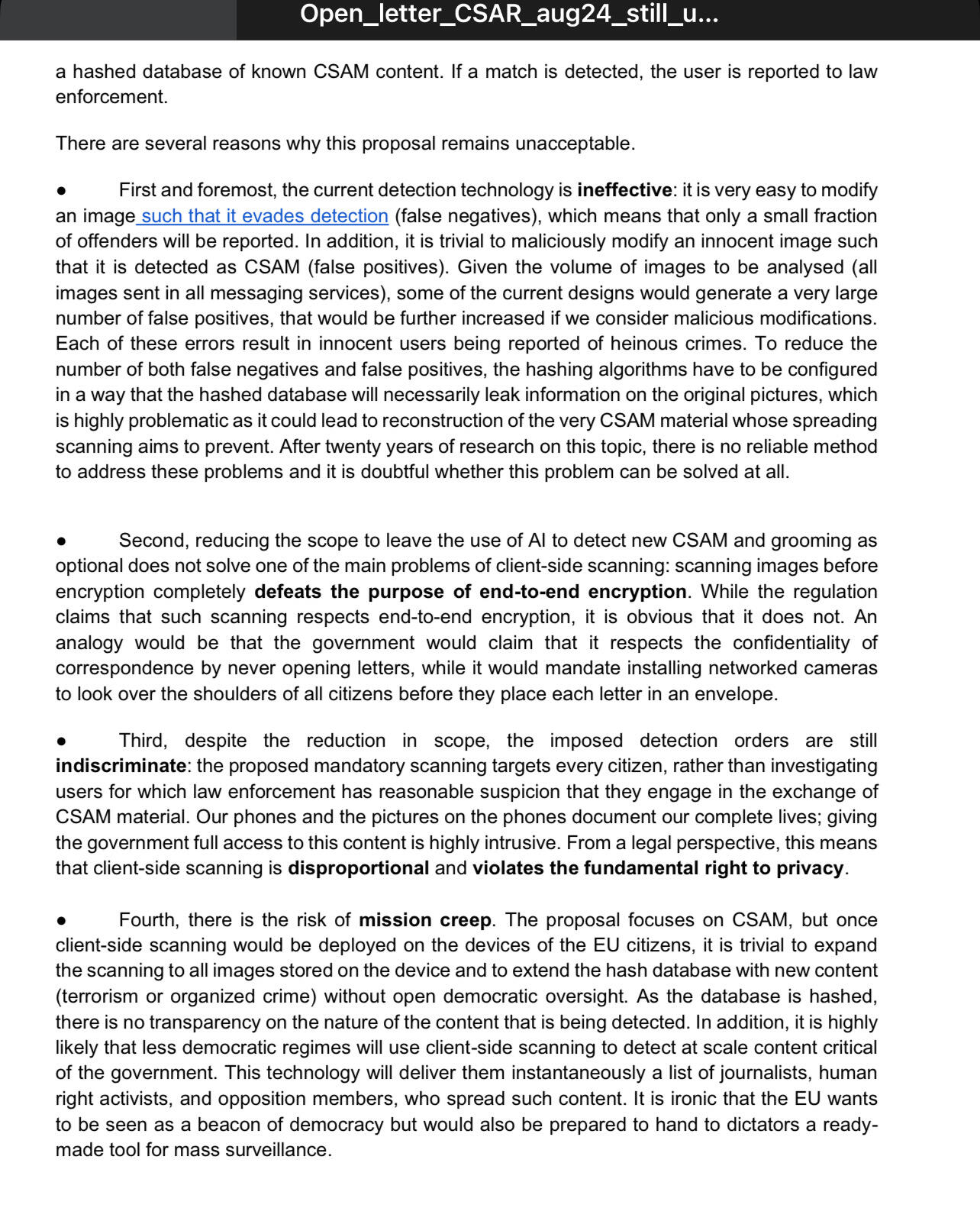
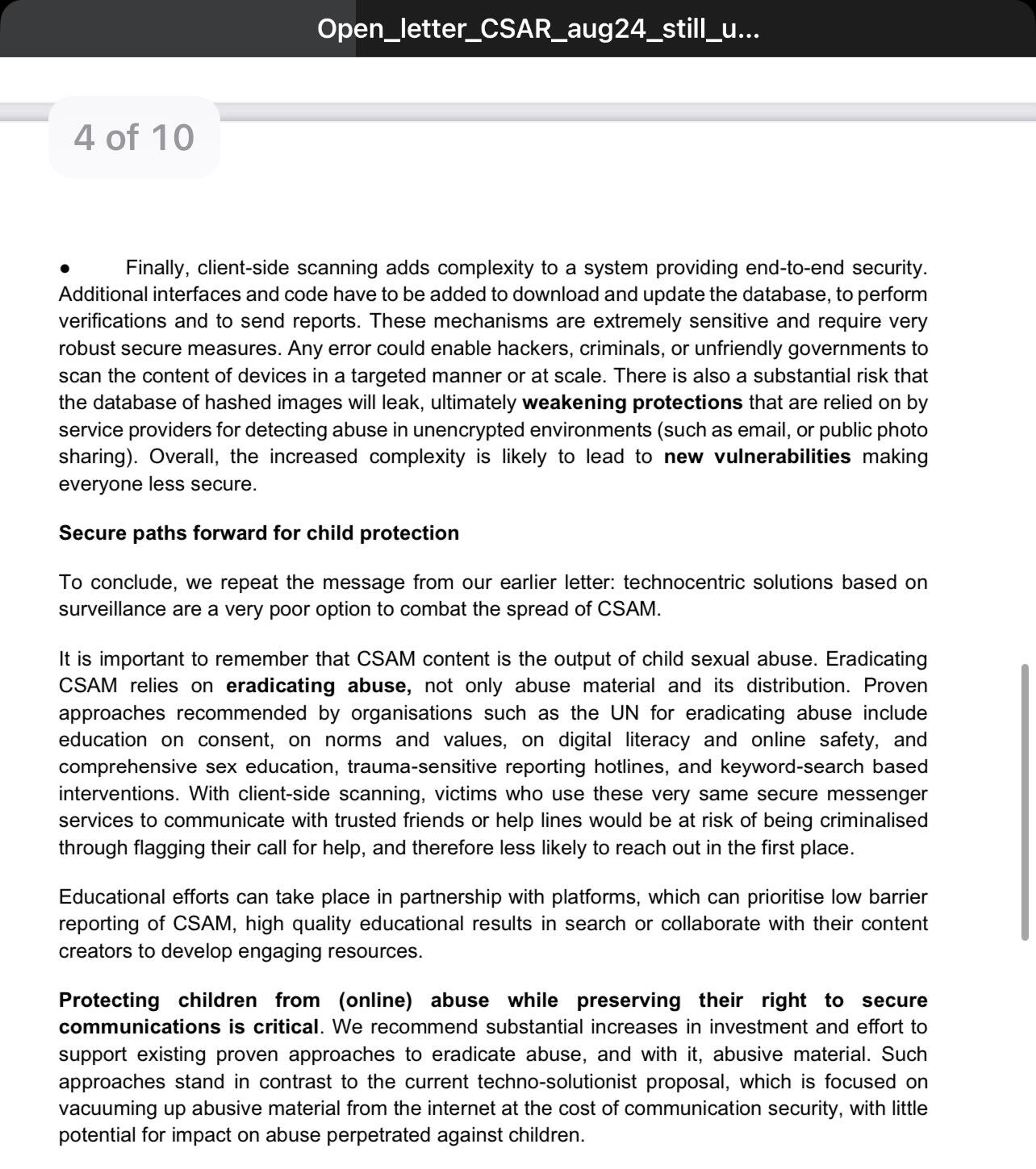
In response to this proposal, over 245 scientists from 31 countries evaluated #ChatControl draft as ‘ineffective, false positives, defeats end-to-end encryption, disproportionate, violates right to privacy, new vulnerabilities’. https://homes.esat.kuleuven.be/~preneel/Open_letter_CSAR_aug24_still_unacceptable.pdf
1️⃣ What you can do now:
🔻Call your goverment and deputies to reject alltogether Chat Control. Find contacts here: https://op.europa.eu/en/web/who-is-who/organization/-/organization/COREPER/
🔻Support politicians like @echo_pbreyer who promote privacy!
🔻Explain why it won’t help in bringing security for our society. Opposite, such approach would put the future of our freedoms is just one step closer to be compromised and abused by dictators.
🔻Address your government before the next meeting on 2nd Oct.:
🔴SUPPORT Chat Control: Bulgaria, Croatia, Cyprus, Denmark, Finland, Hungary, Ireland, Greece, Latvia, Lithuania, Malta, Romania, Slovakia, Spain, Sweden
🟢AGAINST Chat Control: Austria, Belgium, Czech Republic, Estonia, Germany, Luxembourg, Poland, Slovenia
🟡 UNDECIDED (we need to activate them the most!): Italy, Netherlands, Portugal
🎙Respost and call you friends to join the campaign today: If no privacy of communication, no protection for children, anyone in the EU and beyond!
2️⃣Rember and explain:
🔻No algorithm can reliably make a legal assessment. According to Meta, which is the source of the vast majority of reports, they currently only look for known CSAM in EU communications, and yet at least 50% NCMEC of reports made to German law enforcement agencies are not criminally relevant, according to the federal crime agency (BKA).
🔻EU Commissioner #Johansson admitted in late 2023 that 75% of NCMEC reports are not of a quality that the police can work with.
3️⃣ Dictators love Western spy technology: the example of the Intellexa spy company proved: dictators all over the world love Western spy technology for transnational repression of opponents and destruction of the Western world, your and your family freedoms. Urge your government to stop this! https://www.woz.ch/2439/predator-files/die-schweiz-als-drehscheibe/!NN0B9QYP1H7V 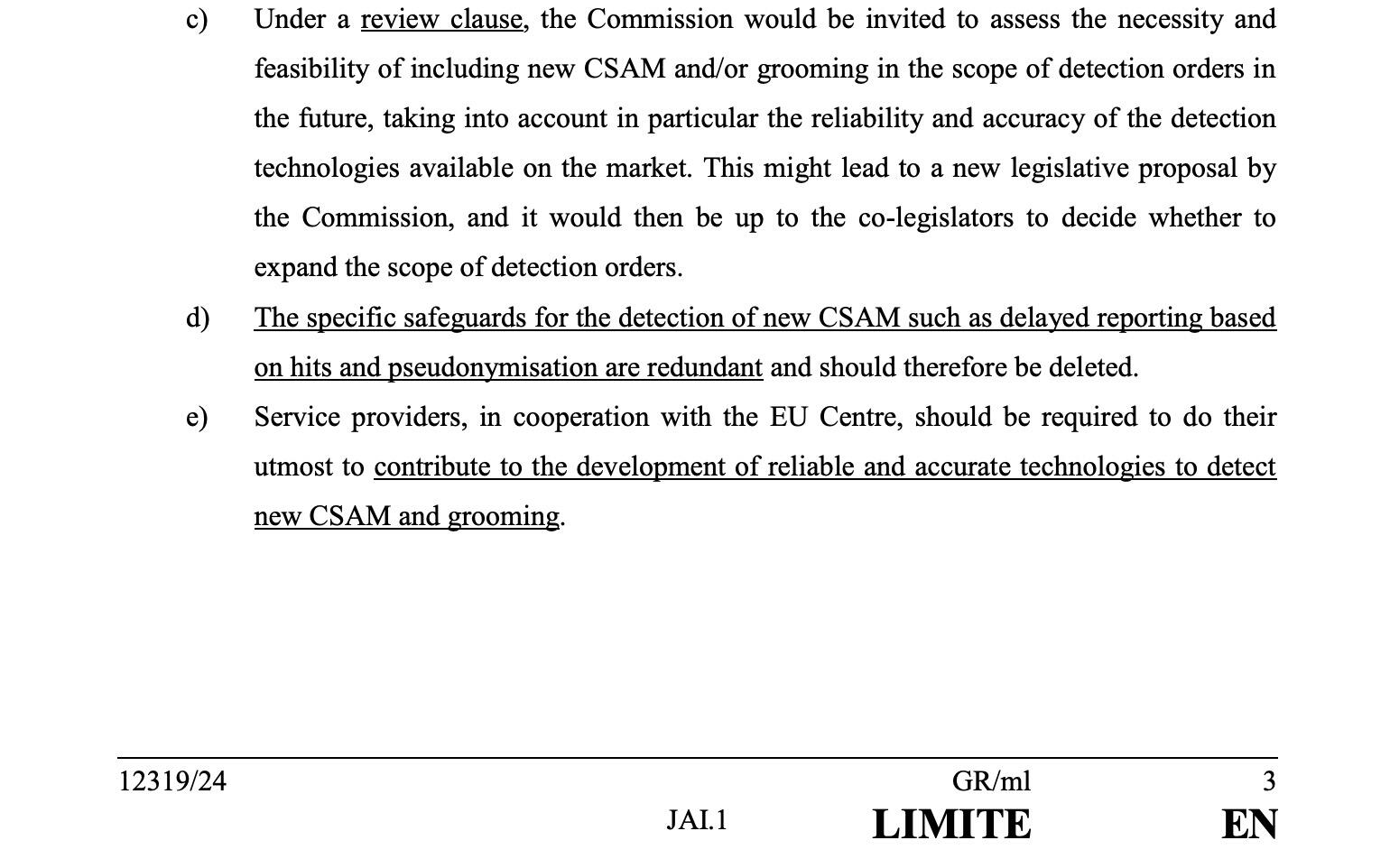
This has to be coming from above somehow, some organization that somehow blackmails the politicians and perhaps even the media directly. So many, including the people with fancy titles that you mention, who have already contacted the politicians and they are still at it.
I live in Sweden, and I think the Swedish mainstream media have mentioned it once - a short general overview with focus that it's "against child abuse material". No discussion of the implications on privacy, cybersecurity, risk of slippery slope, anything like that. I don't consume a huge amount of mainstream media, sure, but a reasonable coverage of this would be at about the same level as that of the wars in Ukraine and the Middle East. Which is pretty much daily news on at least one of the two.

You can legally listen without a license in most places (IIRC, not in UK). An RTL SDR is a cheap device that can receive a lot of radio transmissions, including HAM bands.

No license or anything like that, but I have an RTL SDR that I listen to HAM bands with sometimes.

Were the throttles sensed by [resolvers](https://en.wikipedia.org/wiki/Resolver_(electrical))? Two waves, their amplitudes* corresponding to mathematical sine and cosine of the mechanical position.
*Positive and negative, shifting "polarity" (or phase 180 degrees) when passing the zero point.
Haven't been on here for a while, sorry for late reply.
Maybe. But how about removing those systems and letting people keep their money regardless, so that those who want four kids can afford it, reducing their stress over money and giving them time to take care of them, while removing all pressure on those who want fewer or none (especially for the reason of knowing their own limitations) to have more for economic reasons? #LibertarianDreaming...
I'd say it'd increase the amount of bad parenting if the incentive to have more (or any) children is for economical reasons, and not that you want to out of love for them. Even partially I think it would be true.

I doubt a CBDC would be necessary here. You know how the Swedish system works. The ones in power, whether official power or (usually) not, hints at something being necessary and the right thing to do, and the media immediately takes their side, and every company bends over backwards in a competition of unnecessarily exaggerated compliance, putting up signs bragging about it.
Add a nearly cashless society, where almost everyone has digital ID in the form of Bank-ID (and you are generally looked at as the sole cause of your problems if you don't want to conform to this), and it wouldn't be any problem whatsoever to introduce limits and blocks on who can buy how much of what, if they decided to. Most people (especially in the big cities) would probably think it's great too, at least if it's portrayed as being for the climate.
If it wasn't for the fact that most TV and radio speakers can't reproduce such frequencies, they could possibly have been using [https://en.wikipedia.org/wiki/Infrasound#Human_reactions](infrasound) for a real-life counterpart. Sometimes it's good that technology isn't perfect...
That link didn't turn out well... Trying again: [Infrasound](https://en.wikipedia.org/wiki/Infrasound#Human_reactions)
TIL about fnords… and it’s a pretty cool idea. Now I have another book trilogy to add to my neverending list 😆
https://en.m.wikipedia.org/wiki/Fnord nostr:note10ut6l8equglagzph292jaswtpef646sd6nl6tlkwc9hgyx8tvk7sa4mxv2
If it wasn't for the fact that most TV and radio speakers can't reproduce such frequencies, they could possibly have been using [https://en.wikipedia.org/wiki/Infrasound#Human_reactions](infrasound) for a real-life counterpart. Sometimes it's good that technology isn't perfect...

All the ones I listed are browser based - should work on a Mac too. Addresses:
satellite.earth
iris.to
coracle.social
It seems to depend on the client too. This was a while ago, so it may have been fixed, but I noticed that two different clients, despite having the same relay list, was different in what they showed - one of them only showed some of the notes of the people I followed, while the other showed, as far as I know, all of them. I think it was Coracle that didn't show all, and Iris that did, but I'm not 100% certain. Currently I'm using Satellite, as Iris became worse over time and eventually stopped working in my browser. I haven't tried it for a few months.