
There some interesting stuff in the Cambridge Centre for Alternative Finance, Cambridge Judge Business School's article about the Bitcoin Electricity Consumption Index (CBECI)...
🔍 What's New?
The Center has recently updated its methodology for estimating Bitcoin's electricity consumption, introducing more precise metrics and assumptions. It looks like the changes aim to enhance the accuracy and reliability of the CBECI.
1️⃣ Past Estimates Revised: The updated methodology was applied retroactively, showing a significant adjustment in the 2021 figure from 104.0 TWh to 89.0 TWh, and a less pronounced but noteworthy difference in 2022 and 2023.
2️⃣ Efficiency Reassessed: The paper now takes into account the release dates and weights each considered mining hardware accordingly. The new estimates are better aligned with real-world efficiencies, hopefully improving the model's accuracy.
3️⃣ Future Outlook: The study acknowledges that Bitcoin's electricity consumption is elusive and depends on various factors, including geography and the type of energy sources used. Future research aims to provide a more nuanced view of Bitcoin's electricity mix.
====================
Some stuff that will probably cause (errr...) conversation 😁
📉 Significant Downward Revision of 2021 Electricity Consumption: From 104.0 TWh to 89.0 TWh.
🌍 Implications for Public Perception: Could be seen as softening Bitcoin's criticized environmental impact.
🏛️ Policy Impact: Could affect regulations and investment strategies related to Bitcoin's environmental sustainability.
====================
And some optimistic outlook as well! 😁
🌿 Potential Green Practices: Discusses mitigating methane emissions and other novel concepts like waste-heat recovery, which could make Bitcoin mining more sustainable.
🛠️ Model Improvement: Enhanced methodology to include weighting older, less efficient mining hardware differently, making the estimates more reliable.
🌐 ❓ Expansion Beyond Bitcoin: There are plans to augment the Cambridge Blockchain Network Sustainability Index with Ethereum's pre-Merge and post-Merge greenhouse gas emissions and cover more blockchain networks, indicating a more comprehensive look at the industry's environmental impact as a whole.
Perhaps a final point..?
🔁 Continuous Improvement: I know not everyone will agree, but Cambridge updating their model and data doesn't necessarily suggest that previous estimates were fundamentally flawed but rather, as with all academic work, it's a natural part of the ongoing process of refining and enhancing research. Personally I'd rather applaud the academic rigor and transparency shown.
Thanks to nostr:npub1837u93v8am8q2rauvkqfk9sf6xfq07p9m4m82jueqh5u4qzkg25qesqrr4 for posting the article!
https://www.jbs.cam.ac.uk/2023/bitcoin-electricity-consumption/

Yeah, the shifting narrative is important!
I think the shift will continue towards sanity and reasonableness now that so much of the crypto-shitcoin-bs-bubble has started to subside and fade. It should create more space for honest conversation around Bitcoin, without it being lumped in with all the other fad-crap.
It is definitely looking up.
Turns out the claim "Bitcoin energy usage is comparable to the global energy use of tumble dryers" is wrong. It's comparable to tumble dryers in the US. Source: Cambridge
Cambridge revised down Bitcoin energy estimates. I quote Daniel Batten:
"Key points:
1. CCAF model overestimated by 16.8% in 2021, and 10.2% in 2022. This is in alignment with my previous research where I suggested earlier this year that their model was overestimating by 20.6% https://batcoinz.com/improving-our-estimate-of-bitcoin-energy-consumption/…
2. Clear evidence that GreenpeaceUSA's claim that Bitcoin used "as much energy as Sweden" was incorrect, and was based on CCAF historical overstatements
3. CCAF says explicitly that based on new estimates: Bitcoin energy use is "comparable to ... tumble dryers in the US"
4. CCAF has not yet revised its emissions estimates beyond the direct impact of revised energy consumption.
5. They are still overestimating emissions by 67.6% due to emission intensity calculations that are both overestimated, and out-of-date (have not been updated since Jan 2022). This is an improvement upon the previous estimates which were out 106% (https://batcoinz.com/accurately-dynamically-calculating-bitcoin-network-emissions/…)
6. Re: 5 above, CCAF acknowledges: "Emerging concepts we have yet to consider but could reasonably be expected to lower our emission estimates include the potential to mitigate methane emissions by mining operations collocating next to oil fields and utilizing otherwise flared natural gas, using and subsequently sealing orphaned gas wells, and mitigating methane emissions from landfills, but also extend to other novel concepts such as waste-heat recovery.
7. While there is still much work to do on the emissions estimate side, CCAF should be praised for updating their model, which is now very much in line with what those with up-to-date industry data such as Luxor, Marathon, Blockware, Coinmetrics, the Bitcoin Mining council and I have been using for some time. They also deserve praise for their transparency about historical overestimations, and transparency about the factors not yet considered that could "reasonably be expected to lower our emission estimates". I agree: 57 M t CO2e/year will reduce to a figure more like my model which says 34 Mt CO2e/year once the impact of off-grid miners and methane mitigation is factored in.
8. Key details from the CCAF report Full report: https://jbs.cam.ac.uk/2023/bitcoin-electricity-consumption/
"The backbone of our previous CBECI methodology was the assumption that every profitable hardware model released less than 5 years ago equally fuelled the total network hashrate. This, however, led to a disproportionally large number of older devices compared to newer ones in our assumed hardware distribution"
…we decided to thoroughly re-examine the ASIC mining hardware distribution generated by our previous CBECI model and cross-check the results against other metrics from publicly available data. We found that more recently released equipment appeared to be underrepresented, and equipment nearing the end of its lifecycle was overrepresented.
…we will explore the consequences of these changes when applied retroactively. The first and most noticeable discrepancy appears in 2021, where our previous CBECI model estimated an electricity consumption of 104.0 TWh, 15.0 TWh higher than the revised model estimate (89.0 TWh). The 2022 estimate was adjusted downward by 9.8 TWh, from 105.3 TWh to 95.5 TWh. To put this in perspective, the revised figure is comparable to the electricity consumption of countries like Belgium (83 TWh) or the Netherlands (113 TWh), [31] the energy use of tumble dryers in the US (108 TWh)
Emerging concepts we have yet to consider but could reasonably be expected to lower our emission estimates include the potential to mitigate methane emissions by mining operations collocating next to oil fields and utilizing otherwise flared natural gas, [32] using and subsequently sealing orphaned gas wells, [33] and mitigating methane emissions from landfills, [34] but also extend to other novel concepts such as waste-heat recovery. [35]"
Source: https://www.jbs.cam.ac.uk/2023/bitcoin-electricity-consumption/
& Daniel Batten (Twitter)
Narrative is shifting!
#zapathon #bitcoin #plebchain #grownostr #zap #memes #pleb #bitcoinenergyfud 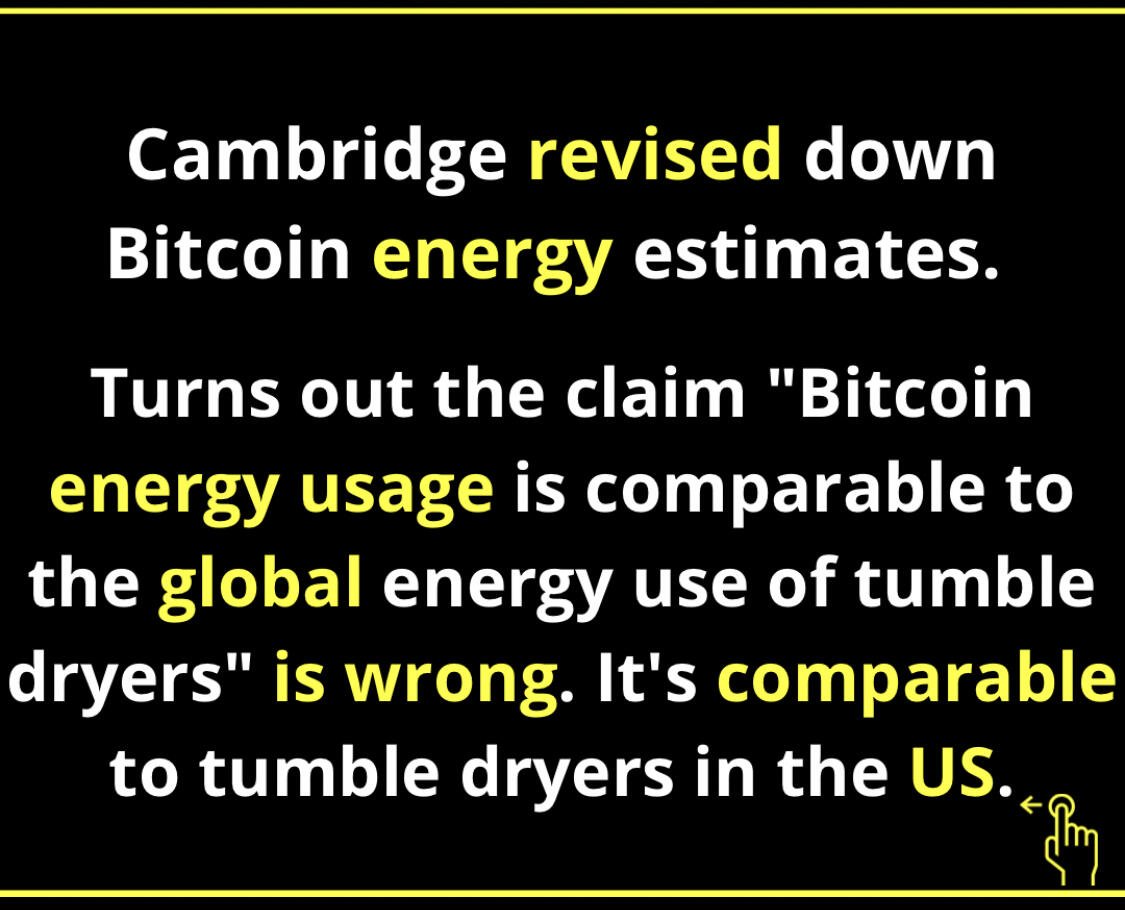
Amazing overview - thanks you Felipe!
I believe that it is a good thing that revisions like this are published by academic institutions, albeit that their initial overestimation was likely fueled by the "outrage economy" and an institutional imperative to stay relevant at all costs, and to remain part of the conversation.


Delicious.li ??? 😁

🫣

⚡️ I constantly hear how bad the #LightningNetwork is and that it can't do more.
Yet, I know from speaking to great builders at #bh2023 that there is so much more to this, and we're just at the beginning of an exciting new wave of applications!
We should embrace Lightning more and use it as a streaming tool! More in my latest blog.
https://blog.joelkailenz.com/p/streaming-value-over-the-internet
Agree! Embracing the #lightningnetwork more will drive adoption... it is still very early days!

GM #plebchain, #coffeechain, and people of the #freedomtech world.
Today, lets get it done, stay humble, learn, and stack sats.
Here is a coffee thought.
☕️⚡️Kaizen in the now
Kaizen (Japanese term for 'change for better') means continuous improvement as an approach. Pressure to reach disruptive leaps makes it easy to underestimate the cumulative power of small, daily improvements. They add up.

Good evening, #nostr #plebchain and #freedomtech people of the world <3


For those mornings where one cup is just not enough :D
GM world
#nostr #plebchain #coffeechain


Yo amo esta ciudad #cdmx
https://nostr.build/av/6eedd0a883c3be1fdb43f8e45106d0d457b9ed4debb0200b2b2f7a731e014239.mp4

Haha the early start of SMS spam in South Africa

Isn't getting a security like this regulated super difficult as well though? 🤔

I read nostr:npub18yvpnchj7yaepjk8yz2pn66hfmmup505aqvx0lpyc3aree0g5fyq8clpz3's article this morning, and had the same thought about the leagal vehicle 🤔 Problem with Tokenized security would be all the SEC flags again, right?
They have a marketing problem... BRICSAEEISU doesn't have quite the same ring to it 😉