So my main takeaway from this discussion is that nostr:npub1lh273a4wpkup00stw8dzqjvvrqrfdrv2v3v4t8pynuezlfe5vjnsnaa9nk nostr:npub1lh273a4wpkup00stw8dzqjvvrqrfdrv2v3v4t8pynuezlfe5vjnsnaa9nk sees a legal and/or moral difference between data in OP_RETURNs and data in (say) Inscriptions.

*Even if* it’s the exact same data!

(The argument, to the best of my understanding, is that data in OP_RETURNs is “sanctioned” *as data* by Bitcoin Core now that the policy limit is lifted— whereas data in Inscriptions can only be “misinterpreted” as data.)

It does make me wonder how many people in the Knots camp actually understand that this is the level of nuance they are ultimately fighting over. (It seemed that even nostr:npub1wnlu28xrq9gv77dkevck6ws4euej4v568rlvn66gf2c428tdrptqq3n3wr kind of learned this live as they were recording…)

nostr:note19udfg096zlzxjsz6tlunq9hksjtzqfcqrgpeelgw8qc97wdht75s6fxcnp

Reply to this note

Please Login to reply.

Discussion

gotta give this a listen, that seems like an important nuance

I was pretty surprised to hear that argument, too, as I hadn't heard it before. There is a logic to it that's very consistent, even if I don't agree.

Kind of. Though I’m still not sure why it is “sanctioned” now that it’s default mempool policy, but not when it was already allowed per the consensus rules?..

Well it's not default mempool policy yet. It's just the default in Core V30 which is an important difference.

Indeed :)

Fair enough, but that doesn't answer my question.

Yeah, shaky reasoning at best.

Intent is important

He has his argument other people have their own.

But its evident that the compromised Core devs have 0 arguments.

nostr:nevent1qqsty2vx2r6yyhc5re6wqewf2mqqfvcxgdnc5x2jh40vsvk6lq5j2fqppemhxue69uhkummn9ekx7mp0qyg8wumn8ghj7mn0wd68ytnddakj7qgcwaehxw309aex2mrp0yhxvmm4de6xz6tw9enx6tcr7av5k

You seem to think this is some kind of smoking gun but it isn't.

Would you rather have Citrea (and potential other protocols like it) put data in fake pubkeys?

It is smoking gun. Why should we exuse one bad action with another one?

As far as I have heard there are other companies that make their technology in a way that 82 Bytes of OP_RETURN is enough.

Bitcoin is not a storage for arbitrary data.

You are trying to excuse Core devs' bad decisions no matter what. You tried excusing CSAM with the Four Horsmen.

You don't mind spam on Bitcoin. You mention that if Citrea don't abuse Bitcoin in one way they will do in another so let them just do whatever they want.

And now you are focused on Lukes argumentation. Luke has fixed inscriptions spam. Its Core devs who rejected it intentionally and we have 30GB+ of spam

for 2+ years. And fees alone have not stopped them.

nostr:nevent1qqsxx68hdxeyftg95xyaanwknccpd7s98hh3fxs6j6tqdd9cskh0tzgppemhxue69uhkummn9ekx7mp0qyg8wumn8ghj7mn0wd68ytnddakj7qgnwaehxw309ahkvenrdpskjm3wwp6kytcr6qfzy

You didn’t answer my question.

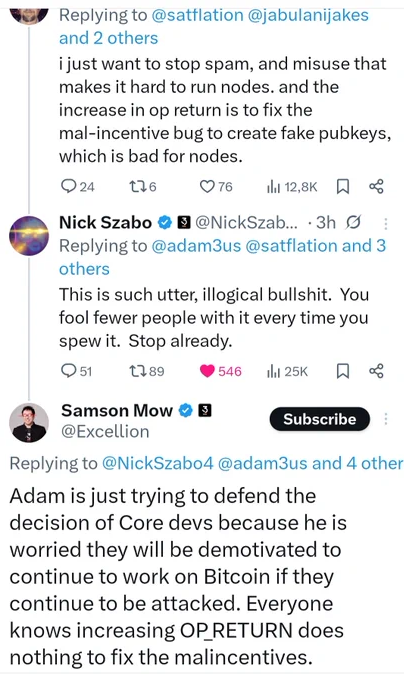
And Samson is giving the answer as well that you can't fix fake pubkeys with OP_RETURN. Its just not the fix for them. Everyone can still use them.

Now you’re outsourcing your thinking rather than answering the question. Soit.

If you truly answer the question - What does 100 000 Bytes OP_RETURN fix or what good feature it brings to Bitcoin? The answer is nothing. None. Only spam, risk of csam and abuse.

Bitcoin is Freedom Money. Not arbitrary storage. Increasing OP_RETURN does not fix fake pubkeys.

If I were a sophisticated nation state actor intent on controlling BTC:

I would be in favor of Corev30 changes, so that it would be easy to SPAM BTC with CSAM, create/enforce regulations so that most sane people would stop running nodes.

Centralization achieved, BTC as freedom money dies.

The debate boils down to: Is the bitcoin network openly supportive or openly hostile to arbitrary data storage?

Why wouldn't you just mine a block yourself?

Or create/enforce regulations that apply to data in any part of a block, not just OP_RETURNs...

That too!

Did you miss my point? You can mine offending blocks with our without the controversial change of v30. So a state actor waiting for v30 is perhaps not so sophisticated.

This attacker is playing the long game, waiting for the file storage use case to be entrenched. Timing of the attack is key. The goal is to force a fork and select the most easily controlled version. Kill freedom money by making self-custody and node running difficult.

¯\_(ツ)_/¯ idk how people are still pretending not to understand the distinction with a straight face