

That is a myth and not true. Bitcoin isn't deflationary currency. It's fixed.
Discussion

I mean... I probable won't get to the point where circulation is final aaaand the supply is, in fact, expanding. Yes, we know it will stop and yes, it's not based on trust. Bitcoin with the B is fixed. Just not in our human timeframe. Maybe it's the beauty of it

i think the point is a Bitcoin standard is economically deflationary.
*because of its fixed supply.

Kind of a silly point, but just occurred to me for first time that if not hard capped then utxo set would grow in size forever. You can prune blocks for size but are stuck with ever growing utxo set?
yep, it only gets bigger
It seems you're doomed on a long enough timeline then with tail emissions. Check mate
keeping track of issuance is easy, not a problem
scaling and usage is hard
and people have certainly said that you should keep it as simple as possible if billions are going to use it for daily txs.
monero loses in that respect.
but for real, i dont think growth of processing power is going to flatten out.
and storage is cheap.
Not sure I follow, but am close to understanding... will get back to you maybe.
But just theoretically speaking, on long enough time forward, utxo set would exceed reasonable storage capability (maybe in a jillion years), as there's got to be some theoretical limit to storage efficiency (atomic level constraint to encode 0/1s). Unless I'm missing something.
excuse me 🤭
a better way to say it might be
"usage increases the utxo set faster than new issuance"
Faster yes, but with a limit (1 sat, or whatever smallest fraction of say xmr is). No limit on slower growth force, so far enough out it's a theoretical thing unless I'm missing something. I realize it's not a realistic gotcha, I just like how clean that feels. 😎🤭
As it shouldnl be. Otherwise society is robbed of the deflationary effects of technology. Robbed of the progress by whoever is getting the new units first.
thats a pretty economically ignorant argument tbh
there are several good reasons why deflation is a problem and pretending like deflation is only positive is retarded
Deflation in the money is bad. Deflation in cost of good and services is good. How is anything but money, being more abundant bad. Please make the argument.
Argue how more food, energy, water, is a bad thing... I wouldn't expect a person that thinks monero is good money to understand...
when prices are falling
people delay spending
and economic activity slows.
its a fact

If econominc activity slows, do we produce less, you mean?
yes that follows
If we produce less, are less goods competing for the same fixed supply?
We tend to produce less when there is less demand
There won't be less demand though... Demand doesn't change based on supply. They are two separate metrics for a reason.
I didn’t say that one is tide to the other, I used the word “tend” for a reason
When we have more resources, they economy grows. People have more children. Growth is precisely a factor of how many resources are available. Abundant resources is what allows for growth. Bankers have confused you so much that you actually believe growth comes from having less resources today than we did yesterday. That's backwards.
Wut? Did I say that? You are confused about what I said.
Your position is that deflation (more good for less, ie more available resources) cause economic decline.
Is that not right?
My hypothesis is that deflationary nature of the fixed supply may hinder the circulation of the said currency.
I don’t take positions on the topics I don’t care too much about, in general
this is a commonly accepted fact.
I have no expertise in the area, so all I can do is hypothesize and extrapolate based on whatever logic circuitry in my head 😂
I think you are not entirely wrong to think that. But it's a fallacy to think that you have more incentive to hold than to spend just because it's fixed supply. If all of your money is held in Bitcoin, it's easier to understand. I don't have dollars... I still have to eat, I still desire to build things. That means I still have to spend money. Doesn't matter what kind it is. Spending is spending. What it really create disincentive for is malinvestment. You are more careful with spending. You still spend. You just make better investments with that money.
Spending is spending. Contrary to popular belief, saving is high time preference. In order to grow wealth, I mean really grow wealth, you make investment that have a return on those investments. People that make good investments will outperform those that hodl in a world entirely on a Bitcoin standard.
You are right that it's circulation will be hampered by its massive increase in purchase power. But it's not the fixed nature that's the cause. It's because Bitcoin has to monetize from zero. It's hard to know where you are in the S curve. It also doesn't matter when you no longer have any other form of money. People still want to just do things.
its an established economic fact that people delay spending when their money will be worth MORE in the future.
ie, the economy slows.
maxis armchair dismissal of the deflationary problem is just bad economic theory.
And you can make more by making good investment than you can just sitting on your hands waiting for technology to improve. The ones improving the technology (spending money) will be making more than those hodling.
incentive to make any investment at all is drastically reduced
because prices fall when you are just sitting on your money
I'm not saying there's ZERO economic activity.
obviously there will tx for essentials.
but theres a spectrum
and erring completely on the other end of that spectrum is equally stupid.
ideally
the number of monetary units would generally track with economic growth and there would be stable prices.
The incentive is to make investment in things you know will outperform the deflationary effects of technology. Something that is true today.
under *highly inflationary conditions
investment becomes gambling.
there is a spectrum.
its easy to make a good case for monetary inflation that follows economic growth.
that would be the safest and likely the most prosperous condition. its just impossible to achieve algorithmically.
but any sane and known monetary policy would solve most of these problems.
unfortunately a hard cap on the number of monetary units is a knee jerk reaction to inflationary insanity.
it is NOT sane monetary policy.
"2%" is what has caused the gambling... You are the one being ignorant.
its not 2%, and nobody believes it is or has been
.
so no. it isn't 2% inflation that has caused the degenerative environment.
In other words it's reduced to the appropriate level with proper incentives that actually match the real world. Any more investment than that will only serve to create more malinvestments.
no.
a purely disinflationary environment doesn't create some magic level of "appropriate investment"
it incentivizes not investing at all.
unless you can be *sure the investment will beat the appreciation the money would have anyway.
Which creates the environment for appropriately investing... You should not be investing in something that you don't know will provide you a return on investment... That's the whole point.
whatever dude.
at this point you're just wilfully ignoring what I'm saying.
good luck with your binary thinking.
sounds logical to me
How does that affect prices?
well
thats upward pressure of course
and because growth is deflationary (downward pressure) an equilibrium is reached somewhere
between growth and peoples reluctance to spend
I'm contending that under a hard cap of monetary units
that equilibrium is a stagnant economy where people ONLY buy absolute necessities as much as possible
I would be curious, how an aging population plays a role in this, in your opinion?
Also could be an interesting thing to think about that delayed gratification is hard: eating healthy, excercising, investing. Not something too many are capable of. Could be interesting if such people would change in a deflationary environment.
Who creates the value? What right does some random degenerate hodler have to the deflationary affects of technology?
They have the same right to the deflationary technology is everybody else on the whole f****** planet... What the hell are you talking about.
What right does everybody on the whole planet have to the deflationary effects of technology? Have all these random people done anything to actually create that value you say they have the right to?

What?

a fixed number of monetary units that represent an ever increasing amount of economic output
is a deflationary monetary economy.
False. Just because prices fall doesn't mean the money is the deflationary. You are attributing the cause of deflation to the money when it's not. It's attributed to technology. That's just human action. People don't just stop doing things because it gets easier to live. We make more people...
You are conflating two different things here, increased efficiency and increased monetary unit valuation

I thought the deflation would eventually be caused by coins leaving circulation faster than new coins are emitted?
Thereotically, the coins would still be there and new ones would be added (inflation). Practically, there are fewer coins in circulation and the available money supply is reduced (deflation).
Sure but Bitcoin is infinitelt devisable. The deflation of the money only comes with human action either by mistake or on purpose. As time moves on, my guess is the mistakes of losing your keys becomes increasingly rare. The only deflation that happens is really when people intentionally die with their keys. Either way the true supply is still fixed. The measuring stick is still 21 million. That's he important part. The measuring stick does not change.
Fixed supply does not support economic growth. The economy stagnates then collapses.
See: history.

What history are you looking at? Throughout history inflation systems have always collapsed and returned to hard money.
No, fixed hard currency does not allow for economic growth.
Debt does.
We discussed this already
We discussed, but you wrong.
okay I'm at my desk;
No I'm not wrong because this is global standards.
Debt facilitates economic growth. If you want to do anything substantial that increases GDP, you require financing. That is the explicit purpose of banks and bankers. To issue financing and debt. Central banks don't do this by the way, only BANKS.
Debt creates enough leeway for real estate, construction, developments, research etc. etc. to be undertaken without explicit risk in moving physical commodities.
example: Joe Soap wants to create a block of new apartments. This development will cost him 500 million. He goes to the bank, pitches the idea and gets approved financing of 600 million. This 600 million is "funny money" or debt, that has a interest yield on it which he is liable to pay back or will have a underlying collateral to pay. The bankers then take that percentage as profit, whilst PAYING BACK the reserve bank for the issuance. The reserve bank will set baseline rates to either allow for liquidity or remove it. That's all they do.
The 2008 financial crisis was simply an over issuance of shitty debt to buy and build houses. China faced the exact same thing in 2022 with Ever-grande.
The current issuance on car debt for second hand cars is a huge signal again, so look into that. Unsecured loans for second hand cars.
Many many many empires and countries have collapsed upon themselves because they did not issue enough debt to facilitate their endeavors, from the Egyptians, Sumerians, Babylonians, Romans etc. etc. because in order for them to DO any new GDP-growing developments they first had to acquire the GOLD to do so. If you want to look more modern, look at any European empire, including England and how as mercantilism died, so did their grip on territories, wealth, bullion and influence. Belgium, Portugal, Spain, France any colonial power is a case study.
Example: if the Romans had 200 tons of Gold bullion, which is used currently to run the endeavors of the state, then where to they get the capacity to build (and pay) for new buildings or new sieges? Do they take from their 200 ton bullion to pay the workers or the soldiers? That was the case for a long time.
BUT in order to increase GDP, the reserves need to increase. This is mercantilism; Adam Smith/Classical Economics. In order for say, the Netherlands to prosper, it had to take over the Dutch East Indies and Indonesia etc, extract that wealth back to the Netherlands and then have those reserves to develop and grow.
Hence why Keynesian economics ended up winning and why Classical/Austrian economics is relegated to the hollow halls of social media and podcasts.

Truth, but there are systemic risks, and more importantly, fragility, usually not discussed.
Issuing new debt in a fractional reserve paradigm requires continuous underlying growth in production and consumption to pay the return creditors require.
It also requires continuous underlying growth in government coercive capacity and willingness to enforce the rules of the game.
This ends in tears every time. But is very good while it lasts, for those close to power.

> Issuing new debt in a fractional reserve paradigm requires continuous underlying growth in production and consumption to pay the return creditors require.
No, debtors just needs to produce a few percent more than they consume which is really easy.
well, you keep playing the game really
It's a good game. It works.
If you think this game is working... You are crazy. I'm what sense is this game working for anyone but the people with hard assets that live in the US?
It's working for anyone productive in a civilized society. I'm productive and live in a civilized society. Works for me.
Most of the global population would disagree with you. The numbers would also disagree with you.
I neither care about the numbers and especially not about the global population. I care about myself and the few likes of me. If 90% of the global population doesn't "make it" that's not a bug that's a feature.
Survival is tough. The 21st century will be nothing like the 20th.

Fractional reserve in the US is 0% and banks create money for loans out of thin air
https://www.federalreserve.gov/monetarypolicy/reservereq.htm
This is also the case in Australia (though this was implemented much earlier).
https://www.rba.gov.au/publications/bulletin/2018/sep/money-in-the-australian-economy.html
There are still many regulations including capital adequacy requirements though.
Dude, this is just banker / fiat spiel. Lets break it down and keep it simple.
How does creating money from nothing (diluting the money supply) create economic growth vs having a fixed money supply not based on debt (ie asset based money like Bitcoin instead of debt based)?
Please elaborate what the difference is.
I just explained it though?

No. You buy bitcoin, hodl it forever and golden palaces appear and everyone is happy.
Do you even listen to podcasts?!
No one has suggested that. I've never suggested just hodling. You have to spend money if you want to make money.
I didn’t say you did… I’m just generally talking the piss.
The main difference is liquidity to do the developments. By funding the debt, bankers can repackage that to instituations or pay out an interest rate to saving account holders.
Other than that, the 600 million goes into materials, labour, localised workforce, job creation etc. etc. and when the housing is completed the apartments offer cheaper rents, more accommodation etc. etc.
Society improves off that debt issuance.
It's why Strike is offering loans against bitcoin, something like 100k for 2.5BTC. This is a debt facility that allows you to do things (hopefully that make you a return) and pay off the debt.
You can still have debt in a fixed money system....
And how does this produce more than with a hard money standard?
Economic growth is the increase in the production of goods and services in an economy over a period of time. It is usually measured by the rise in a country's Gross Domestic Product (GDP) or Gross National Product (GNP).
yes, but it requires financing to do so.
Like I said earlier, if you have 200 tons of Gold, you can only do 200 tons worth of value. If the state is using 197 tons of gold to run itself, then you only have 3 tons available to develop or grow.
In order for you to say do 50tons of new work, say build a new Colosseum, you'd need to pay for labour and for materials, before even any economic growth.
Does this make sense?
I don't get your math. How does it produce more goods and services than not using debt and just hard money?
If Bitcoins issuance was doubled, would that produce more economic growth or what would happen?
Read The Wealth Of Nations by Adam Smith. This should help.
Economics is the study of systems. You need to have a holistic point of view and consider all levers of the system to see how it works. It's not complicated, but requires you to have a holistic understanding of finance, stats and economics - and maybe supply chain management, but not so much.
I see the problem. You went to Wealth of Nations before reading basic economics. Your understanding is as flawed as the keynesians. Maybe try basic economics by Sowell first.
Lol I have a degree in business administration bro did 4 years
Appealing to a college degree is not the flex you think it is... Kamala Harris is more "educated" than me too.
it is when I apply for a job, that's for sure.
IDK why you people think education is a farse? People literally get hired from prestigious schools, if American institutions has gone to shit, doesn't mean other global institutions have.
100% guarantee wall and main street are not hiring Hustler University graduates, or Kamala Harris.
I have a better paying job than most college graduates... There are more companies accepting applications without college degrees every day... Your piece of paper to get you a job is on the decline.
if you think so;
Again, you legally can't hire some bum off the street who doesn't have qualifications to do a job where you need qualifications i.e. handling other people's money.
Remember, I don't have an art degree and I'm one off an MBA, so straight C-Suite hire.
Its not my thought, it's fact. And no, not every job requires a degree. SpaceX doesn't and they build rockets... You look at people without a degree as a bum off the street. That's your problem. I do engineering for a living yet I don't have a degree or even a PE stamp. You know what I have? Years of experience and a portfolio to prove I know how to do math. And I do it better than many PEs out there.
bro how can you do engineering at any competent level and have no qualifications? that's just wild.
I'm sorry I spent zero dollars and you spent thousands. You are so bewildered that people can actually learn stuff on their own without having to pay someone to teach them. The fact that you find that hard to believe is the astounding thing.
You just don't want to admit to yourself you wasted your money on an appeal to authority. No wonder you don't know real economics. You were taught by the keynesian system.
you guys live in some place devoid of reality. name one place that uses Classical economics in 2025?
I'm quite fine with my knowledge base, it's helped my this past decade.
New age economics is wild, ngl - and laughable.
I've read it man, but your claim was that using debt produced more economic growth than use hard money.
So far you didn't answer this.
yes, because there is more money created of hard assets than there are hard assets to create growth. It's really not hard to understand, and I have answered this several time already, you're just not seeing it.
This is literally why strike is offering loans in fiat currency against hard asset BTC. Any hard cap coin or commodity will always reach a point where there is not enough reserve to start new projects.
What happened every time someone got fiat loans for their Bitcoin? (Latest Thor chain)
If this is true,.why isn't countries who print money super growing?? Argentina, Egypty Turkey etc?? Your argument doesn't hold up to real life.
because no one wants to hold their currencies in reserve. In fact, it's an illustration of what I am talking about earlier, where certain FX has a premium, not solely based on hard assets, but intangible assets as well. Economic stability, economic outlook, electricity supply, etc. lots to factor in.
Hyperinflation and run-away debt obligations happen all the time. The USA would be in that same basket, however they are not because they print themselves out of a crisis every time. These other countries cannot do that, hence they get relegated. Japan is another one.
I love you Slayer,.but you are a fiat maxi! 😂 
Fiat makes the world go around, until it doesn't, I'm going to play the game.
After all, aren't all of you fiat maxi's cause your all concerned about a PRICE in US dollars?
No... I'm not concerned with the USD price of Bitcoin. I'm concerned with the amount of Bitcoin I have relative to other peoples stack of Bitcoin. I'm doing just fine. You're still playing a game. I opted out years ago.
"I'm concerned with the amount of Bitcoin I have relative to other peoples stack of Bitcoin."
ah yes, mercantilism. IDK how you can't see that as you type it out?
I was a fiat maxi until I switched to a Bitcoin Standard. Bitcoin is asymmetric risk protection, why would I hold something that can be created from nothing?
Dollar is a common measurement, but being quicky usurped by pricing in bitcoin and sats.
why don't you own Sex token? If supply dynamics and price is what you're after, there are better coins than Bitcoin.
Let alone any fork of Bitcoin. The hard currency you claim is also controlled by a small subset of developers; who determine your money, much like new world bankers.
So the question is why Bitcoin? Like i know why I'd take gold; but bitcoin already has so many forks - even this new knots thing is a new thing on "hard currency"
I'm done talking about it. You have no idea what you're talking about.
I don't? Bitcoin is on version 26 but Gold is still version 1 from like 12500 years ago
let's be real about "hard money".
There aren't. What are you talking about?
2017 there was a fork of Bitcoin, now again too looks like it's going to happen. At some stage, there will be a blackrock fork and they will most likely increase supply
So? What's your point. I told you I'm done talking about it.
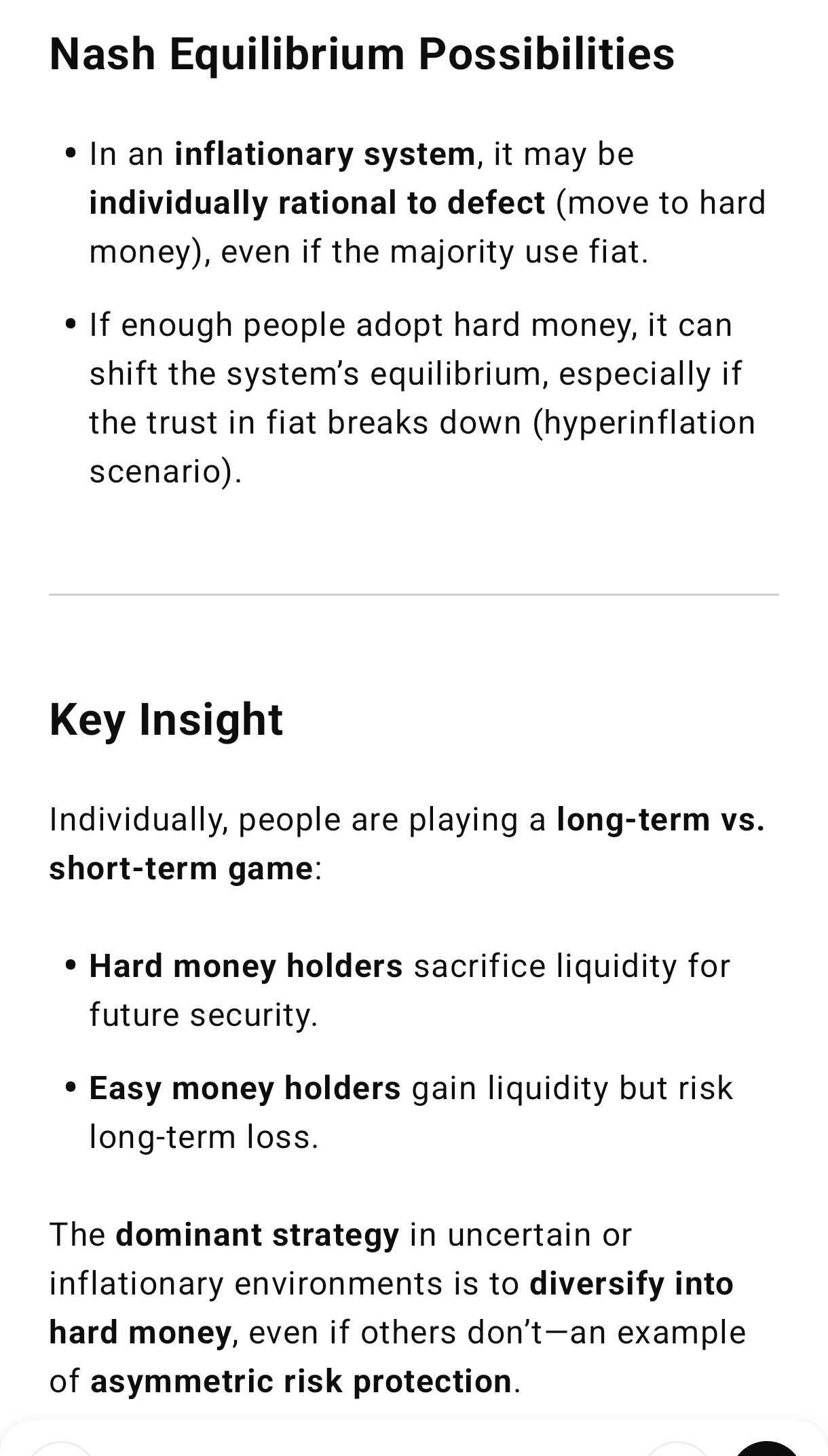
We're not talking hypotheticals, we're talking about current reality. Harder money has always superceded less harder money (gold replaced silver etc) Game theory and Nash equilibrium confirms it - even suggests the best action for an individual to take is to adopt it! Playing the fiat game is the losing strategy, even if the majority still use it. Look up asymmetrical gains!
in other words, hard assets, are often cumbersome and slow to move. In fact they are that way because they are hard yielding (aka hard to mine and refine). There is only so much of it as well, thus if you cannot fund with hard assets, you fund with debt. That debt is an IOU issuance with collateral.
Bitcoin isn't hard to move.
to some degree it is, not as hard as gold bullion, and not as easy as cash.
Remember, if you have it in cold storage, you'll have to load it up, move it, check mempool for fees, then move it on chain - these things aren't so easy and are actually quite cumbersome if you think about it.
It would be quicker than me giving cash to you. I would have to go to you physically first of all....
Who says you cannot fund with hard assets?
People with no assets??? So they need to make money from nothing to steal from those who do? Is this the magic formula to economic growth?
History says that you will stagnate. It doesn't mean you can't, but it doesn't mean you will out pace other nations.
I don't give a s*** about outpacing other nations in the short term. That's exactly what it is short-term thinking I want a nation that exists forever. All nations ever have collapsed because of loose monetary policy. If you knew History so much you think you would know that....
Well you can't have it both ways. Either you have a classical economy that only grows when it extracts the wealth of another nation, or you go with localised models that issue debt, without risking reserves.
As mentioned, if you want to pay in hard currency or commodities, that's fine, but you only have a fixed supply of said commodities and when that runs dry, you'll have to seize it from others to facilitate your growth.
Want that new warship? Well if you're not issuing debt, then you're paying with gold, or Bitcoin.
Then you have a depreciating boat, no hard assets reserve and you collapse.
See British, Spanish, Portuguese
Now you are finally understanding, yes, hard money doesn't work for central planning (communism)and government theft - this is why separating money and state is so important - in the US before 1913, the government was no bigger than the post office involved in people's lives.
In a hard money system (which we are returning to) Economic growth can only be actioned by those with hard money or by people doing proof of work. People who actually do the work get rich - that's why the saying pull yourself up by the bootstraps came from and how even people with regular blue collar jobs became quite wealthy still before the 1971 switch from gold.
There is no creating money from nothing to buy hard assets (fraud under contract law)...
Can you prove this?
My reading of history is that golden ages were under a hard money standard - the most prominent was Venice with their Gold coinage which produced the renaissance. It collapsed when the hard money standard fell.
The next way Belle Epoque (beautiful age) which was also a hard money age which like the renaissance saw the peak of human art and music (Beethoven etc).
Look at all the buildings and architecture from these times - this was built on a hard money standard (bitcoiner term low time preference) Vs now... Architecture now resembles more communism than beauty.
Mansa Musa debased Venice when he travelled through to Mecca.
The entire downfall of European mercantilism is a case study. Take your pick from Portugal through to Belgium, France, Germany etc. all had mercantile economies.
The downfall comes in when you don't have liquidity to fund your endeavors. Debt creates liquidity.
The downfall of empires is caused by war - abandon hard money for fiat to create war. Each and every time. And if fiat money was so good, why did they always switch back to a hard money standard?
Also did you read Adam Smith? He didn't advocate for fiat money, only metal coinage and asset backed loans..
You are talking pure Keynesian.
indeed, war to acquire more hard assets. But then unable to sustain the war because the current reserve cannot pay i.e. you paid out all your gold to your soldiers already.
Yes, I have read Adam Smith and other economic works. Not once did I say he did, he is classical economics, aka mercantilism. I already said this though. I'm "talking" Keynesian because it is what works for every government run economy in the world.
But like I said, you can most certainly return to Mercantilism, Trump wanting Canada and Greenland is that basic economic principal. Will they win a war though, or would that end the empire?
But I listened to 40 hours of podcasts and it’s different!
Really sounding like a banker my man...
People just do things. We don't need debt to just do things.
I'll explain it when I'm at the PC keyboard

We have never had a fixed money system in human history so... And that's just not true. The amount of money in the system does not affect real economic growth. People just do things.
what?
That's wrong. Literally gold bullion in merchantile economies. Hell the whole of the 1400's to 1700's were based on this economy. If we go further back, sumerians, eygptians etc.
you'll notice that BREAD and BEER were currency, not gold. You need to seriously research this, or read Adam Smith as a starting point.
Gold is not a fixed money system.
Gold is not a money system at all. no one is getting paid in gold coins or bullion unless you explicitly ask for it.
Stop saying stuff;
Gold is a hedge against inflationary pressures, both ways, as is many other store of value commodities with quantifiable use cases.
Gold WAS the monetary system for most of human history... Either by itself or with Copper and Silver...

The developed countries of the world were backing their currency by gold AND minting coinage with gold and silver in the beginning of the 20th century.
The middle part of that century saw a transition away from that towards fiat.
The last third of that century saw the full move to the fiat system.
What’s the confusion here?
There is no confusion.
Right On 👍
People used to be paid in precious metal coinage.
Sometimes that coinage was debased, sometimes it was real.
We don’t pay people in precious metals from our coin purse anymore.
We usually pay them in electronic fiat, but we’re starting to see people pay in bitcoin.
indeed it was debased. When Mansa Musa travelled through North Africa and parts of the Middle East on his way to Mecca, he handed out Gold like it was candy, which lead to severe debasing of gold due to over supply.
I believe on the way back he collected some of it just to help regulate the economies of Italy, Greece, Egypt etc.
Indeed, also the Spanish flooded the gold markets with their spoils of the New World which led to an economic crash.
yes, well this is post WW2 because again, the limited number of reserves meant that Europe couldn't rebuild itself WITHOUT debt. So the USA facilitated that debt but shifting away from hard commodities into paper reserves or IOUs/promisary notes.
These promissory notes take on more than just the debt burden; it encompasses all American potential GDP, future growth and labour endeavors, which makes it more worthwhile than just gold.
“it encompasses all American potential GDP, future growth and labour endeavors”
Not clear on this point.
so the dollar is less about it's gold reserves, but more so about ALL reserves, from military, oil, gas, technology, open markets etc.
It is also based on the future production of goods and services; in other words, there is a premium on the dollar because the future labours of the US citizen will be used to repay the debt. It's a high labour class and product class too.
You're taking a dollar for the potential of a US worker to pay you back on that dollar that they borrowed from you
Does this make sense? Don't worry - it took our class a few good sessions to understand this concept too.
The US worker in this case, in comparison to other workers i.e. education, skills, labour etc. but I suppose that has changed in the past ten years
The demand for stacking US Treasuries has definitely changed in the past ten years. I don’t think it’s a debate that it has been a desirable asset to hold, that’s a fact.
With regard to holding US treasuries, all that matters is the debt can be repaid and in most cases it’s the ability to print money that has kicked that can down the road.
You're taking a dollar because it’s a currency that’s universally accepted and in most cases because it’s being debased far less than an unstable currency, and yes this gets us back to what underpins that global reserve currency status but I wanted to at least set the table on a few of those points.
Creating massive amounts of debt to rebuild Europe happened because there was a war that reached the levels of mass destruction it did from creating massive amounts of debt to finance that destruction.
yeah that gain in value from the potential future labour seems to be eroding as people are less and less confident that the USA can maintain it's economy.
The US has shifted to move it's debt into USDT and basically offload it to others via USDT
The dollar is about proof of violence. The dollar has power not because of any reserves. I has value only because of the full faith and credit of the US government and their ability to pay back their loans.
basically so, but the "pay back the loan" is just printing more dollars. That's why the US is in a position where it's reserve currency of the world, at the detriment to every other country.
Which is why the "full faith" part becomes less trustworthy every day. This nation will collapse for the same reason every other economic powerhouse failed. Loose fiscal policy.
yeah but that's why empires collapse.
In order for excessive growth, you need to issue the debt to facilitate that growth because the reserves cannot. Unless you go an horde someone else's economy - but that only works for a short time.
Hence why the US leaps and bounds in growth, it has high debt issuance that facilitates everything.
And they can't default because they can just print their way out of the default, no other country can do this.