

Fuck that bullshit, serious financial privacy will be built on Bitcoin, the tools are there, it's just a matter of time.
Discussion
I see several tools being built, but there doesn’t seem to be anything that stands out. Fedimints are centralized and require lightning, which has its own issues. Liquid is centralized and was never meant to be a proper sidechain. Even their website says real sidechains are not possible yet. Plus they have something called Confidential Transactions, which is much different than private transactions. Privacy offers deniability, and that is essential to protect against $5 wrench attacks. There is a recent pull request to add "Deniability" to Core, but we will probably never see it 😞 I don’t know, maybe I’m missing something.
Supposedly bitVM makes trustless 2way pegs possible, which would mean private sidechains are possible.
We could have MimbleWimble already but we don’t for whatever reason?

FWIt’s fucking Worth:
I bought all my BTC via Coinbase.
I didn’t get in early enough to have non-kyc.
But I figured a way to get forward privacy (fwit) via a sophisticated Monero transaction back to BTC.
So FUCK Monero haters.
Bitcoin isn’t privacy money, and it never will be.
And I don’t want to pay to “whirlpool” coins that will be questionable at best.
Bitcoiners need to stop shitting on Monero, even for its obvious faults.
It has what we want, but can’t have.
BitVM can do pegs, but they are difficult, expensive, and can easily be stolen by the miners. This was basically the same problem in the original Blockstream whitepaper.
If sidechains are ultimately going to be the way to scale Bitcoin, then it makes sense to allow Bitcoin to have the most secure sidechain properties possible. This will require a soft fork.
I was under the impression that bitVM opens the door to a lot of programming options & while in many ways those programming possibilities are very inefficient, it sounded like 2way pegs would be relatively simple. If it doesn't improve things over what is being done currently with Liquid then why would 2way pegs be mentioned in conjunction with bitVM at all? How does it allow miners to steal anything?
Bip300 would allow miners to potentially steal everything in a sidechain.
I was hopeful of this too, but unfortunately miners can steal from bitVM. They won’t though, just like they won’t steal from drivechain. nostr:npub1h8nk2346qezka5cpm8jjh3yl5j88pf4ly2ptu7s6uu55wcfqy0wq36rpev knows this.
If I’m not mistaken, bitVM sidechains will be superior to Liquid because you only need to trust that one of the 15 is honest. I think it only works if we have OP_CTV though. Right now, bitVM is limited to two parties.
Also, we can have multiple sidechains. So untraceable zcash privacy instead of Liquid’s obfuscated transaction amounts.
BIP300 would give us all of that, but without the multisig and with an interval of time that publicly exposes if the miners are trying to steal. Plus, miners receive the fees. It’s literally proof of work. Privacy and big block scalability secured by L1 and Bitcoin’s massive hashing power


We know extremely little about what BitVM enables or what its limits are. I’m not sure what you are talking about with miners stealing it, I don’t see how they could steal any coins any differently from any other script. If they can’t produce the signature that can’t take anything and the signature is dependent on the code being executed.
Are you sure you aren’t confusing BitVM with something else?
The miners can collude with your counterparty to censor your fraud proof transactions. This would be very bad for a popular sidechain, but not likely to happen.
Maybe nostr:npub1yxp7j36cfqws7yj0hkfu2mx25308u4zua6ud22zglxp98ayhh96s8c399s would be willing to join this conversation 🙏🏻 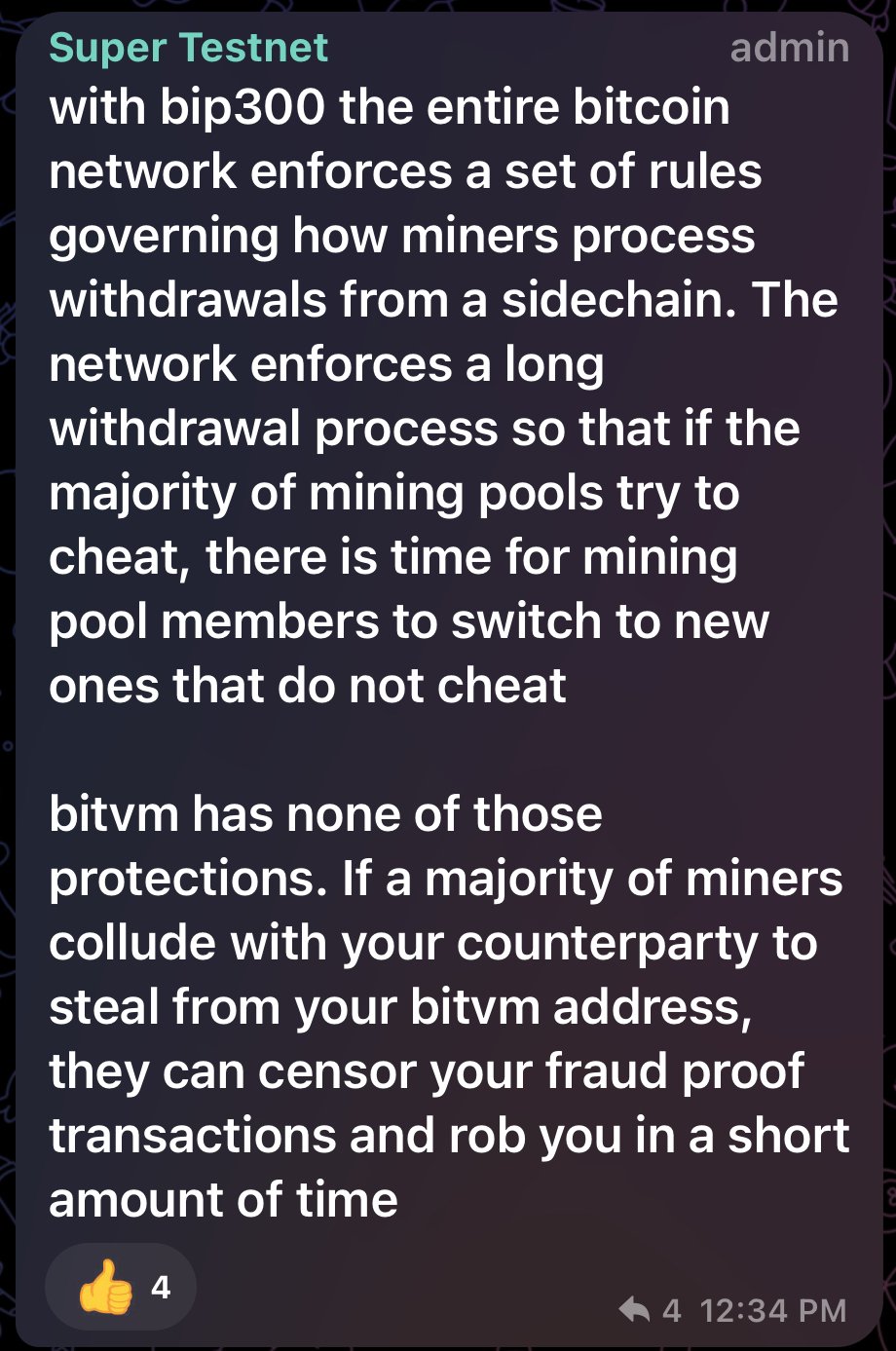
*Colluding* with 51% of all hash power is a very different dynamic than BIP300.
In the LN or BitVM situation where you need the justice transaction to not be censored, the attacker has to *actively* collude - like actually plan the attack, personally contact all of the relevant miners (or the pools that are ok with destroying their pool) and bribe them to participate in the attack or convince them to commit to the crime before they even get a payout. Then they all have to actively censor the justice transaction and reorg all blocks not in their censorship group when the attack happens.
In the case of BIP300, anyone with enough hash power to create a block of withdraw and cast some votes could out in a malicious withdrawal. If 60% of the miners aren’t verifying that particular sidechain (or probably not validating any of them because we’re talking gigabytes or even terabytes every 10 minutes in a successful BIP300 scaling model), then the majority of miners would just *passively* vote for the malicious transaction. They’d have no clue whether it was honest or not. No active participation. No explicit altering of the pool/client to censor a justice transaction and reorg other blocks. No collusion. No bribes necessary. When any validators of the sidechain contested it, it may very well become a social mess figuring out what is honest and what isn’t and miners have to be contacted and to force them to setup or sync sidechain nodes to cast the proper vote, or they just blindly trust to what someone else claims and manually change their vote.
Yes, 51% of the hash power control is a problem in either scenario. But in LN or ButVM, or any other justice model like we already use, the miner **is not the counterparty.** they can’t just unilaterally pay themselves out of MY channel. The BTC goes explicitly to me, or my channel partner. And *I* decide who that partner is. My trust is another layer of defense, on top of the multiple levels of difficulty and direct, malicious collusion necessary.
In the BIP300 scenario I can’t choose which miners I want to trust. And I can’t force miners to run full nodes for my sidechain. Anybody, anywhere with hash power is suddenly “my counterparty” to the sidechain operation. They can steal if they have with *passive* hash power not doing the job necessary to *contest* their claim.
These just are not at all the same dynamic nor have anywhere near the long term risks. Longer we have BIP300 success, the more likely nothing is being validated. The more BitVM and LN we have, cost of validation continues to decline. It’s all still only on the main chain.
Short version:
The issue in BIP300 is that the validation cost of MASSIVE blocks isn’t offloaded at all. It’s just moved. Votes are likely to be blind in the “I have no fucking clue what’s going on, but here’s a “yes” anyway” sense.
The risk in LN or BitVM is literally the exact same for any and all time locked justice model. It requires active, and explicit collusion between all active miners, to knowingly censor or even reorg, with a counterparty you choose explicitly, to get THEM the money which they then pay out to the miners by choice.
Okay, I have studied this topic some more.
Apparently with bitVM, we are talking about a federated model that depends on collateral. So if the amount of BTC in a sidechain is more than the collateral, we need the investor to add more collateral or we risk the funds. The 6-month timelock is not like BIP300, where there is a constant warning the miners are attempting to steal.
Any L2 that doesn’t pay the miners will eventually be controlled by the miners. The whole "miner centralization" is far more likely in this scenario than whatever Shinobi was talking about with the $10M Amazon node.
Miners will become the LSPs. If they cannot easily capture the LSPs, then it would be in their interest to censor justice transactions until everyone switches to their LSP. Same with federated sidechains. After many soft forks, this might solve scalability, but what about privacy?
The likelihood of any of this happening is very small. But BIP300, like Bitcoin, provides miners with a goose that lays golden eggs, and this is one of the oldest and most trusted incentive models in the world. And like lightning, it relies on the hope that miners want Bitcoin to succeed, because nobody has more skin in the game than them.

Monero is just a tool no need to be upset.
It's picking up in an area Bitcoin is lacking in.
It wouldn't even exist if privacy wasn't always an afterthought. With respect - I've been reading your brother and you say it's just a matter of time for years...perpetually just around the corner.
It's hard to be angry with those who get tired of waiting and finally say "fuck this" and just build out and start using those privacy tools