
Honest question: do French people celebrate their 80th birthday by smoking up?

Team associations create the perfect conditions for the opposite of truth to flourish.
If you haven't already, be sure to watch or listen to our latest episode with nostr:npub1kvgw6zj55uwvlz5rdqpjm5a5hqah4j3ggza3pfx4umh5k6j00yaqt6v0p2 via YouTube or wherever you get your podcasts. Link in bio
https://video.nostr.build/25c54fef6d4a77deb91034d4fb1f479e9799370c73b511505fd84be17dc86f85.mp4
As always, it's great to hear Natalie speak. She's always so very articulate, thoughtful, and insightful.

Thanks! I don't know about you, but I add extra garlic with every recipe :)
Rather, don't really need a recipe, just approx propositions.


Damn that looks good. Do you have a recipe?
A few years ago my wife planted arugula and that stuff grows like a weed - I made arugula pesto with some of it and it was amazing.
It's a solid point...





It's been fighting to get past $38k for like a month and then in the last 24 hours just blows right by.


I've had reasonably good results in the past using ChatGPT to help me with effective prompts for Midjourney.

The article I saw basically said a large percentage of the water is from energy production (ie cooking water in coal plants for example) that is then used to mine Bitcoin. So in my mind they're really just double-dipping on the energy FUD - so, basically they're playing Energy FUD Whack-a-Mole.
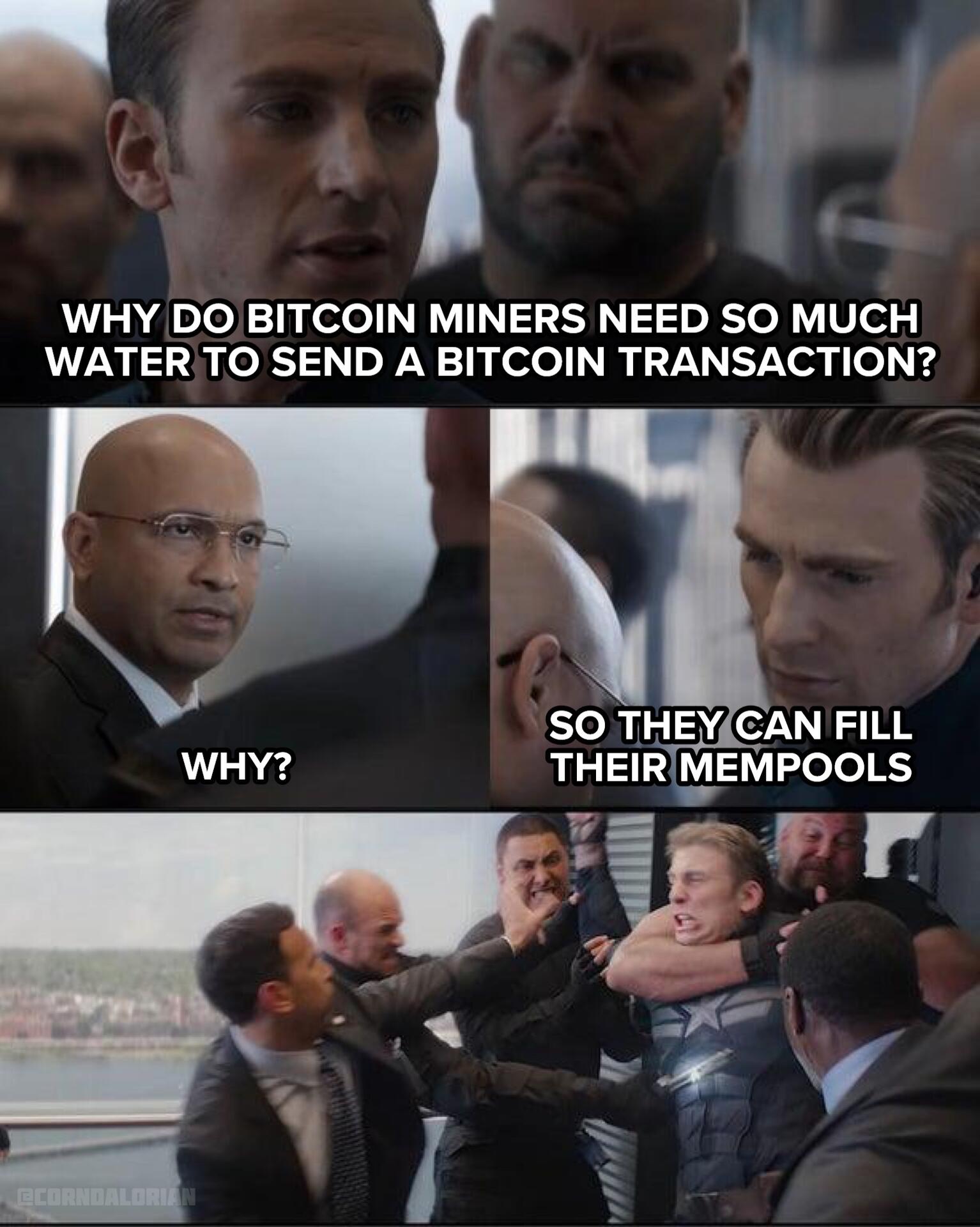
It seems the latest media attack vector on #Bitcoin mining is water consumption. Once we move past the initial knee jerk reaction, calm down, ignore the media spin, and look at the data and source material a little closer, we actually find a more useful counter-narrative.
Having visited the original source cited in the BBC article on the matter (which I won't share here because I don't want to amplify), we see data from the University of Cambridge (link below). To be clear, it's just data - that's it. It even says right at the top of the source:
"All comparisons below are based on our best-guess estimate. The listed comparisons are for illustrative purposes only and do not constitute an endorsement nor any other form of value judgment."
I actually don't see any water consumption data in the source, but more on that later.
Interestingly, there is other data in the original source that can be interpreted in a positive light for Bitcoin mining. Here are two examples:
1) Bitcoin mining energy consumption accounts for 0.16% of global use (I recall nostr:npub1a2cww4kn9wqte4ry70vyfwqyqvpswksna27rtxd8vty6c74era8sdcw83a pointing out this was number is within the error bar for global energy consumption estimates).
2) Bitcoin energy consumption compared to industries, countries, activities:
- Bitcoin mining global energy consumption rank #26, while it ranks #66 in GHG emissions, showing it's cleaner than most industries, countries, etc.
Now as for the water consumption issue, let's assume for a moment that miners are not cooled using a closed-loop system (which would be insane if they weren't), and also let's assume the global Bitcoin mining water consumption cited in the BBC article is correct at up to 2,200 GLiters per year (there are caveats to this, namely this figure includes cooling water used in the electricity generation itself, which is kind of disingenuous). Nevertheless, this does indeed sound like a lot of water. But remember, it's important to always ask "it's a lot compared to what?"
The BBC article says each transaction uses a backyard swimming pool worth of water. Having done a back of the envelope calculation using ~10M BTC transactions per month (it's been pretty steady at the value the past ~5 years, at least from the data I saw on Wikipedia), and assuming a backyard pool is about 5000-10,000 gallons (assumes a pool is say 12 ft long x 12 ft wide × 5 ft average depth), their estimate total of ~2,000 GLiters per year roughly checks out (feel free to check my math and correct me if I'm wrong; don't trust, verify).
Having said all that, global annual water consumption is estimated at ~4 trillion m3, or 4,000,000 GLiters (source: ourworldindata). From these numbers, and assuming the earlier water use data is correct (which I question), Bitcoin mining accounts for 0.06% of global water consumption.
Alternately, let's look at water consumption of other human activity. Take lawns for instance (full transparency, I have a nice lawn so please don't accuse me of being anti-lawn or something) - lawns are fundamentally mostly aesthetic. If however, we categorize them as a "crop" (one that produces no food, but I digress), in the US, lawns use more water than all other crops combined. As well, if we look at other factors for lawns such as cumulative effect of minor fuel spills from people filling their gas mower, it works out to multiple Exxon Valdez spills *each year* (source: Jordan Harbinger Podcast episode 901). I've done the back of the envelope calculation myself - if you assume each household accidentally spills about 1/4 cup of fuel per year, and if you multiply that by all the households in the US, the amount you get is staggering.
For me, the lesson here is we have an opportunity to educate people with facts. It's easy to scream things like "the media is lying again", the path I prefer is that we need to be really diligent and intellectually honest about Bitcoin. If we're serious about winning, we need to be better than the corporate media at this. That means things like being honest that all industries, Bitcoin included, have externalities, they all have trade-offs. We have to educate people on the reality that it's a net good for the world. I remember a good quote once that went sometime like this "when we invented the airplane, we also invented plane crashes". I believe most reasonable people would agree that airplanes have been a net good for humanity.
Me after the 30 day Twitter reactivation period has passed and my account is gone:



I could throw fuel onto the fire and say that if the cocoa bean origin is not labeled, it's almost certainly from Ghana or Ivory Coast, and therefore almost certainly a product of child slavery and human trafficking.
Having said that, as a parent myself, a couple dozen chocolates a year isn't likely to do much long term harm, and the trade-off is if a bit of chocolate/treats are demonized too hard you can be certain when she has her own autonomy when she's older she may overdo them then. Parenting decisions are often not easy.
Of course, you could also compromise by having her eat it after dinner so the sugar spike is dulled by the other food in her belly... just my two cents.
Wow. Just comically ridiculous.
https://cointelegraph.com/news/ftx-ftt-token-rallies-30-binance-effect-or-ftx-2-0-reopening

I agree with you 💯. What frustrates me is by the definition of assets and liabilities, a customer deposit to the bank is a liability on the bank's balance sheet and therefore the bank should honor that - it seems in practice that's not quite true in some instances.

Any time I've made a largish wire transfer (which admittedly isn't often), I get asked "what's the purpose of this transaction", and I always think:

This is a great episode, and not at all terribly surprising what the guest speaks about. Some of the criticisms the guest levels against green groups sound awfully familiar to how green groups speak about Bitcoin mining (this show has nothing to do with Bitcoin to be clear).
Worth a listen.
https://www.jordanharbinger.com/chris-dearmitt-rethinking-plastics-environmental-impact/

This comment was a follow up to my previous reply, which included this explanation. I find it's best to try to stay calm and seem to understand before reacting.
