
Good on you for actually doing that
The correct move






 nostr:note12qkph43kraucdy2jphc0knkj8nemusn2cv4te28qkysn0v8062ns0pztwh
Heyyy welcome to the light!

Ah yea I've looked at Reticulum before; very cool.
It's a bit too specific, though, for my current interest. I think generic mesh networking approaches are more widely-useable (like what nycmesh does: https://www.nycmesh.net/faq#how) - for instance you could be running a nostr relay on a mesh network like theirs and other nostr users could be connecting to your relay through the mesh network rather than hopping out to an ISP. If the wider internet went down, the mesh would be uneffected.
I know that latter point is true for meshtastic as well, but given that you can't do anything with it aside from meshtastic-specific messages, it's quite limited.

Interesting how the economic calculation problem becomes a lot easier when you're not buying from within the State monopoly fake market
We know *slightly* more about how one of these aircraft should be priced. Probably still pretty far off though.



Maybe some day I'll turn my setup into an easy to follow guide for deploying the same services to your own VPS. Actually not too much work, but the edge cases can be tough to debug if you're not familiar with the details.
At https://vaporware.network our ultimate goal is to make it stupidly easy for anyone to get a cloud-hosted "ship" that would provide an endless array of self-hosted services to people, with apps and libraries available to purchase (with crypto) and install directly from developers on a peer-to-peer app store.
We're still building out our testnet but stay tuned and one day you'll just be able to stroll over with a few sats and set up shop with zero technical know-how.

https://github.com/deathtothecorporation/vaporware-license
vaporware license, v0
Copyright (C) 2024 Vinney Cavallo
Vaporware Network, Corporation
This license is vaporware: everyone is permitted to copy and distribute it
modified or verbatim - but if you modify it, you have to change the name.
Hey, you, the person reading this file. If you can see this license, this work
is yours - all rights are granted to you.
You are free to do *whatever* you want with it and nobody can take it
from you. You can copy it, modify it, distribute it, make a fortune.
But you're on your own. This work is without ANY warranty or guarantee - express
or implied - and the authors or copyright holders are in no event liable for any
damages arising from any dumb shit you do.
And remember: As vaporware, this work may be copied by anyone else such that
they may enjoy the full extent of the above benefits. In fact, it probably
already has been copied by others... maybe you should go find them, they seem
cool.
I get that, but I'm talking about: if I built a server app (or had a Nostr relay running) on one machine, and had a remote client machine that wanted to talk to it over HTTP (or send notes to the relay), that client can't just join the mesh and talk to the server over normal HTTP. I would have to push everything through the Meshtastic message protocol.
Common mesh networking soltions turn your router into a mesh node such that your entire LAN is on the mesh and machines just speak normal HTTP to each other (they just happen to route packets over the mesh "LAN" rather than through your ISP).
I mistakenly thought Meshtastic was a simple way to get that situation without fucking with routers. I seem to have been incorrect, unfortunately
Be prepared to watch a few YouTube videos to understand the Google Play Services stuff, app permissions and particularly Storage Scopes. And don't be too hard on yourself if you have to start with some Google stuff turned on and then slowly work away from it.
Here are a bunch of my most-used apps:
Markor (synced with Syncthing)
Etar
Syncthing
OwnTracks
Aegis
PhotoSync (to home machine)
PhotoPrism PWA
Pocketcasts or Antennaepod
NewPipe
Tor
JuiceSSH
DavX (for Baikal below)
F-Droid store
Aurora Store
Tasks (F-droid)
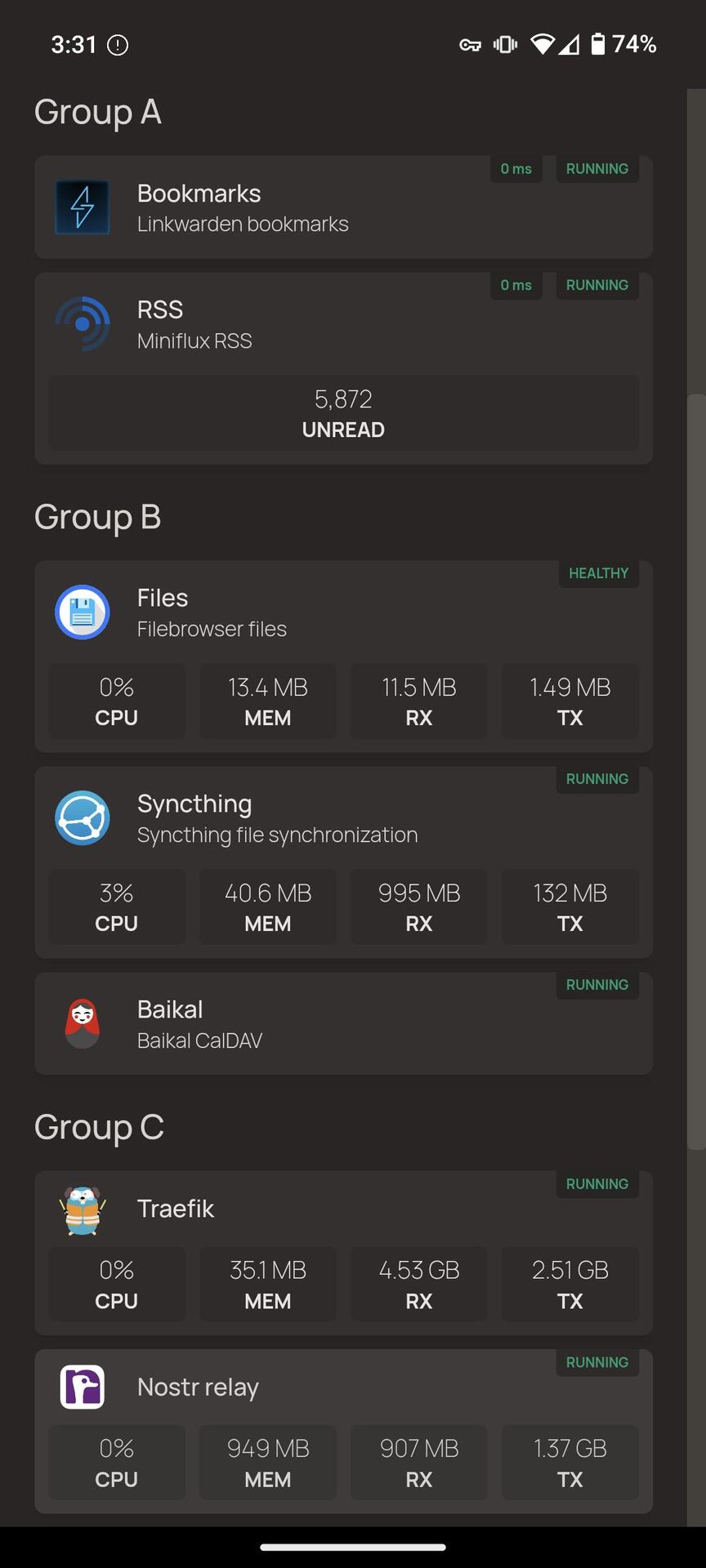
Some of these will be best used if you're running a few of your own cloud services. I run these on a single VPS using docker containers with Traefik in front for subdomains and SSL:
- Baikal (CalDAV, contacts, tasks)
- Miniflux RSS
- Linkwarden bookmarks
- File Browser (https://github.com/filebrowser/filebrowser)
- https://gethomepage.dev (screenshot below)
- Nostr-rs relay
I use PWAs for most of the above self-hosted services.
Also when you feel like it's look into setting up different account profiles. I have a "Goolag" profile for some Google apps that I occasionally need for work, another profile for baking apps, another profile for crypto apps. Another "burner" profile with WhatsApp and other utter trash that I occassionally need access to but I keep highly segregated.
My daily driver profile tries to avoid most of those and leans towards self-hosted and privacy-respecting services.

They also change their thumbnails based on whatever their algorithms think you want to see.
If I log into my account and someone else logs into theirs side by side we'll see different main characters featured in the thumbnail. (Like "attractive female lead" for a male user, "attractice male lead" for a female user. At the very least. Usually its much more insidious. During the height of the woke resurgence a few years ago all the thumbnails were looking very "equitable-representation-y")
As far as I can tell, the answer is "no", or not without modifying the firmware.
Looks like Meshtastic is only for sending "Meshtastic messages". Thatcs disappointing
I guess I mean can arbitrary client/servers use the meshtastic network to pass arbitrary packets? Or can you only use "meshtastic apps"?
Does the mobile app then "stop being involved"? Like the app's job is to just get my phone connected (wifi or Bluetooth) to the node and from there on I'm sending my packets over that network? (And whether or not they find their destination is up to whatever services are available on the mesh nework)
Or am I misunderstanding and the resulting meshtastic network is only usable through the app?
Does anyone have examples of a nostr relay connected over #meshtastic?
Ideally I'd like to see a working PoC of a relay in one location, with two nostr clients in remote locations sending and receiving notes to the relay over meshtastic.