

A lot of OGs were just lucky and they’re not in it for the Austrian Revolution, they want the Fiat and they have all the bitcoins. ATH is an easy time to make bad life choices



For Transparency:
Yesterday I asked OpenSats to close my grant for https://algo.utxo.one/ 6 months early.
Two primary reasons:
1 - AI helped me build the features I wanted much faster than I planned last year
2 - After almost a year of being live, barely any clients have adopted it
Project is not abandoned or relay will remain online for the few clients that are using it.
I believe this is the more honorable route than continuing to take money that many of you have donated.
That said I have a very exciting NWC project underway that I hope will be funded (Bitvora Commerce), more details to come!
Just you try and refuse these 21 sats, King

Below is a mind-bending Guest Post by nostr:npub1ltt9gry09lf2z6396rvzmk2a8wkh3yx5xhgkjzzg5znh62yr53rs0hk97y
**Protected: Does Bitcoin Break The Simulation?**
After thinking deeply about physics, reality, simulation theory, and proof-of-work for a long time, I came to some insights that sound wild, but quite plausible. While many others have already written about simulation theory, I have something new to add: the interaction with Bitcoin and ***the distinct possibility that Bitcoin destroys The Simulation.***
**Are We In A Simulation?**
I’ve accumulated many arguments suggesting we’re in a simulation – and one pesky argument against it. Here are some from the “for” side:
**1. Bostrom (“Game Power”)**
There has been a difficult-to-read short paper published on this (Bostrom, 2003), but Elon Musk has been the one to bring it to popular attention recently. Slight paraphrasing him:
A dense but influential paper on this was published by Bostrom (Bostrom, 2003), but Elon Musk brought it into the spotlight. To paraphrase him:
*“If you assume any rate of improvement over time – 1%, 0.1% – just extend the timeframe, and games will eventually be indistinguishable from reality. Either that happens, or civilisation ends. One of those two outcomes. Therefore, we are most likely in a simulation.”* —Elon Musk, Joe Rogan Experience, episode 1169
https://www.youtube.com/watch?v=VQi2KC6jKjg
Musk extrapolates that if civilisation isn’t destined to destroy itself, then given enough time, there should be billions of simulations indistinguishable from reality because simulations continuously get better. It’s a very compelling argument, but there is a critical flaw which I’ll come to later.
**2. Quantum Mechanics is Too Weird**
**Copenhagen Interpretation:**
The more we learn about reality, the stranger it appears – almost to the point of being unbelievable. At the subatomic level, particles and light are described by a wave function, which represents a probability distribution over all possible states.
This wave function evolves smoothly over time. However, when a measurement is made, the wave function appears to “collapse” to a single outcome.
For example, a particle might exist in a superposition of being in multiple places at once, but upon measurement, it is found in only one location.
So the key idea is: reality is undefined until measured, and quantum mechanics only predicts probabilities of outcomes, not underlying reality itself.
**Competing interpretations:**
I personally don’t know a lot about the mathematics of quantum physics, but there are competing explanations about the nature of what is observed. For completeness, I give you a list that is safe to skip over:
**1. Many-Worlds Interpretation (Everett)**
- No collapse, and all outcomes happen, but in different branches of the universe.
- Reality is the full multiverse of wavefunctions.
**2. de Broglie–Bohm Theory (Pilot-Wave)**
- Particles always have definite positions.
- The wavefunction is real and guides them (like a hidden GPS).
**3. Objective Collapse Theories**
- Collapse is a real, physical process, not just from observation.
**4. Quantum Bayesianism (QBism)**
- The wavefunction isn’t reality — it’s a tool for *personal belief* about outcomes.
**5. Relational Quantum Mechanics**
- Reality is relative: properties exist only *in relation to an observer.*
- No absolute state of the system.
**Explanation of WHY – The Simulation**
The simulation comes into this when we ask, “Why should it be this way?”.
If you were designing a computer simulation of the universe, would you need to accurately calculate every position of every subatomic particle in every star in every galaxy for the total of the universe? Why would you when you can create a probability function and save your computer’s computation power? Especially if no one is looking. Why not do that for all subatomic particles until someone makes a measurement and “checks”?
Another way to think of it, if you have ever played exploration games, a map of the game world exists, but you only have lit up the areas you have explored. The rest of the map is dark. It’s there, but no calculations, and no graphics rendering until you need to look. The universe is behaving like this.
**3. Fermi Paradox**
We’ve found no conclusive evidence of aliens. Why? With an estimated 10²⁴ stars (that’s 1,000,000,000,000,000,000,000,000), and countless planets in “Goldilocks zones,” life should be common – carbon based or not.
One explanation: the universe isn’t actually as vast as it appears, and the Simulation may impose limits that prevent us from ever verifying its scale.
https://www.youtube.com/watch?v=sNhhvQGsMEc
**4. Limits in Physics**
The speed of light is limited to 300,000,000 m/s. So is the speed of INFORMATION travel. Maybe this is some physical computer cycle limit?
404 Error: no more information can be processed
When pushing the limits of the speed of information transfer, time gets dilated. Maybe this is a way for the simulation’s computer to handle its limitations?
**5. Every Variable is Too Perfect**
I admit I have not studied the math, and can’t check, but apparently every variable about reality is astronomically precisely perfect such that even if the strength of gravity were different by one in 10 to the power of 50 or something ridiculous, then existence wouldn’t be possible.
Some argue this proves our reality was designed by God. Others argue that many possibilities “existed” and never came to deliver conscious thought. We were just selected out to notice the only combination that can produce us.
Another possibility is that we have a creator who’s the simulation master – Our creator. But not necessarily “God”, who would be the creator of base reality. Whether that makes a difference to the simulation argument doesn’t matter, but it is a subset of religious argument.
Some might call God whoever it was that created us, simulation creator or not, and others would prefer to reserve that title for the creator of all reality.
**6. Crazy Conspiracies**
There are a lot of crazy conspiracies. I would like to call to your attention the Flat Earth theory. It sounds completely bonkers. So many people would have to be trying to fool you for no apparent reason that the Earth is flat, all in on it together. And so much of our understanding and accumulated knowledge of the sciences needs to be reworked to make Flat Earth work.
Then comes along one measurement across an icy lake, with laser precision showing no Earth curvature. Hmm. Who’s prepared to throw everything they think they know about reality over some guy’s potential hoax YouTube video?
But if that, and other similar demonstrations, were real – how to explain it?
Well, if we’re in a simulation, almost anything is possible, even crazy conspiracy theories. Even dinosaurs being implanted into the Earth’s crust to “trick us” could be a thing. It’s not hard for a simulation creator to do that.
These theories only sound ridiculous if we assume reality was normal.
**Summary of Arguments and One Main Counterargument**
Argument 1 is the strongest case for Simulation Theory – it can stand on its own. Argument 2 is also compelling, but not as decisive.
I only need to poke a hole in argument 1 to put a flaw in Elon Musk’s question, “Games are getting better, allowing billions of simulations (given enough time), then the chance we are not in a simulation is 1 in billions. Where is the flaw in the logic?”
My response – Why assume there is enough energy to sustain billions of worlds “nesting” each other?
There is no evidence that our reality has limitless quantities of energy to create a computer simulation, and for the beings inside our created simulation to create their own simulation – using our energy! That can’t cascade indefinitely if energy is limited.
But if energy is limited, it explains why it appears energy is being conserved (argument #2 for Simulation Theory). While the apparent need for energy conservation exists, it still undermines Elon Musk’s specific reasoning.
**Bitcoin Might Break The Simulation**
Let’s assume that energy is being conserved by the Simulation “computer”. This might be by not calculating the positions of every single atom in all the stars of all the galaxies throughout the entire universe, but instead averaging it out with wave functions, and presenting a blob of light to our eyes if we look. The nature of our reality seems to be behaving this way, as discussed.
Now, consider the enormous amounts of energy Bitcoin consumes, and the increases that will be happening in the future. This energy expended by miners hashing is also energy expended by the simulation computer.
But the computations of hashing cannot be “fudged” the way the computer might be fudging the computations of atom positions in the star, Betelgeuse. Calculations for stars might be minuscule compared to the sheer volume of verifiable activity happening on Earth, where most precise observations are happening.
Why can’t Bitcoin mining energy be “fudged”? PROOF of work. The work done is provably expended. Why is it provable? You have to understand a bit about how mining works. I explain in detail here, but briefly, hashes are produced with unpredictable results, each attempt at winning the block resulting in a completely new and random (but deterministic) hash. It’s not true randomness, because it’s a reproducible function, but a priori, it appears random and can not be predicted. So the work to find an eligible hash is done by trial and error, and cannot be guessed. So when winning hashes (currently with 19 leading zeros, astronomically improbable by chance) happen every 10 minutes, you know work is actually being done to find those hashes.
What if this work, which can’t be dodged, is draining energy from the simulation computer? What would happen? As the machine begins to fail, what might we see? Perhaps all the NPCs (non-player characters, ie not real people but simulated) in the world will start behaving more and more the same (to conserve energy), or maybe many NPCs might be killed off? Do I have to remind you of the insanity we saw during COVID? During this time, after observing collective human behaviour, I began wondering if these were real people.
One argument against this idea is that the Simulation computer might actually be able to paint any hash it wants at will, without doing manual trial and error hashes. No one can know either way, but it’s interesting to speculate.
Great post! I’ve been thinking more about simulation theory since stumbling across My Big T.O.E. and it’s very compelling. Bitaxes finding blocks is another angle on this, and whether the act bitcoiners observing them is somehow creating reality at the quantum level. I miss weed sometimes 🤣
My daughter has been really enjoying graphics and playing with the iPad. We turned it into a game where I was the client. I pitched Nostr and showed her a little mood board and asked for a logo. I think she did great!


I remember the show, and flex or not you absolutely nailed it Doc. I bought at 78k with whatever I had left, analysis like yours helps galvanise support. Loving your shows btw, not seen one for a while?
New shirt. Slightly more subtle than a big Bitcoin logo! LFG. And GM!


Thrilled to announce that OpenSecret—the encrypted-by-default backend and the engine behind nostr:nprofile1qyjhwumn8ghj7en9v4j8xtnwdaehgu3wvfskuep0dakku62ltamx2mn5w4ex2ucpxpmhxue69uhkjarrdpuj6em0d3jx2mnjdajz6en4wf3k7mn5dphhq6rpva6hxtnnvdshyctz9e5k6tcqyp7u8zl8y8yfa87nstgj2405t2shal4rez0fzvxgrseq7k60gsrx6zeuh5t —has been accepted into #NVIDIAInception! 🚀 Confidential GPUs + our private-key stack unlock a new era of verifiable, end-to-end-encrypted AI. 🔒🤖
See how this milestone supercharges our roadmap for privacy-first apps and Confidential AI.
🔗 https://blog.opensecret.cloud/opensecret-joins-nvidia-inception/
Watching you guys, super interesting 🫂
Her: Now that "our" Bitcoin hit a new all time you can sell and take profits and take me on a holiday
Me: Not a chance, i'm buying more to add to MY Bitcoin stack
Her:
https://blossom.primal.net/d870fb0db6af84b2fbc55181c7a8262fb73f87e40338e3310ce8d559940407f6.mp4
Ok, no idea what this is or what she’s upset about but her ending up in the pool was pretty funny 🤣

Yes, absolutely! I have been indoctrinating (giving) all my nieces, nephews, godchildren, randoms bitcoin for years and it is starting to stick. The clever ones see the NGU which is a great start

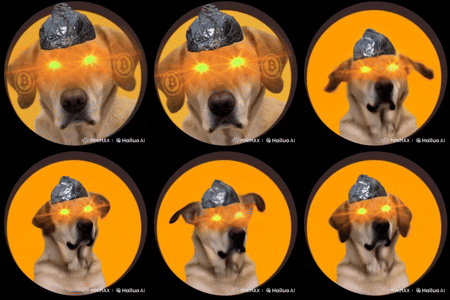
Awwww shit, you’re gonna make me reminisce about Bitcoin Twitter. Golden days


I’ve always felt a bit distant and different, and that I had to play something of a character to integrate. Bitcoin has basically meant I’m now just myself all the time and fuck it 🫂

Two replies, doesn’t look like the bots are that bothered?


These guys have a real bee in their bonnet. They’re not backing down until forced to. Fingers crossed they’ll push too hard, but they seem to have picked their hill and if they go down they’re going down fighting