
of course, I'm doing it for science!
yesterday was my first full day of eating only soy. I had edamame, soy milk, tofu, and tempeh. I wanted to eat soy nuts too, but couldn't find any. I'd also like to include natto in the mix, but I've never found that anywhere, or gone down the rabbit whole of fermenting it myself
GM, but only to those who celebrate

pubky has already been made 😂
what could 30 vibe coders accomplish together in one day?
big tech will never put this in their algo... this is why we need nostr

The Ray Peat phenomenon feels like the final form of the weird fixation among bitcoiners of tribal signalling based on their dietary choices. We're not just going to follow a niche fad diet as far down the rabbit hole as it can go, but we need to narrow the vast variety of human experience when it comes to food down to the whims of a single guru.
I'm out.
it's what causes them to get paid


maybe if you're having some writer's block, post drafts as kind 1, make edits, and the publish the final form on Substack/nostr

that sounds good!

Most people accept having a phone number as a given, like an unavoidable fact of life. It’s treated as if you can’t function without one. But a closer look shows that carrying a phone number comes with costs that aren’t just financial, they’re social, psychological, and even practical.
A phone number is an anchor. It ties you to systems that track and monitor your movements, habits, and identity. Every major company and government agency uses your number as a key to connect data about you, from your purchases to your location. It’s a unique identifier that turns you into a permanent entry in the databases of entities you don’t trust, and often can’t even see. Without a number, there’s one less point of entry for your life to be cataloged and mined.
Beyond surveillance, a phone number invites intrusion. Telemarketers, robocalls, and unsolicited messages are constant, but the bigger problem is how the number turns you into a node of instant accessibility. Anyone can demand your attention at any moment. This constant reachability pulls you away from the present, eroding any separation between solitude and interruption. Even if you silence your phone, the expectation remains that you’re only a call or text away, always on call.
There’s also a deeper layer of dependency. Phone numbers are a bridge to centralized networks, carriers, SIM registries, and government-regulated systems. These networks can cut you off or deny service without your consent. In contrast, other ways of communicating, like email, encrypted messaging, or decentralized platforms, don’t rely on the same choke points. They allow you to remain connected without being tethered to a single gatekeeper.
Some argue that you need a phone number for jobs, banks, or basic communication. In truth, most of these uses can be replaced. Many services accept email or app-based verification. Messaging apps work over Wi-Fi and don’t require a number once you’re set up. If your goal is genuine communication, there are plenty of ways to talk to those you care about without relying on a ten-digit handle that doubles as a tracking beacon.
Living without a phone number isn’t about rejecting technology, it’s about rejecting needless tethering. It’s about reclaiming the right to choose when and how to be reachable, and refusing to hand over one more piece of your identity to systems built on surveillance and control. If you want freedom from constant reachability and data harvesting, the simplest first step is to let the number go.



what if the spam relays and the paid relays are ran by the same people, with the spam there to get people to switch to the paid product?

according to my own heuristics, I am not ruffling enough feathers here. time to go on a rampage and earn some mutes!

Extending the web of trust to 3 degrees:
When you follow someone on Nostr, that creates a connection in your network. Each person is a node in the graph of who follows who.
Some people you follow directly. Others you see through reposts, zaps, or replies from people you follow. These are indirect connections.
People who show up through a chain like:
you → someone you follow → someone they follow → someone they follow
are called depth 3 connections.
To decide whether these distant people should show up in your feed, you can use the mute to follow ratio.
For each person at depth 3:
Count how many people in your extended network follow them.
Count how many of those same people have muted them.
Calculate the ratio of follows to mutes. If many follow and few mute, they’re probably worth surfacing.
If few follow and many mute, it’s a sign they’re low signal.
This helps you tune what you see based on how trusted people in your network react.

fourth turnings been happening for a while?
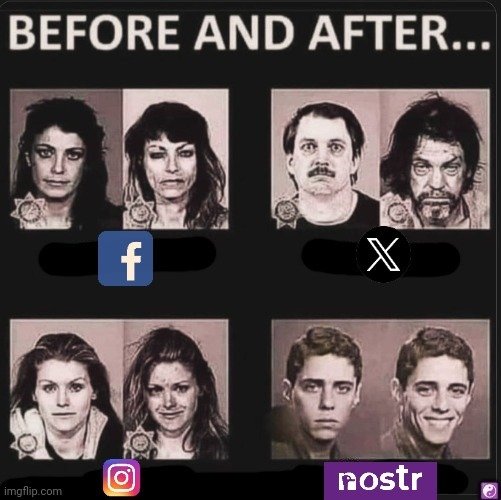
the behavior here I've been observing, and in some ways emulating, belongs on X and not on nostr. I will be muting some accounts and staying away from drama
Lord, have mercy on me, a sinner 🙏🏼
it's not a centralized algorithm. it's entirely in the hands of the user


my algo doesn't require you to enter any weights, it figures out everything based on who you follow and mute

I grew up listening to Alex Jones, and it's hard for me to pinpoint when he was fully compromised. then I moved on to Joe Rogan around 2013, but lately it's tough for me to listen to him anymore, because I would rather not be subjected to the current PSYOP
I have become a dopamine driven developer