


And then the relay admin removes it on their own eventually just to save space haha
As silly as it sounds, any user could have an AI assistant automatically apply content warnings for them. No need for others to do it nostr:note13952034xgnu9dw8f9vyrrf2cdewuwggm679st4v6vvmzlafdyf5qd4paq7

People used to pay $12 a year for Whatsapp. That was considered quite normal

Bitcoin should be a lesson that decentralized networks cannot rely on goodwill. Things need to be properly incentivized. The longer it’s put off, the worse it’ll get

The nostr version of Misskey !


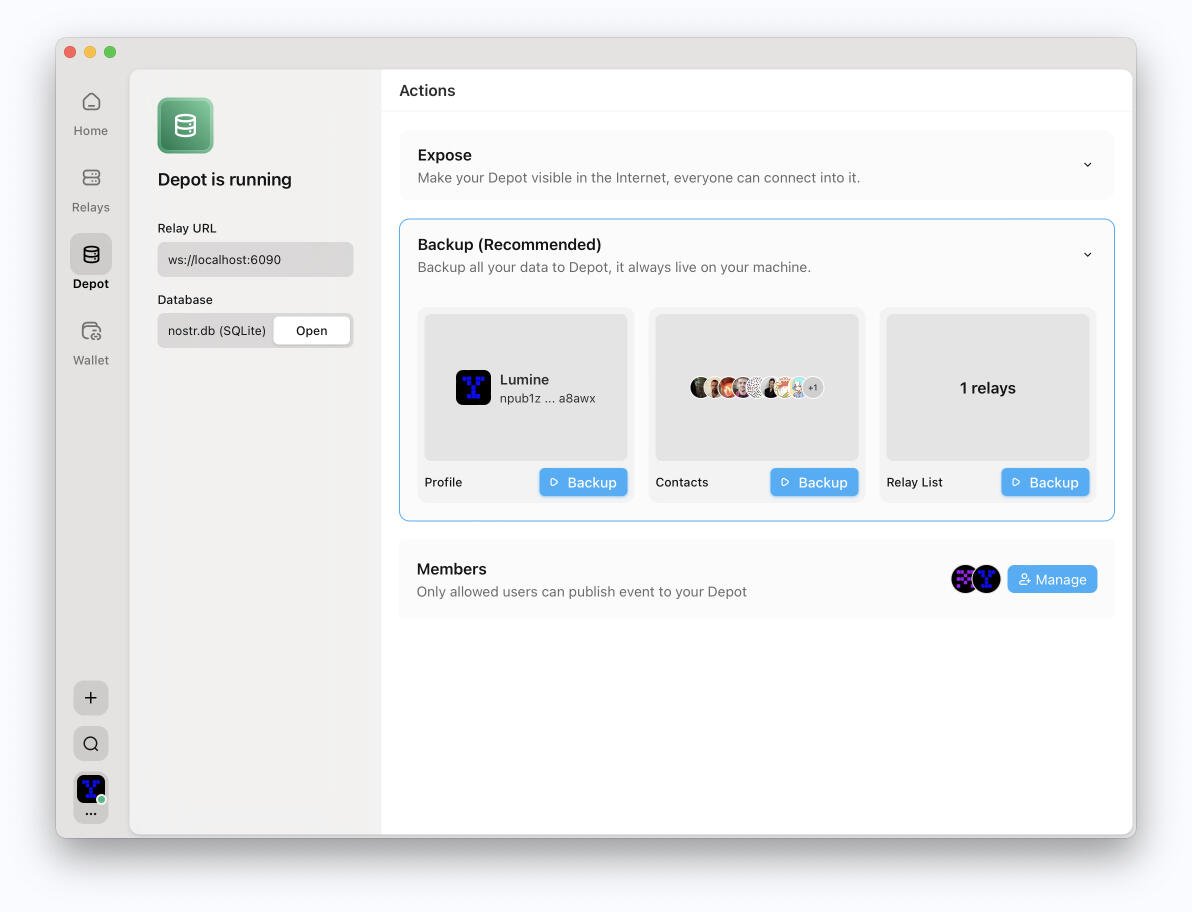
With all the discussion on the security of encrypted content, device access is everything. Running your own relay will be best practice. This rocks

I keep saying: Everything will flow through Nostr.
Here's a YouTube competitor: https://www.flare.pub
And here's the NIP for it: https://github.com/nostr-protocol/nips/pull/923
Why wasn’t this an extension to NIP-94 as multiple people suggested? Seems a bit annoying

At this point then, the bigger concern should be WHERE the data lives.
Need to limit where you’re posting DMs to and who can harvest them
If nostr:npub1exv22uulqnmlluszc4yk92jhs2e5ajcs6mu3t00a6avzjcalj9csm7d828 is open source, then couldn’t someone just rebrand it with a new name and ship it on the App Store? It’s an open protocol, right?
🗣️ NIP4 is dead! Long live NIP44!

I've been watching "WWII in Color: Road to Victory" on Netflix and learning quite a bit about WWII that I had no idea about. Some examples:
UK supposedly entered the war because a german U-boat commander mistakenly sank a civilian ship full of British citizens.
When Roosevelt sent troops to North Africa to fight the Germans in Lybia, instead of welcoming them, the French attacked the Americans. This was in part because the local installed govt. was afraid of what the Germans would do to the some 2+ million french POWs.
While soldiers were sacrificing their lives so larger numbers could be evacuated at Dunkirk, some were having a grand ol' time at the beaches, having parties and live circus entertainment.
When the US troops landed in Africa, they brought with them 6 tons of lingerie to bargain with the locals.
There's a lot more, but overall it's an interesting show that ties a lot of the things together for me. I've learned about the individual events and various parts of WWII battles, but never quite fit them into one picture - a sequence that made sense.
Of course, we don't know the full scope of what happened behind the decisions that were made, but it's still interesting.
Worth a watch if you like that sort of thing: https://www.netflix.com/title/81488464

I highly recommend They Shall Not Grow Old next! It’s also on Netflix at the moment. https://www.justwatch.com/us/movie/they-shall-not-grow-old
I'm shocked. Nostr was mentioned twice in this article. It wasn't mentioning very positively, but it was mentioned.
https://www.theverge.com/23990974/social-media-2023-fediverse-mastodon-threads-activitypub
It was mentioned positively.
> I’d bet heavily that ActivityPub becomes the default choice over time, but ultimately, it doesn’t matter so much which protocol wins as long as one of them does
The problem is more to do with the nature of *who* is running the servers. Some random guy that made a server for some random hobby? Yeah that’s awful.
A municipality running a server with tax payer money that simply follows the law? That’s definitely more interesting
Anyone use or have a wife/gf that uses the Natural Cycles app + the Oura ring?
I understand the Oura ring being expensive, but it’s a one time payment. What I DONT like is the Natural Cycles app costing $10 per month when all they’re doing is holding very small amounts of your data.
Would be amazing to have some hacker version that is much cheaper

# Taproot didn’t cause Ordinals ❌
I've seen the view that "Taproot caused/enabled Ordinals" commonly mentioned across Twitter, and it's one that can be extremely harmful. Many in the space would love to further ossify (prevent change) in Bitcoin and use Ordinals "spam" as the reason for doing so, but I'd argue that that would be the worst possible outcome from this situation.
This needs a lengthy explanation to properly grasp what's at play here, though, so let's get into the fun details.
## Arbitrary data in Bitcoin has always been possible
Something most people don't understand is that a system like Bitcoin is built for data storage, it's just intended for monetary data. This design made it possible from day one to include arbitrary (arbitrary) data into the blockchain, either through methods like OP_RETURN (a good place for storing arbitrary data as it can be easily pruned) or in tweaked pubkeys (a bad place for storing arbitrary data, as it cannot be pruned).
Some examples of this:
- Satoshi inscribed a newspaper headline in the genesis block coinbase (https://mempool.space/tx/4a5e1e4baab89f3a32518a88c31bc87f618f76673e2cc77ab2127b7afdeda33b)
- Luke Dash Jr. used his pool to inscribe Bible texts and prayers in 2011 in the coinbase (https://bitcointalk.org/index.php?topic=38007.0)
- Someone added the entire Bitcoin whitepaper to the UTXO set in 2013 (https://bitcoin.stackexchange.com/questions/35959/how-is-the-whitepaper-decoded-from-the-blockchain-tx-with-1000x-m-of-n-multisi)
All of these happened before both SegWit and Taproot, and there are many more cases of this type of data storage on Bitcoin.
## But I thought Taproot enabled this?
Unfortunately, there is a common misunderstanding (thanks for the troll name [@TaprootWizards](https://twitter.com/TaprootWizards) 😅) that Taproot enabled this type of data storage, thus opening the way for Ordinals "spam." In reality, this type of arbitrary data storage on Bitcoin has always been possible, but was made much cheaper to do with the introduction of SegWit in 2017.
SegWit was a major upgrade and bug fix for Bitcoin that enabled the Lightning network to be built and included a 3MB "witness" data allowance within each block w/ reduced fees for data to incentivize spending UTXOs (therefore making them prunable). More on SegWit in a fantastic post from [@River](https://twitter.com/River) here:
<https://river.com/learn/what-is-segwit/>
This incentivized portion of each transaction (called "witness" data) is intended for things like Bitcoin scripts, but can be used to store any data as long as it's done the "right" way. Specifically, Ordinals store them in an "envelope" between two opcodes, allowing the data to count as witness data and get the discount. This storage method was possible before SegWit, but now saves on fees in comparison to pre-SegWit usage.
While this of course was not the intent of SegWit, it underlines the simple fact that if someone wants to store arbitrary data in a blockchain, they will find ways to do it.
## Does that make SegWit bad?
If your first reaction is then to want to raise a pitchfork and campaign for no more changes in Bitcoin, remember this -- without the SegWit soft-fork there would be no Lightning network, no discount for users consolidating UTXOs, and instead users would be incentivized to create more un-prunable UTXOs as it's cheaper to create than to consume UTXOs w/o SegWit.
Additionally, Ordinals being stored in witness data allows those who run a node to easily prune them and not store them in RAM, unlike any method that leverages pubkey tweaking or other types of stenography to include arbitrary data on-chain. This means that the actual impact of Ordinals on those who run a node is drastically minimized versus other arbitrary data storage methods.
## If we didn't have SegWit, Ordinals would all use the UTXO set
It's extremely like that if we had never included the SegWit soft-fork into Bitcoin that the Ordinals craze would still have happened, and along with it a drastically worse outcome for the blockchain. In this alternate reality, Ordinals (and all similar NFTs) would likely be inscribed directly into the UTXO set, similar to how Stamps function today.
Some within the Bitcoin community have been asking for a removal of the SegWit witness data discount to force Ordinals to pay the same fees as all other users per byte. Unfortunately, this would have two extremely detrimental side-effects: it would disincentivize healthy UTXO management (consolidating UTXOs vs creating new ones) and incentivize Ordinals to be put in the UTXO set directly.
While putting the data into the UTXO set does cost those creating these NFTs drastically more, it also means that those running a Bitcoin node cannot prune the data, no matter what. Bitcoin relies on nodes being able to retain the entire UTXO set in order to verify transactions properly and prevent double-spends, and any data within that UTXO set must be kept in perpetuity.
That would be drastically worse for those running a Bitcoin node, and makes the Ordinals in SegWit witness data pale in comparison when it comes to negative impact on Bitcoin nodes.
## So what can we do about it?
The solution to reducing the cost of using Bitcoin is not censoring Ordinals (something that isn't even technologically possible, BTW), but rather is finally building solutions to Bitcoin's long-term scaling. Ordinals have highlighted something most of us knew would happen -- base-layer fees would become untenably high, as they have to for Bitcoin to be secure long-term.
In order for the average person to use Bitcoin, we need powerful scaling solutions like layer twos, and unfortunately Lightning in it's current form isn't the final solution. Lightning relies on every channel-owner (and thus user when done in a non-custodial manner) being able to settle back on-chain to resolve disputes, something that isn't economically feasible in a realistic fee environment.
## The solution? Covenants
Enter covenants, an improvement to Bitcoin that has been a long-time in the making and is finally picking up the steam it deserves in the space. Covenants enable both improvements to Lightning that make it drastically more scalable, and new layer two networks to be built that have different (often better) trade-offs compared to Lightning.
As this post is already getting a bit too long I won't dive into the details of covenants, but instead ask you to spend a few minutes going through this fantastic set of resources on covenants to better understand what they enable:
Have questions? **ASK THEM!** The best way for the broader Bitcoin "rough consensus" layer to work is for more people to step up, learn, and ask questions as they go.
Too long; didn’t read. But I generally agree with everything you say anyway

nostr:nprofile1qqsr9cvzwc652r4m83d86ykplrnm9dg5gwdvzzn8ameanlvut35wy3gpzamhxue69uhhyetvv9ujumn0wd68ytnzv9hxgtcppemhxue69uhkummn9ekx7mp0qyt8wumn8ghj7un9d3shjtnddaehgu3wwp6kytc6m02cg clued me in to Oblivious HTTP on our podcast the other day, it looks like a really promising: https://www.ietf.org/archive/id/draft-thomson-http-oblivious-01.html
This sounds like a poor man’s version of Homomorphic encryption. Simple is good!

What if there is a happy middle ground? Instead of asking users to confirm that two strings match, do it for them and just show a green light or a red light. Something like that?
> It allows for public and private read receipts, so it covers DM/group chat read receipts as well as user notification read status.
LETS GOOOO

I said this to you on a twitter Q&A years ago, but incentivizing the upkeep of packages is the main problem of all solutions like Start9. You need to find a sustainable way to manage it