
I was on a few of the social media sites briefly and dropped out because I didn't like any of them much. I gave Twitter a second chance after Musk bought it. I got about as far as following Musk, SpaceX, and a couple of space agencies, and reading a few tweets while posting nothing yet, before getting my account temporarily disabled, with a demand for pictorial ID, for "suspicious activity." (Reading is apparently a very suspicious activity to certain parties.) I told them they weren't getting any ID and they should kill off the account. They kept sending me new-user suggestions while preventing me from logging in to turn off the useless emails. I threw all Twitter/X email addresses in the spam trap. Curtain.
It was relatively early and I figured maybe Musk hadn't cleaned all the Lefty Censors and their systems out of his purchase yet. Maybe. But I was still radically unimpressed and untrusting. There will be no third chance.


Aw, I hope he or she gets better.

What does this improvisation remind you of?
nostr:nevent1qqsz5ljur7tv8yf0vfm0x5ptncgc8255t764jmztzxgqr7s70jx23rcl26n59
Pleasing memories brought into the present and still active, rather than something lost.


When I change contexts, I change 'nyms. I never crossed into RL in the majority.
Most of my old pseudonyms are dust in the wind now, along with the contexts I was using them in.


I read the TOS and found the rights claim potentially too broad.

Because many social networks are dishonest censors and radically untrustworthy.

It's not necessary for me to disconnect. It's just that I'm doing a very long, slow wrap-up on my most recent online project and presence. Maybe there'll be another. I'm poking around to see, because this isn't the justly lamented '90s Internet anymore and it's now hard to locate online places to settle that aren't hostage to a corrupted oligarchic establishment.
Not a Bitcoiner. I will never be a Bitcoiner, or at least I will never admit to it, because, with my philosophy, naturally I will never willingly write anything that must ultimately attach my mundane name to an uneditable public ledger. This makes nostr an awkward fit in some ways. But it's not obviously unworkable.
What I most regret, over the decades, is some of the unintended disconnections from people I liked. When the common activity ended, we exchanged contact info and went our separate ways for a while ... and, eventually, even with people who don't intentionally fade from public view as I do, the contact info no longer works. I should have acted more quickly to keep those contacts live. But I didn't foresee the ephemerality of life online, back then.
Most other people don't seem to be able to get friend groups to shift, if the original venue is still functioning. Cue "I don't like it but I guess things happen that way."
I haven't tried to bring anybody. Long time ago I developed the defensive habit of altogether abandoning my old handle when I sought out a new activity. This is because I first got online in the Wild West Internet days, and it didn't take me long to realize that a) good people I never would have met, and bad people who never could have noticed me, were now both in range, and b) there was no practical defense against an obsessive evilminded lunatic from out-of-district; pre-Internet law enforcement wasn't set up to cope. Pseudonyms that only last for a time could make me hard to follow around. Just in case.
(Now we have got an establishment that has decided that what's important is not protecting the serfs but suppressing them. Worst of both worlds, in certain ways.)
Maybe nostr'll serve. I've considered dropping offline altogether except for practical stuff, too. That seems a little drastic. But it's now on the table.

1. I have a list of projects and tasks to touch most days. I have too many at the moment, so I've found it useful to make sure they get short sessions to keep them in memory, rather than letting enough time pass to let me start forgetting what I was doing. I get to most of them most days. I work on one project till I get one item done or in a position to leave with a note, or until I see I'm not making progress that day and try again tomorrow. Perfect consistency is not necessary.
2. If I'm not working productively on anything much I take a day off.
My first post, I'm discovering Nostr and Primal. I don't yet know what I can and can't post, or who will see my posts.
So, let me introduce myself: my name is Vincent, and I live in Corsica.
I spend as much time as possible in nature with my dog, Vasco, a Mini American Shepherd who follows me everywhere, all the time.
On my outings, I like to take photos and videos, especially of sunsets over the Mediterranean Sea.
So I'll start by sharing a video of Vasco and a sunset on the beach; it pretty much sums up what's important to me.
https://blossom.primal.net/9957520e83d27bd4b2e07f4b55f1a8f84d1a7eb874ae4bc0ad1e0ac7784c480f.mp4
Hi! Nice photo, glad the dog is having fun! Dunno what I'm doing yet either, so I've decided to follow new people.


Funny! Not entirely fair, though. Comic Sans is usually legible, unless you put it on a ridiculous background.
The most common bad user experience is inflicted by the numerous websites following an incompetent design fad: using low-contrast grey lettering on stark white, apparently on the theory that it looks sophisticated. The badness is exacerbated if the website is perpetrated in a thin-stroked font whose stroke width doesn't increase with the font-size -- an abomination like Raleway. Body text on such sites ranges from the painful to the wholly unreadable.
There were formerly occasions when I wanted to read a particular site badly enough to rewrite its horrible stylesheet, but I've run out of patience and now just abandon such.


Welcome! Been hanging around for a month or so. I have small idea what I'm doing.

I've been hanging around without doing very much, so far.
Motive for being here at all: escaping the Censors of the Left, and the Censors of the Establishment. _My_ Internet, the one that I joined in the 1990s, is dead and gone, partly through the usual course of eventual concentration of corporate power, and partly through the malice of powerful people who freaked out at the intolerable spectacle of mere plebeians daring to say unapproved things to large groups, in ways the powerful people couldn't (then) readily control.
I can cope with a lot of Bitcoin posts, but I never propose to join the congregation of Bitcoiners, nor to post about Bitcoin.
I rather like the homesteaders and do-it-yourselfers but, for various reasons, will probably never have anything useful to say there either, since I can't follow that path.
If I go forward, that means bootstrapping a community that discusses other subjects I'm interested in. Starting from scratch means:
1. Committing to post on the subject most days; and
2. Making the content publically available, but concentrated in one findable place, so it's possible to recruit non-nostriches by saying "if you're interested in Y, sign up for nostr and do such-and-such";
3. Some mechanism of pest control. A small enough group can get along without it for a while, being scarcely noticed; a successful group will eventually need it.
1. is personal: it means finding the free time and dedication.
2. & 3. are questions about what's technically doable with nostr, and how? which I have not yet adequately researched.
It isn't the first thing I read. But the first thing I stuck with: iris.to
It's really, really easy to set up and there are links to people and hashtags on the right side, which makes it easy to start browsing.
I already knew about what I wanted in a social network and was looking around to see if it existed. Nostr's close enough.


Welcome! Beautiful dog.

Python.
If you want to write code for your website right away, then you should do Javascript. But I don't like it much, and in some ways it's weird and creaky.
But Python's a lot more fun to write, clearer overall if you're just getting started, and versatile.

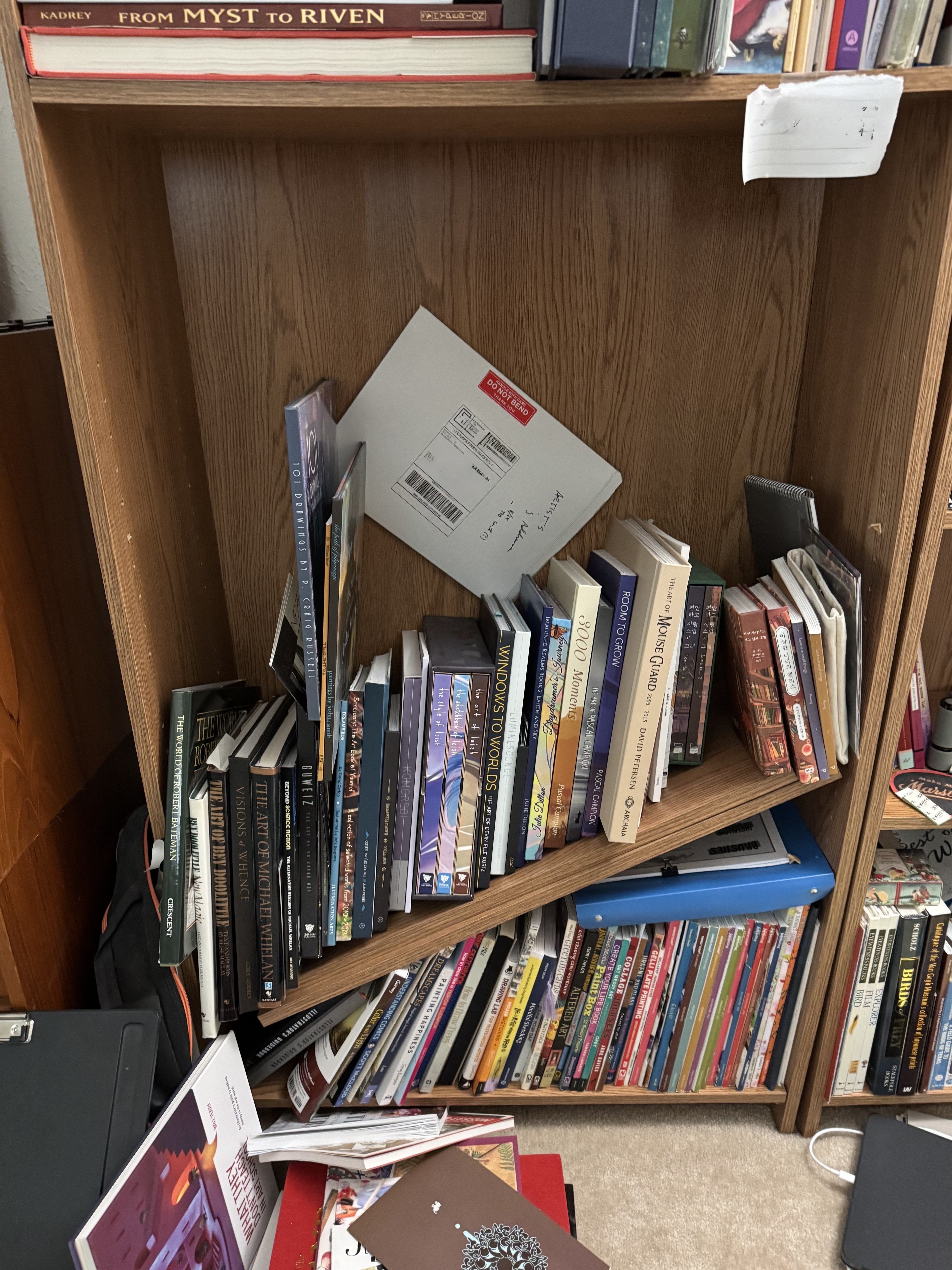
The plastic shelf clips bend under the weight of the books on a full long shelf; the shelf collapses; and then the bookcase lists and makes further shelf collapses even more likely. I found some metal replacements for those plastic shelf supporters, which stops that particular progression. Also it's best to keep the heaviest books on the bottom. I wish I'd bought something else, naturally.

I can't find a way to construe that that doesn't make it a bad analogy.
1. Higher level languages -- COBOL being one of the first -- do pretty darned similar things in pretty darned similar ways, much of the time. [Inevitable caveats.] The major break was not between COBOL and anything more recent. It's between assembler/machine language and any higher level language.
2. Higher level languages allow you to do more in less time because you're offloading part of the fiddly nuisance management to the machine. But programming in a higher-level language does not require more knowledge of how the machine works. It requires less. Very substantially less.
3. Since we haven't been training many COBOL programmers, and since a great deal of expensive financial programming was done in COBOL on expensive mainframes intended to last a long time, COBOL programmers who can maintain the old stuff make good money.
Programmers have passionate likes and dislikes for systems we consider well-designed for their intended purposes, or badly designed. But we don't tend to sneer at old tech simply because it old. Particularly we don't usually sneer at the people who knew how to get useful work out of much less accommodating tech.

Well ...
1. Even if Duck Duck Go doesn't keep logs, so far as I know, they don't do their own searches directly. Last I heard, they act as an intermediary between the users and the outfit they're buying results from (a while back that was Bing; whether it still is, I don't know).
2. That search is probably unique. I doubt anyone else has ever searched for your secret key. In that way it sorta sticks out. So it's not whether you trust Duck Duck Go, but how much you trust any of the larger companies they could have bought search results from (Microsoft or conceivably Google).
3. I would assume the key has been seen and logged by large nosy agencies, including from unfriendly nation-states.
4. If you have an ordinary life, past, present, and future, likely nothing will come of it anyway.
5. But I think I've just about talked myself into disclaiming any key pair if I ever accidentally search for the secret key. Most likely nothing would come of it; but who can know that the future we'll see is a likely one?

GM! What a nice-looking spot for coffee. I'm poking around nostr to see what it's like.