

When people talk about Occam's Razor as if it proves something, rather than being a bullshit detecting heuristic, then ... yeah. Also, it's much less useful outside of maths and formal logic, which is what William of Occam was focused on when he coined it.

wow, nostr:nprofile1qy2hwumn8ghj7un9d3shjtnddaehgu3wwp6kyqpqqfsw3ctkyhh4zphgmurq8xdpemqm9g59h72q4z6gqf7ms5wacrys243hke released their Sculpt OS for MNT Pocket Reform with i.MX 8M Plus processor https://www.genodians.org/jws/2024-11-25-sculpt_mnt_pocket
I love the idea of the MNT Pocket Reform, but I'm loathe to buy a brand new device that can't run without binary blobs in the Linux kernel. Especially one that costs upwards of 800 Euro.

"They focus on transactions.
They should focus instead on the relationships we are forging with each of those transactions."
Intriguing thought. I'm reminded of a concept described by Charles Eisenstein in Sacred Economics, and David Graeber in Debt, that monetary transactions originated as a tool of exchange between strangers. Who couldn't be relied on to continue participating in the gift economies and mutual credit systems that predominated within local communities.
A friend of mine was experimenting with an [SSB-based app](https://togetherproject.nz) index for exchanging IOUs (promises to pay), backed by crypto reserves. But not actually clearing transactions unless the app couldn't "close the loop" within a network of exchange.
I asked him if the app could be rebased on Nostr, and he said he had thought about it, and probably yes.

Freedom is our natural and constant state of being. Consenting to a transparent and consultative set of laws and regulations is the entry fee for advanced cultures, capable of large-scale cooperation (eg making and distributing personal computers). But we never stop being free unless we submit to an opague and imposed form of rule.
If that's what you call "long form", your normal posts must make haiku look wordy 😆

"Legislating is Congress’s job—and Congress’s alone."
The Fifth Circuit's ruling to remove Tornado Cash from OFAC's sanctions list is a direct stab at the Government's recent regulation by enforcement strategy.
Here are the most important arguments:
1. The court has found that Tornado Cash smart contracts do not constitute a service or property, defining the contracts as tools that are "nothing more than lines of code," which cannot be sanctioned under current OFAC regulation.
2. The court has found that Tornado Cash does not own or control the smart contracts, as the developers revoked any role in the software's operation – making important distinctions between "mutable", which it defines as custodial, and "immutable" software.
3. The court recognizes that OFAC's framework may be outdated to apply to modern technologies, but explicitly states that it "declines the Department's invitation to judicial lawmaking", stating that
"Legislating is Congress’s job—and Congress’s alone." ✊
Updated story: https://www.therage.co/fifth-circuit-lifts-tornado-cash-sanctions/

Both legislation and enforcement are crucial to effective regulation. There's no point in a law against unreasonable search and seizure if there's no consequences for anyone that does it. But dumb regulation is the enemy of both good regulation, and public trust.
History will judge whether or not the Tornado Cash case is dumb regulation. But from what I've read so far, it's sure looking that way.

The debate about F-Droid security and trustworthiness has been ongoing for a while now with passionate arguments on both sides, so I will let you go down that rabbit hole for yourself.
The main issue for me with F-Droid is having to trust not only the dev but also F-Droid. This is basic OPSEC. If you can get it from the source (GitHub usually) without also having to trust a 3rd party, then that is basic security practice. If the release is on GitHub, the Obtanium is just pulling from the repo.
If the dev releases the apk on F-Droid only, then that is the release repo (not GitHub/GitLab, Codeberg), straight from the dev. Using Obtanium, in this case, now introduces a third party, so while the risk is minimal compared to an alternative client like Neo Store, I still recommend following best OPSEC practices and just getting the apk from the source, which in this particular case is not Codeberg, or GitHub, or GitLab, but F-Droid. I already spoke about why I recommend F-Droid Basic in the post.
Here is more info on the subject: https://discuss.privacyguides.net/t/remove-note-about-getting-f-droid-apps-from-obtanium/14440
Thanks a lot for the detailed response. Just posting the link would have been quicker for you, so I appreciate you taking the time.
"If the dev releases the apk on F-Droid only, then that is the release repo (not GitHub/GitLab, Codeberg), straight from the dev. Using Obtanium, in this case, now introduces a third party"
I guess the underlying issue here is one of dev practice. If all mobile app devs ran their own
release repo, independent of *both* code forge and app library, then something like Obtainium could always download directly from the dev.
Installing with F-Droid could then be an automated process of adding that repo, and installing from it. At least as an option, for those who don't want to trust the F-Droid team to compile from source.
As things stand, people using Android apps are usually forced to trust either Goggle Prey Store, GritHub, or F-Droid. I know which of the 3 I trust. F-Droid is the only one where full source code is available for *every* link in their distro chain.
In the long term though, the solution to all this is Reproducible Builds. Or some other way of checking whether a binary (or server) is compiled from the published source code.

Gentle Reminder....
https://video.nostr.build/cc1e0c94f7df57516ee2d3039c6e268e7d618499c2788a4775c6740a5dc51bf0.mp4
#YouAreWorthy
A good remainder that the value of money is determined by social agreements, and therefore,by relative social power. In the airport, retail management has total social power and you've got none, so they can devalue your currency when you buy things as much as they want.


Looking for an open-source privacy oriented fitness tracker?
I have really been enjoying FitoTrack.
FitoTrack is a mobile app for logging and viewing your workouts. Whether you’re running, cycling or hiking, FitoTrack will show you the most important information, with detailed charts and statistics. It is open-source and completely ad-free.
Features:
• Track workouts. Choose the type of sport you would like to track and just start running, cycling or hiking, for example. You can see the general information right below the map on the tracking screen.
• View your workouts. View general information such as date, time, duration, distance, speed and pace. See your route on a map. Work out your level of performance from the speed diagram.
• Open-Source. There is neither advertisement nor tracking, and the source code is open and licensed under the GPLv3.


Check it out!
The repo is on Codeberg and the official release is on Google Play and F-Droid only, so...
I recommend getting it from F-Droid Basic and not a third party like Obtanium.
Get it here:
https://codeberg.org/jannis/FitoTrack
For those who wonder why not Obtanium?
My views align with PrivacyGuides and modern security standards regarding obtaining apps from F-Droid. I don't recommend getting apps from F-Droid unless it's the only option.
If F-Droid must be used, F-Droid Basic is the preferred choice. F-Droid Basic supports automatic background updates without privileged extension or root and has a reduced feature set, limiting the attack surface.
Third-party F-Droid clients can have numerous issues, such as lacking proper mirroring support. For this reason, I recommend avoiding Neo Store and no longer suggest using any third-party clients for F-Droid repositories.
#Ikitao #Fitness #OpenSource #Privacy
One of us is confused about how Obtainium works. AFAIK it's not a third-party client for F-Droid. Rather it downloads releases directly from the code forge used by the app developers (usually HitGub).
Also, can you link to a good summary of the perceived security issues with using F-Droid, and what the alternatives are to using that, Goggle Prey Store (obviously not a good idea) or Obtainium?

"That no one cares about censorship resistance."
Or that there are other things they value more right now. Seems most people prefer a space where they might get banned, to a place where they have to wade through a cesspit of spam and harassment.
BS is solving the moderation problems the same way as any centralised platform, with centralised moderation. The only reason to leave the birdsite for BS is if you prefer your censors with the opposite set of biases. Just like everyone who left Titter for Myths.social and returned after it became "X".
The fediverse solves the problem by letting people pick their mods without changing networks. Future features could make this more effective, like nomadic identity;
https://wedistribute.org/2024/03/activitypub-nomadic-identity/
... and automated consensus moderation;

"What can we in Nostr learn from the recent surge in users for bluesky and mastodon?"
1) People go where they think they'll find their friends.
2) We need to keep working to unify all the ethical social web projects, both the networked ones and the monoliths. I believe Minds are now federating over Matrix (for their chat) and ActivityPub (for posts). Are they publishing to Nostr too? If not, what's the quickest and easiest way for them to start doing that?
3) People are more likely to use things they've heard of. We need to find grassroots ways to promote decentralised projects that don't depend on the tech press or FB ads.
4) People have drunk the kool-aid and they think BS is decentralised. It isn't, it's yet another VC-funded platforms and will enshittify accordingly;
https://pluralistic.net/2024/11/02/ulysses-pact/#tie-yourself-to-a-federated-mast

"Is the 📡still on nostr?
I’m surrounded by normies who have no idea that bitcoin game theory about to blow off."
Sounds about right. In my country, "blow off" means to fart 😋
"And I'm grateful you're here 🙏 Bitcoin attracts the best of the best."
I'm not here for the digital derivatives, but thanks anyway.

"Inherent in my ideas are often questions that an AI might help answer."
I guarantee you and your rubber duck could come up with more creative and more relevant answers. Or at least the duck could help youformulated the right questions. At which point an old school, nonsmart index search is your go-to.
"Another aspect is memory; I would expect my AI to be able to recall that crazy idea I was grinding on last month"
Why would you expect that? I find they often forget context in the course of a single conversation.
"Brave does show sources ;) as does Duck Duck Go."
Good to know. In which case they're just as featureful as a Wikipedia page, but probably not as accurate. Because they could at ant time be "hallucinating" and spouting confident nonsense.
"DDG's browser product is trash, though, I just use their search at times."
Their browser is just a wrapper around Blink (or WebKit if you're on an iThing), I agree it's of limited use. Their search portal is a wrapper around Bing these days. It's not as good as it was a few years ago, before it was that. But I've to find anything to replace it.
Is there literally no one talking about juggling on Nostr?
#juggling

"In many circumstances animal products are more environmentally friendly. Such as using animal fat for skin care. Albeit I am assuming the animals are raised on a regenerative farm and fed naturally."
Free range, organic meat is about on par with industrially produced plant-based meat and cheese. It's still much less resources-intensive than either if you make your own plant-based meats from local, organic crops.
Key point, animals don't make any of the nutrients other animals like us need to eat. They just concentrate proteins, carbohydrates and iron from the plants they eat. While using up a huge volume of those carbohydrates, and heaps of water. Using the same resources to produce a range of plant-based food, using permaculture design, mixed cropping etc, gives us way more calories and at least as much of the other nutrients.
In case you're wondering about B12, yes, animals have bacteria living in them that shit out B12. But there are more direct ways of getting bacteria to give us B12 too.
"I like the idea of having an AI to be a sounding board, just to bounce random ideas off of."
Why is this more useful than a rubber duck?
https://rubberduckdebugging.com/
"What has been helpful is Brave browser's AI search result. I can't comment on other browsers/search engines."
I don't find this useful. I want a search engine to show its sources, so I can check it's not serving me confident nonsense. If I want high-level summaries, they can be found on Wikipedia, or in blog posts by people I know are human, again with links to sources.

> most ISPs are a subscription model, where you pay per month. This is normal most places. That's metered access, just on a longer timeframe than your willing to consider. But there's really no difference.
If you take a taxi, they have a meter, so they can charge you per distance travelled. So that's metered. If you give your mate $10 to drive you somewhere, that's a fixed fee. There's no meter running, so it's not metered.
By the same token, if you pay for an internet connection for each hour/ GB you use, that's metered internet. If you pay a fixed price per month for a connection, that's a fixed fee. There's no meter running, so it's not metered.
This difference matters.
Here in Aotearoa, the move from metered to unmetered internet is a big part of what made it affordable to the average person. The introduction of metered mobile data then created a 2-tier internet. Where some people have unmetered WiFi at home, and can use the net with no time or data limits. While other people can only use the net as much as they can afford mobile credit.
IMHO we need to be pushing for universalisation of unmetered internet. So coming up with better ways of metered internet doesn't excited me that much. Sorry.

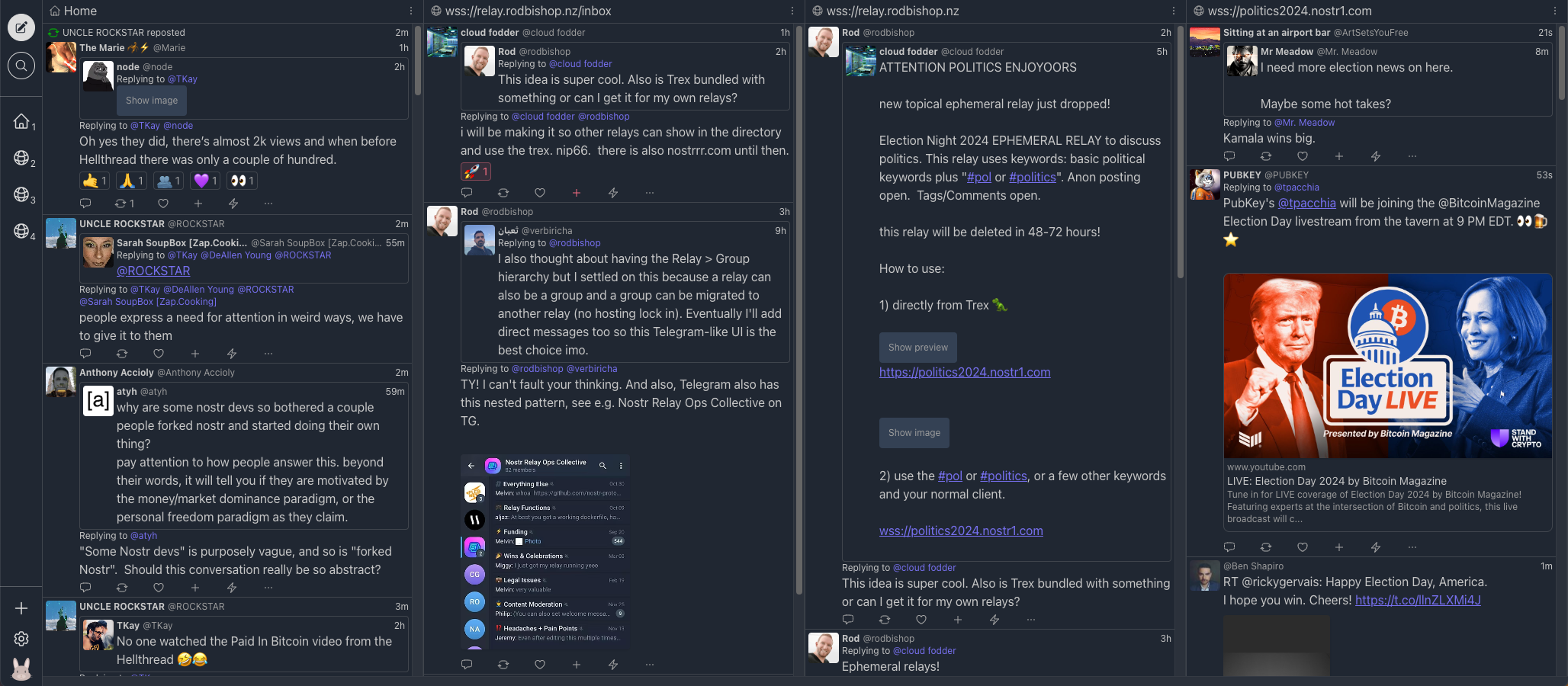
"I love it! Relay-first view in multi-columns like Tweetdeck or Hootsuite"
... or the original Mastodon web app. Still available as an "advanced" interface in the settings.