

Perhaps if self-custodial LN UX improves without sacrificing privacy. But even then there are still other arguments for Monero (decentralization from ASIC-resistant mining, future blockchain security from tail emission, scalability from dynamic blocksize, better privacy of L2s built on an encrypted blockchain, etc)

Monero has already been the leading privacy coin for quite a long time already. It's the preferred currency of darknet markets.

Yea, I won't disagree, if someone makes as many mistakes as the guy in this video (not masking IP address and using centralized exchanges) and everyone involved is colluding, Monero and Lightning probably aren't going to help much
There is no one holding money temporarily in this scenario. I think you misunderstood what I said.
If person A pays person B, then person B pays person C for a good/service, the original sender A has no idea where their money eventually ended up. From the perspective of A, person B could have sent it to someone else, themselves, or it could have never left their wallet to begin with.
I wouldn't say not private, but less private than alternatives.
Depends who you're trying to be private from and how you're using it.
Sending your Monero to someone else, or another wallet you own, after you receive it is functionally no different from trampoline routing (besides the fact that it's done in a single step with the latter). In either case the sender doesn't know for sure where the money eventually ended up or if it was even spent to begin with.

And another datapoint:
I just talked to the owners of https://proxysto.re/
They said that the usage of crypto vs. fiat is somewhat equal (when it comes to volume for their business).
And that Monero gets used MORE often than Bitcoin.
Oh and also that they're adding LN as a payment option hopefully soon.
And last but not least they think about making the statistics about crypyo & fiat usage publicly available.
Big thank you to these guys for running that business and being open about the numbers with me!
Now that I used their service I highly recommend their service :)
#xmr #monero #btc #bitcoin #makecryptousable
That would be great if they made the stats public

Don't get me wrong I think ecash is cool and has it's own unique advantages, but I just think his chart is misrepresenting it's attributes. I wouldn't ever keep large amounts on it.

It also adds an additional rug risk to user and vendors; the market escrow itself(is multisig currently or theoretically possible with ecash?) + ecash mint. I doubt most vendors are going to manage their own LN node. Ecash is a big convenience upgrade for users though so might be cool to at least see the option.
I wonder if there are any mints that exist right now that are Tor-only

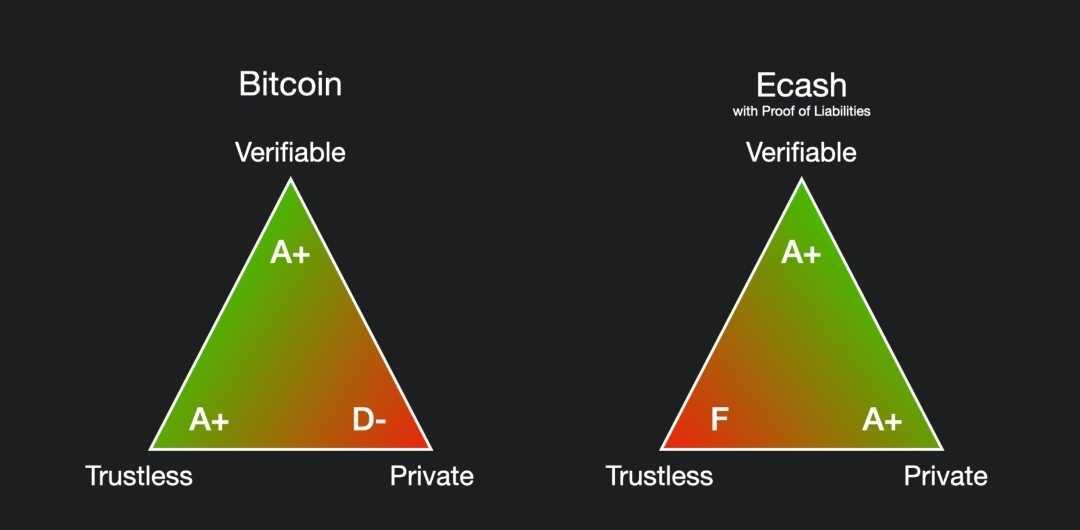
Ecash is not A+ for verifiability...mints can covertly print tokens unbacked by Bitcoin. Even with epochs for proof of liabilities it's more like a C+/B-
Transaction amounts you spend/receive on ecash are visible to the mint - the only thing it blinds is who the signer is. Transaction amounts arent visible to any third party on Monero.
Ecash has other advantages over Monero though (i.e. instant, free/very cheap tx fees, offline use, no public blockchain) and vice versa (self custodial, more verifiable/secure, global anonset [not fractured up across different mints], more censorship resistant [mint is a single point of failure])
I know the nuance might short-circuit you, but its true regardless
Ok, I thought so, but just wanted to mention it as a backup in case you didn't know about it
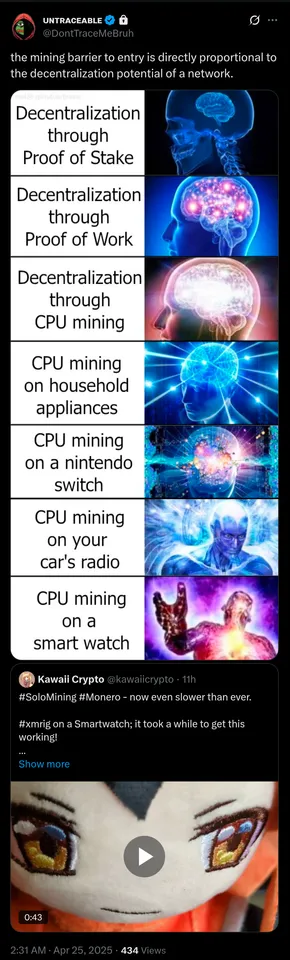

Exactly. Even putting aside it's various other issues a central problem for me is that you can't actually spend Zcash anywhere (especially not z2z). P2P markets are also non-existent. Moneros realtively small economies feel massive in comparison.

Eles executam seus servidores em RAM, o que oferece resistência contra análises forenses
Você tem razão. É preciso confiar em qualquer VPN até certo ponto. Com a Mullvad não é diferente. Embora eles tentem minimizar essa confiança o máximo possível. Isso pode ser suficiente para muitos, especialmente se o servidor estiver localizado em outro país. Depende do que você está fazendo e da dificuldade de rastreá-lo, especialmente se for algo tecnicamente ilegal, mas de menor importância.
Se precisar de algo mais robusto, confira o Obscura, que possui dois saltos entre duas partes diferentes (Obscura e Mullvad). Nenhuma delas sabe seu endereço IP ou tráfego da web ao mesmo tempo. Embora eu não ache que elas estejam disponíveis para Linux ainda.
Se você precisa do mais alto nível de anonimato e está sob ameaça crítica, você deve usar uma mixnet como Nym, Tor ou I2P para essa atividade de qualquer maneira.
If it happens again maybe you can use xmrchat as a fallback

nostr:nprofile1qqsr26r4lltjnvrwadxp67ns58m4qpzaqemhf5sup7hlujhjh7t296qppemhxue69uhkummn9ekx7mp0qy8hwumn8ghj7mn0wd68ytnddaksjnsd25 any thoughts here on best practices? Is there a way to keep identify from shipping address now and is there an opportunity for a NOSTR app to protect this?
If you're just looking for privacy from the general public a P.O. Box or mail forwarding service like PrivacyPost

Does caffeine and nicotine count? If so 100% Monero drug addict here

>"A Liquid já é amplamente utilizada (e aceita) na comunidade que aceita BTC e tem seu efeito de rede (embora não tão aparente e nem tão grande, é suficiente para os meus propósitos)"
Qual é a sua métrica para "amplamente utilizada"? Certamente não é a contagem de transações na blockchain da Liquid, porque ela é extremamente pequena.
>"Não vejo problema, novamente, porque é uma segunda camada e apenas uma parte insignificante dela por curtos períodos de tempo para propósitos específicos."
Este é um argumento semelhante ao que lhe dei para usar o Monero. É uma parte insignificante por curtos períodos de tempo para propósitos específicos. Mas agora vejo você usando isso como um argumento a favor da Liquid.
>"A beleza de uma segunda camada é que você pode facilmente e nativamente voltar para a primeira camada sem muito estresse e sem qualquer risco de flutuações cambiais sempre que quiser."
Há muitos lugares para negociar Monero e Bitcoin sem muito estresse. Ele não tem a estabilidade de preço que a Liquid oferece, mas isso pode ser tão prejudicial quanto benéfico para você nesses curtos períodos de tempo, como você disse acima.
>"Você diria que o Lightning BTC também é outro token? Porque a mesma coisa que garante a paridade L-BTC garante a paridade do BTC Lightning: a transação OnChain bloqueada na camada 1."
Não, eu não diria que o Lightning é outro token porque é literalmente Bitcoin bloqueado em uma assinatura múltipla. Você não precisa de permissão para sacar seu Bitcoin. Para a Liquid, você precisa de permissão da federação. A Liquid não oferece o mesmo nível de segurança criptográfica porque a federação pode conspirar para roubar o Bitcoin que lastreia cada token da Liquid — tudo o que eles precisam fazer é concordar. Com a Lightning e a Monero, isso não é possível.
Você está certo de que as atualizações da Lightning são, em sua maioria, compatíveis com versões anteriores, mas não concordo que compatibilidade com versões anteriores seja necessariamente sinônimo de segurança. Versões mais antigas do software Lightning estão repletas de vulnerabilidades de segurança e bugs, permitindo até mesmo o roubo de fundos com "ataques de ciclo de substituição" e similares. O objetivo da atualização é corrigir esses problemas de segurança primeiro.
Acho que nossa conversa vai continuar. Então, talvez devêssemos parar com "Concordo em algumas coisas, discordo em outras".

I was with you until #usdt 😅
If you must use a stablecoin - at least use one they can't freeze #dai

Está a ir longe demais. Talvez não tenha uma compreensão completa de como o Monero funciona.
Mesmo com este cenário muito improvável, o Monero continuaria a ser muito mais privado do que o Bitcoin. Portanto, ainda não seria "tão vulnerável quanto o Bitcoin", como você diz. O montante enviado e o destinatário continuariam a ser completamente ocultos. Não posso exagerar este facto. Não existe um gráfico de transacções como no Bitcoin, mesmo que se descubra o remetente. Também não há valores visíveis.
Também não se saberia necessariamente a identidade do remetente literal. Talvez seja a mesma entidade que enviou uma quantidade desconhecida de Monero para um destinatário desconhecido.
O Monero também tem proteção IP padrão com "Dandelion ++", pelo que não se saberia a origem IP da transação, mesmo sem Tor ou uma VPN.
Monero neste cenário é improvável:
Talvez Alice tenha enviado $[?] para [?]
O Bitcoin funciona perfeitamente como normal:
Alice definitivamente enviou $X para Bob