

Follow these:
nostr:npub1syazeldyn2yqrcsma57z8q88smayett48hg4kxh3ngm6s92hj4usvagmnw
nostr:npub16zf05np625wqzz80euvyc2r37y6r2vfwcatj80k4rdjlyqq3sals5e8sln
nostr:npub1ynfk3s2qaend2knwq7hry2qdxglxxvch03jksjc7stk4ancq6vtshlf3np
nostr:npub16uqhv2xpgmn2w9gmg00dvs28x9pd79wzcdnqcmfjjtpym35qymmq3cv8yd
nostr:npub1md5qn5j74l7zkjzd58dqcjwkwdj4uc8legh8zyzrym4mrkzesffqj36q6s
nostr:npub19at4nqjjymca2lh3v546vcg5ktun3al4c5xu2pts3ewckv0y70ys0gupzr
nostr:npub1c6evhuufunv5w3ksz5y7lqfq3nzm45m2uwtq9fp8ghnvfalu2pmshtg8df
Kind to be recommended but I'm not after follows, I'm more a quiet background reposter and zapper than content creator. nostr:nprofile1qqsg5h65kw0vz5w2u00n7lkq994lza4rsdlf6w3e9rx7na4m8wy2mnspz4mhxue69uhkwun9v4h8xmm4dsh8xurpvdjszrmhwden5te0dehhxarj9ekk7mgpz3mhxue69uhhyetvv9ujuerpd46hxtnfduu748ay deserves more accolades for his #saturdaysforsatoshi sitouts


In this context I think it's simply an abbreviation of "Bluesky"
Bluesky

Saturday, 4th January 2025 - Oracle Roses
Tim and I worked into the garden clearing up our fallen trees before the snow was due. We chopped, dragged, and barrowed until we had reinstated clear pathways through the garden. My muscles in every part of my body happily ache. We didn't get any snow. We got rain.
I feel bereft. I have finished watching The Resident.
Day 4 #stadaeasel
I have had fun playing with time-lapse videos of my painting. I have done one of the painting below. If you would like to see it have a look at my Instagram page katerundellartist.
-
-
-
#stradaeasel #apaintingaday #katerundell #artblog #dailyart #instaart #instaartist #artoninstagram #painting #watercolourpainting #blogger #dailyblogger #winsorandnewton #instadaily https://cdn.nostrcheck.me/18d26089c0617d1b68bd08dfef065cf5eb5316a97eee1c0014d079ed3a6bc815/53151e850adb6288e5bd983d3736a8933c0034b23788e0b2573d16453560f252.webp
Can you post the video here?

Active Artists on Nostr (Less than 100 Followers)
I procrastinated with this for too long..
There is going to be more than one post because there ARE LOTS OF ARTISTS ON NOSTR
nostr:npub1xxt66cxm30xej88muq3sj653eragnymuxhsahclzj6t2k7sj9w2slgmucj
nostr:npub1x7adwrtl5a3xv50htqmtm70h2rgr9rrj2k4ejeem7dhn6jdkmruqwjclkf
nostr:npub1zxvlau05um9jwpzvg7x29z8t9qntsmny4qc8klsclesjf8khuf5qc239ry
nostr:npub1cca4wrzmhe22sx4tgz9uhutuwugh25wxm5vxd035myjc4wwqwhusuglc5f
nostr:npub1hf9rnm4ssuf4y30zhs3x0k38yj555p6yxaft3zaqcdfnmhumf34sd8z24s
nostr:npub1ta2v0rhkql3tjkenjs52k07dge2yn99fkpu30retq0c3qafnm9wqqsrl5j
nostr:npub1mv028ks4l8nftzxr29k3l83slwnmcpxq62uc7c4vj3hfl55epshst04srn
nostr:npub1800zn58jux9jsysd26hdgktvzlty9xwh3rjfes9qh6ypds95vx4shr69lt
nostr:npub1rmu9s2zqm6wl5xffl8ydyzkc603zmgf3y7rsfg7xwnhqsp8vj7nsddnty9
nostr:npub1yele2nm30cve0u3qj4nrrmqc8q5f33d9hqcn23qwwhhcftykryhsle3n4e
nostr:npub1shad0wc4vhrxlclxmetxs3c44s30wy9gjslft4gaqg6v8u5wpv2quelupk
A few are semi active but VERY GOOD
if you write them an encouraging comment they are more likely to become active members of our community !
#art #artistr #artonnostr #grownostr
My mum's consistently putting out her art here too nostr:nprofile1qqsp35nq38qxzlgmdz7s3hl0qew0t66nz65hamsuqq2dq70d8f4us9gpr9mhxue69uhkummnw3ezu7n9vfjkget99e3kcmm4vsq3camnwvaz7tmwdaehgu3wvf5hgcm0d9hx2u3wwdhkx6tpdsqs6amnwvaz7tmwdaejumr0ds8pznm5
Monday, 30th December 2024 - Christmas Fairy
I met the Tescos delivery man on my doorstep in my yoga gear. Better than the previous week when I was in my PJ's and slippers. I think part of their training must to avoiding commenting on attire people meet them them.
I fired up my old computer in the bedroom and found Yoga for Renewal. Adriene helped me stretch my many body parts. So good I must do it more often.
Lindsey popped in. Her festive family have left. I know the feeling of how sad that can feel. I made her a mug of tea to make her feel better.
This evening Tom cooked for us. A mushroom tagliatelle was perfect food for a winter evening.
Today's postcard is my penultimate one. The fairy that adorns the top of our Christmas tree was my model. I am looking forward to painting bigger in 2025.
-
-
#katesconnectedpostcardproject #apaintingaday #katerundell #artblog #dailyart #instaart #instaartist #watercolour #artoninstagram #artofinstagram #painting #watercolourpainting #blogger #dailyblogger #winsorandnewton #instadaily #danielsmithwatercolors https://cdn.nostrcheck.me/18d26089c0617d1b68bd08dfef065cf5eb5316a97eee1c0014d079ed3a6bc815/3b72f9c60224bb7db349d5c61e759b77f5d973ab6bcec11a520feb7ca566e736.webp
Penultimate card of the year!

will interview amir taaki tomorrow at around 5 pm cet
bitcoin takeover podcast s15 e71, the last one i record in 2024
any questions? https://video.nostr.build/f7c136af9fc8f1da9f32dc6ce11464587c7ec4141d859dd1c7cbef35151387f6.mp4
Yes please I have a couple, please ask what's his opinion of the most promising scaling solution(s)? Drivechains/sidechains, fedimints/ecash/cashu, other?
Also does he see Ethereum as a shitcoin or as a net-positive playground for ideas?
Thanks Vlad and Amir, happy new year!

Bull Bitcoin becomes the first mobile Bitcoin wallet that allows users to send and receive asynchronous Payjoin transactions without needing to run their own server, using BIP77!
I am very excited about this new and bleeding-edge feature, because it has been a long-standing ambition of Bull Bitcoin to become the first Bitcoin exchange to process Bitcoin withdrawals via Payjoin (Pay-to-Endpoint) transactions.
However, it was hard to justify Bull Bitcoin investing time into building this feature since there were no commercially available end-user Bitcoin wallets that were able to receive Payjoin payments.
Indeed, in order to receive Payjoin payments (BIP78), a Bitcoin wallet needed to be connected to a full node server and be online at the moment the payment is made. This means in practice that only merchants, professional service providers and advanced full node users had the capacity to receive Payjoin payments. This is, we believe, one of the major reasons why Payjoin had failed to gain significant traction among Bitcoin users.
For this reason, the Payjoin V2 protocol (BIP77) was conceived and developed by Dan Gould, as part of the Payjoin Dev Kit project, to outsource the receiver's requirement to run his own server to an untrusted third-party server called the Payjoin Directory. In order to prevent the server from spying on users, the information is encrypted and relayed to the Payjoin Directory via an Oblivious HTTP server.
Bull Bitcoin’s Payjoin ambitions had been put on hold since 2020, until there was more adoption of Payjoin receiving capabilities among end-user Bitcoin wallets…
But it turns out that in the meanwhile, Bull Bitcoin developed its own mobile Bitcoin wallet. And it also turns out that the open-source Bitcoin development firm Let There Be Lightning, which we had collaborated with in the past, had itself collaborated with Dan to build a software library for Payjoin that was compatible with and relatively straightforward to integrate into our own wallet software. All that was missing was to put the pieces together into a finished product.
Thanks to the collaborative open source effort of the Payjoin Dev Kit team, Let There Be Lightning team and the Bull Bitcoin team, the Bull Bitcoin wallet has now become the first commercially available end-user mobile wallet on the Google Play store to implement the BIP 77 Payjoin V2 protocol.
Moreover, the Bull Bitcoin wallet has also implemented asynchronous Payjoin payments, which means that a Payjoin transaction can be “paused” until the receiver or the sender come back online. This way, the receiver's mobile phone can be “turned off” when the sender makes the payment. As soon as the recipient’s phone is turned back on, the Payjoin session will resume and the recipient will receive the payment. This is a major breakthrough in the mobile Payjoin user experience.
We would like to thank the Human Rights Foundation for allocating a generous bounty for the development of a Serverless Payjoin protocol and its implementation in a mobile Bitcoin wallet, as well as OpenSats and Spiral for supporting the work of Payjoin Dev Kit, which made this all possible.
Why does this matter?
Payjoin, also known as Pay-to-endpoint, is a protocol which allows the Bitcoin wallet of a payments receiver and the Bitcoin wallet a payments sender to communicate with each other for the purpose of collaborating on creating a Bitcoin transaction.
I first heard about Payjoin (then called Pay-to-endpoint) in 2018 and it completely blew my mind. What I liked most about it was that it was not a protocol change to Bitcoin, but rather it was an application-layer protocol that allows wallets to communicate in order to create smarter and more efficient Bitcoin transactions.
Whereas in a normal Bitcoin payment the transaction is created by the sender, and all the inputs of that transaction belong to the sender, in a Payjoin payment both the sender and the receiver contribute coins as inputs.
In the Bitcoin whitepaper, Satoshi wrote:
"some linking is still unavoidable with multi-input transactions, which necessarily reveal that their inputs were owned by the same owner"
With Payjoin, this assumption is no longer true. With Payjoin, we have fixed one of Bitcoin’s most fundamental privacy problems... without changing the Bitcoin protocol!
In a Payjoin transaction, the output amounts visible on the blockchain does not necessarily reflect the value of the payment that was actually exchanged. In other words, you can’t easily tell how much money one wallet sent to the other. This is great for users that are concerned a malicious third party may be attempting to obtain sensitive information about their finances without their consent. This does not however pose an accounting problem for the Bitcoin wallets involved in that transaction: since both wallets are aware of which coins they used as inputs and outputs, they are independently able to calculate the "actual" value of the payment that was sent even if the payment on the blockchain appears to be a of a different amount.
Payjoin breaks the common input ownership heuristic, an assumption used by hackers and fraudsters to track ownership of addresses on the blockchain. The neat thing about this property of Payjoin is that it benefits everyone on the network, not just the Payjoin users themselves.
It allows the receiver of a payment to opportunistically consolidate his utxos when he is receiving funds, in a way which does not necessarily appear to be a consolidation transaction on the blockchain. Depending on the configuration of a payment transaction, it can also make a regular payment look like a consolidation.
In addition to these benefits, the introduction of collaborative peer-to-peer transaction protocols opens up exciting opportunities for the creation of Lightning Network channels, as well as efficiencies for transaction batching.
How to use Payjoin in the Bull Bitcoin wallet:
It’s so seamless, you may not even realize you are using it!
To receive via Payjoin, simply navigate to the “Receive tab” using the network “Bitcoin” and you will see a Payjoin invoice. When you want to get paid, send this invoice to the payer, or show them the QR code. If the sender’s wallet is compatible with Payjoin, it will be up to the sender to decide whether or not they want to use Payjoin.
To send via Payjoin, simply paste the receiver's Payjoin invoice, or scan the associated QR code, in the Bull Bitcoin wallet. If you decide that you don’t want to pay with Payjoin, simply turn off the Payjoin toggle.
Original post: https://www.bullbitcoin.com/blog/bull-bitcoin-wallet-payjoin
Download the wallet: https://play.google.com/store/apps/details?id=com.bullbitcoin.mobile&hl=en-IN

Hey Francis, just setting up the app, I've noticed sometimes the bottom of the app is cut off on my device (Pixel 7 on GrapheneOS). Same was when I input 24 word seed phrase and it was invalid. 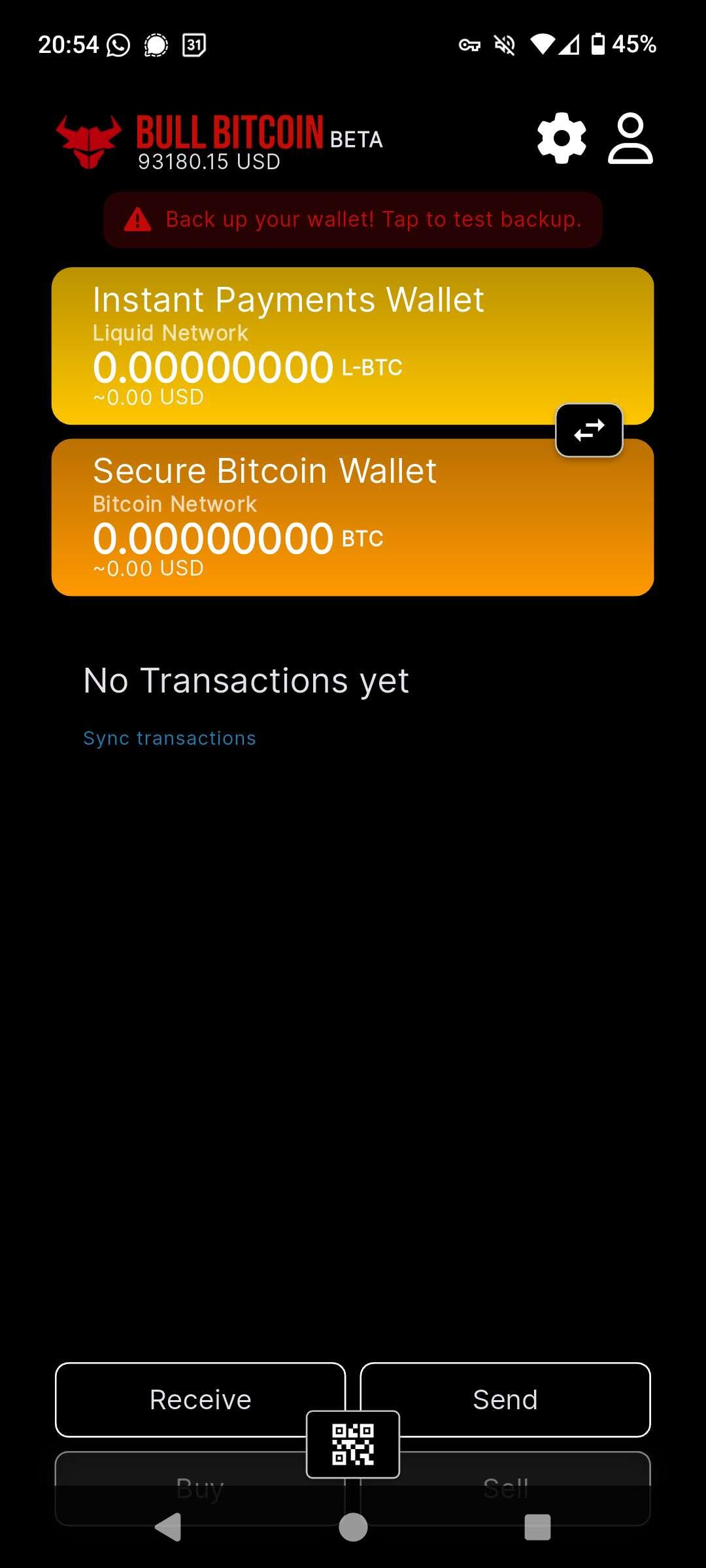



Thoughts on:
note1rkduxswjd2x9uaukqdpnw20ydv8g27q2fvm2l9k49n92hlhr66jstx4nfh
The open source micro-kernel is interesting but idk enough about embedded to comment more. could this micro kernel be used for ASIC control boards? could it run on an ESP32? How does it connect to secure elements?
The KeyOS piece sounds interesting with the sandboxing. I wonder how it compares to nostr:npub1235tem4hfn34edqh8hxfja9amty73998f0eagnuu4zm423s9e8ksdg0ht5? How does it compare to nostr:npub126ntw5mnermmj0znhjhgdk8lh2af72sm8qfzq48umdlnhaj9kuns3le9ll? How does it compare to nostr:npub1a00wj229auzjswlq4s77y4u8eqdx5k9ppatgl8rtv8va65f6mwksum9q3h?
I like that it's in Rust, mainly because I can poke around an embedded Rust project.
Bluetooth was a big red flag but I'd be interesting in a protocol tutorial video or similar. Something just a step more understandable than an RFC spec, but that's cool too.
Use Cake Wallet once upon a time so cool to see it's sill around.
Wtf is "Magic Backup"? And how does it compare to nostr:npub1mutnyacc9uc4t5mmxvpprwsauj5p2qxq95v4a9j0jxl8wnkfvuyque23vg? (cc: nostr:npub136jg2fnty2z5vwcnh7p4jpckrs3tk0dpueftgs7mznuuaenjpfps6tjnxf)? I assume Shamir sharding is so it can support shitcoins so that's not cool. But if it's open source, I wonder how FROST or other Schnorr schemes might be added as an option for master key.
They're charging money, but it seems that it could be self-hosted in time. Again thinking of nostr:npub126ntw5mnermmj0znhjhgdk8lh2af72sm8qfzq48umdlnhaj9kuns3le9ll and how it might be paired with the Magic Bakcups.
If it had an e-Ink screen like nostr:npub1a00wj229auzjswlq4s77y4u8eqdx5k9ppatgl8rtv8va65f6mwksum9q3h I'd probably buy one.
For my security posture and understanding, there are too many radios on this thing so i"ll be sticking with a dedicated device.
Listened to the #btctkvr podcast where they discussed this in a good amount of detail.
Seems fascinating from a cybersecurity perspective, it seems everything is built to enable long term support and usability even if the company goes bust.
Bluetooth is run off a separate chip, and data are encrypted before it's sent to the chip both ways, so the chip knows no raw data.
It's a platform too, so should be fun from a dev perspective.
Amethyst lets you set your home/private/archive relay, so you can set that to that relay. That's about as close as I know to get there
A succinct definition of secular humanism. Answered in a question that starts at 1:15:55

Cool theories, I find the first (brain asymmetry) most believable. Maybe interestingly I have an artistic sister who is left handed, whilst I'm right handed and an engineer. I'm not sure if that strengthens or weakens that theory though :-)
Bitcoin fixes this

Read and enjoyed all 3 Nexus books on your recommendation. Then read Mandibles and was left confused...
Mandibles, the horror story about fire ants by Jeff Strand != The Mandibles by Lionel Shriver

Great video addressing all the fud

Started and will finish tomorrow, looks great so far. Thanks for the effort