

nostr:npub1kp2cktgg2qg2va2u5shhq7l4e3fk6qq98dyxzxwkl6vu83xtz83smx9n8c
Cerra un poco los ojos
#negr0art


gracias, Negr0

I like to imagine that kind of derision of people who have an obvious passion for bitcoin will diminish as ngu. even then though, they still won't get that it's not about ngu (though ngu doesn't make me sad, ngl).
it's almost like crabs in a bucket... and you're the crab just talking about escape. they can't see it and don't want to acknowledge it's even possible because doing so would bring their whole worldview into question.

I can't speak to the Aussie restrictions but pushing money from your US bank account to exchanges in the US is still possible for sure.
Malos please call out the neighborhoods you are showing. knowing where things are happening is meaningful.

yeah... just scanned the article.
thanks for writing it, L0la.
not surprising to me.
banking customers have to understand that their banker is obligated to surveill customer financial behavior and report anomalous and/or potentially criminal activities. use of ALL internally-available data to accomplish this set of tasks should be expected (to do less would leave the bank open to accusations of negligence).
however, if your bank is monitoring your social media in any way, they've stopped being just a bank. at that point they've essentially become an intelligence agency that offers some banking services on the side.
I recommend any/every retail and institutional consumer establish no less than three banking relationships at the national, regional, and credit union level. without this redundancy you're essentially trapped if you want to shut down an account based on poor treatment (or if the bank suddenly wants to shut you down).
it may take some effort to establish what I'll call resiliency in your operating accounts. but the effort will be worth it should your bank execute a quick pivot on you, your industry, or your latest social media post. (this resiliency will also serve you well if you bank fails because they foolishly concentrated holdings in Treasuries or Commercial RE loans.)
oh... and buy and self-custody bitcoin, too.


that is the best use of the meme to date. pays to watch to the end.
kudos.

I'll leave that discussion to the courts and café lawyers. I have my own opinions but they aren't relevant to the practical application of an AML program within an institution nor are they appropriate for interpretation of regulatory expectations.
question for you nostr:npub1a2cww4kn9wqte4ry70vyfwqyqvpswksna27rtxd8vty6c74era8sdcw83a
if you had a choice between banks participating directly in bitcoin and no banks (just organic growth) which option would you prefer and why?
after reading my profile some wonder why I'm even here.
they say, what the hell? how's a bank compliance guy here? why? what does he want in our space?
I'm the signal you've been waiting for.

I understand what you're saying though.
Many in banking are still either ignorant or fearful of bitcoin. It's just a fact.
I'm doing what I can do from the inside.


I went through your list about a month ago and followed a few of your follows... so mi casa su casa in a way.

Most of the people I know who think like this don't actually have kids and many probably never will.
Allow me to be your sample size of one, nostr:npub1m4ny6hjqzepn4rxknuq94c2gpqzr29ufkkw7ttcxyak7v43n6vvsajc2jl.
I think like this.
I am a parent.
But taking your point as a potential indicator of a significant archetype hodler, and thinking optimistically, maybe future bequests to non-family beneficiaries will be championed by childless hodlers.
Can you imagine prominent buildings in future civilizations like "Laeserin Free Library" or "Laeserin Center for Nutritional Research" for instance?

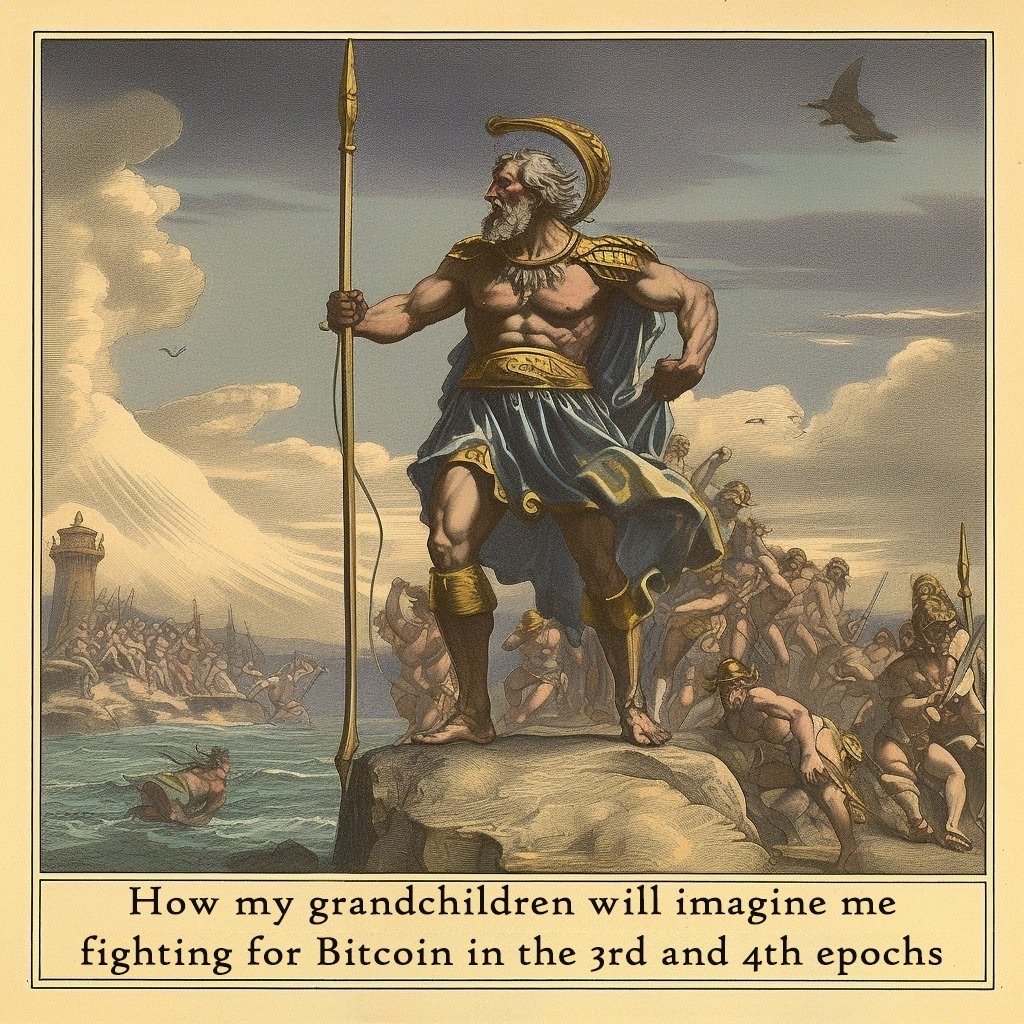
Any time I see a zap between10 and 20 sats I think, "Well, there's a nice fat future Delmonico, medium-rare with a slight toasting of the fatty bits, sprinkled with sea salt, resting on a cutting board... juices still flowing... for my great grandson/daughter in like 50 years."
Because that's where we are, imho.
The ability to visualize likely results of extreme low time preference and hard money pushes one towards mental and emotional castle-building to the benefit of future generations. (Pardon me just a moment while I commission a portrait of self to be displayed in the gallery of my family's future palatial estate.)

This gets me thinking about creation of "easy" financial products that emulate the familiar, targeted toward people who can't be bothered to learn about bitcoin.
Yes. I know. There are examples now in companies like Fold and self-custody or multi-sig IRA... these are primarily opt-in vehicles for those who have studied a bit.
I'm just wondering out loud whether there's something to be done *within financial institutions* to "supercharge" legacy financial products by adding a dash of bitcoin to the mix.
What about paying interest on accounts in bitcoin? A typical retail/consumer savings account might earn 2% or less and a typical interest-checking account might earn 0.25%. Perhaps if the offer was "interest paid in bitcoin to your institutional account (custody)" or, for those who bother to learn self-custody, "interest paid in bitcoin to your KYC'd self-custody wallet of choice?"
Incentives seem to align here.
Thoughts?

tried when midjourney was new-ish but not since... goal was to create an artful process flow diagram with the tool. it did not look good at all.
suggestions, Guy?
Can anyone point me to the primary infrastructural vulnerabilities of the ethereum blockchain?
I recall arguments about centralization of validators, about necessity of AWS in many cases, and some tcpip element upon which the entire infrastructure depends (need deets there).
Check my profile and you might be able to see why I'm asking... Can't share more unfortunately.
nostr:npub12rv5lskctqxxs2c8rf2zlzc7xx3qpvzs3w4etgemauy9thegr43sf485vg
Anyone here maintain a handy list of countries where Bitcoin is already legal tender or has legal status as a property?
Already know El Salvador and the city of Lugano for legal tender... Many others where it's considered property.
Any good sources I can look to?
TYIA