
I'm not *quite* directly disagreeing with Lyn per se. I'm emphasizing an orthogonal point about the importance of stability, and suggesting that if the dollar collapses in a catastrophic way in the near future, then I'm not confident we survive the chaos at all. I don't think we get a chance to reset with Bitcoin. I think it's just potentially game over for our civilization. If people are still living, they'll be living in a dark age.
Yep. 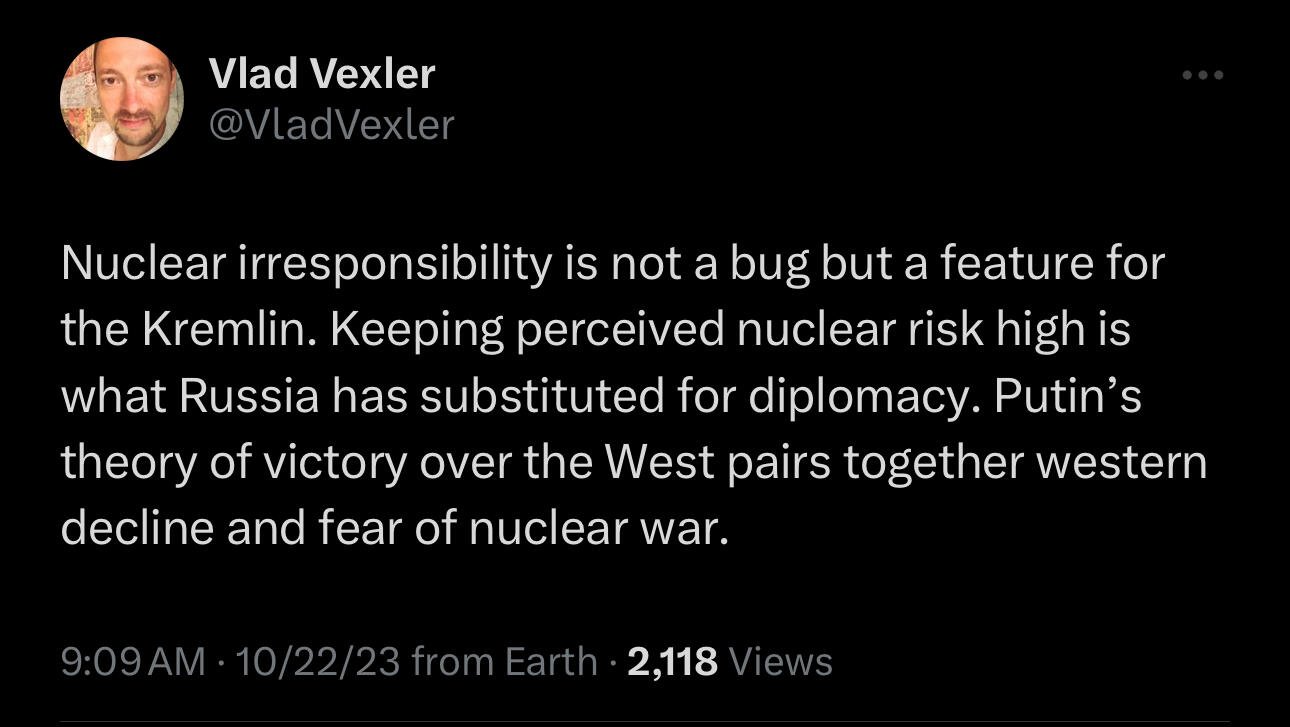


I agree with you in the sense that all macro patterns in complex systems are meta stable. And no system will survive forever. My disagreement comes from that abandoning incrementalism and suing for compete revolution is profoundly dangerous given the complexity of modern states, modern economies and the modern world.
We agree that these breakdowns are often associated with war. But I disagree that money can be a limiting factor -- especially for say a great power conflict. Governments can just nationalize supply chains and defense production directly. They don't HAVE to go into debt to sustain a war. And if the war is considered to be existential, it's likely this is what they'll do. In fact, the US already had laws on the books that give the president expansive authority to seize control of production in the presence of a real or apprehended war -- the Defense Production Act, for example.
So I get my back up against the wall when people suggest something like Bitcoin can bend us away from these kinds of risks because of any discipline they think it can impose on governments, in this sense.
I'm willing to concede that wars like Iraq in 2003, conducted at the height of America's unipolar moment, within a largely peacetime framework of government debt and spending, could potentially have been attenuated if the public had felt the effects of that more directly, as you pointed out on WBD.
But I think existential wars are different. The rules change. The government can just force industry into a wartime economy and use production nationalization as a tool, if necessary. Which happened under FDR in WWII.

Redefining the definition of "war", "empire" and "depression" to the point they contain no historical symmetry or stable meaning across time, so you can tell your doomer and declinist narratives, makes you no better than the government propaganda you criticize. You're just a propagandist trying to tell a story that serves your selfish agenda.
Sad. But true.
You're just saying words and causally redefining what they believe so you can tell the story you want to tell.

I have no fucks left to give, right now. I'm alarmed by the geopolitical risks I see, and I think people need to wake up from their luxury narratives.

Neither of these charts show a depression. Can you reference the raw datasets? But generally, I'm sorry but ... a depression is not measured relative to a long term exponential curve. That's just a stupid argument.
The idea there's going to be a mass tax revolt, where everyone stops funding the government by hiding seed phrases in their heads is a cool story.
GDP is a fundamentally unsound and manipulated statistic.
Here’s the thing - more economic activity than ever can also be the result of a depression and breakdown of an economic system. I love the nostr:npub1h8nk2346qezka5cpm8jjh3yl5j88pf4ly2ptu7s6uu55wcfqy0wq36rpev analogy of fiat being like adding dirt to a cup of water and then claiming that cleaning it is “production.”
Go look at statistics like the affordability of essential goods such as housing, transportation, energy, and healthy food when compared to median salary. Consider that many people are working multiple jobs, oftentimes outside of their speciality, in order to stay afloat and maintain their debt payments. Consider the impact to society of shifting from a single income household to it basically being a financial requirement that both a mother and a father have a full time job.
Sure, the highly massaged employment statistics look good - everyone who needs to work is working. And sure, we are nominally producing more shit than ever before - although there are structural problems in America where a lot of the shit we produce isn’t even desirable or tangible goods. But the average American is struggling desperately, and has been for the better part of a decade. The deterioration of economic activity will only get worse as debt continues to spiral and we are eventually faced with either having worthless money or an end to social programs which have allowed our aging population to maintain itself.
Sorry. I don't believe that real production has declined. And I'm pretty sure people have nothing but feels and anecdotes to advance the argument that's a thing.

I agree the risk of chaos is alarming. What actually makes me angry is people who think we should just let our institutions fail and prepare for what's next, cross our fingers and hope we survive the chaos.

This is irrelevant. I agree with you that the US has done evil. I’ve criticized it. But it’s so fucking ahistorical by any standard — I don’t give a fuck HOW you define war — to suggest that the last half of the 20th century through the oughts and teens of the 21st haven’t been the most peaceful in the history of recorded civilization.
And thinking that if you just take America out of the equation and everything would have been so much more peaceful because you think that the only thing fueling war is the profit motive of the military industrial complex is so naive, and so geopolitically ignorant, that it’s nausea-inducing.
The idea that America is the principle agent in all conflict, and that conflict will subside fi the US was defanged is ridiculous. There are so many geopolitical tensions built in historical, cultural and religious animosities that have nothing to do with the US. And if anything, it’s been the US’s shadow that has kept some of those conflicts at bay. And we’re seeing some of them flare up as we speak!
I think people overstate the case about the “constant forever wars”, quite honestly. And I say that as someone who is a harsh critic of US foreign policy. The reality is that the period starting at the end of World War II, all the way up to today, has been the most peaceful time in most of the history of civilization.
Civilization itself, going all the way back to the Roman Empire has been a forever war. We have existed in an era of the Long Peace. Sometimes called the Pax Americana.
The number of people dying in wars has been in precipitous decline. So when people act like this so-called “American Global Empire” has been an unmitigated war machine that has made the world a far more violent place, I actually don’t know WHAT THE FUCK they’re talking about.
Here’s a chart of the last hundred years of people on this planet who have died in wars. 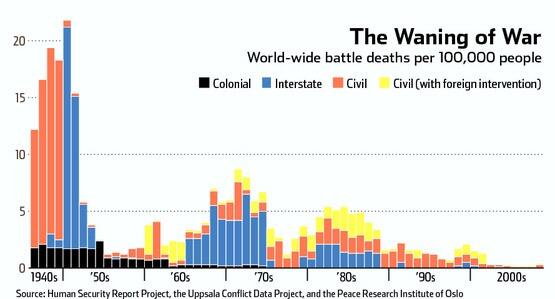

Well, aside from this question being a straw man, I would say that my default assumption is not that everything the government tells me is a lie, like some people in these conversations. As it pertains to econometric data that government agencies like the BLS put out … do I think that this data is all fake and made-up? No. No I don’t.
The reality is, if the data was really as badly manipulated as you intimate, quants at hedge funds and other private researchers would have figured that out a long time ago, and probably made a big stink about it.
I guess my framework is just that it needs to be stopped. It needs to end, it cannot continue. nostr:npub1hyqrsvl6hle8r5rc9cpshesm0mpcee75tgde4p5lhke5h83dyqqqdwk7cp would be correct that if we cannot find a solution to these problems, we face a grave existential crisis. Due to this framework, I’m forced to argue that Bitcoin is capable of defunding state violence and bringing more peace and prosperity to civilization, because I see it as by far the best chance we have, and nothing behind it comes very close. If I’m wrong, I’d rather have lived in some hopeful delusion than accept that humans cannot evolve past this as a species.
I think just sitting back and letting our institutions fail, rather than trying to reform and fix them, is just about the dumbest fucking idea at this point. It’s playing with matches at a civilizational level.
We have found a way to overcome our tribal impulses. It was called liberal democracy and pluralism. We built institutions that facilitated the peaceful resolution of disputes, and the basis for economic exchange.
The people who want to tear these institutions down and replace them with “pure capitalism” or some nonsense like that, have no idea of the forces they’d be unleashing.
The problem is always going to be, that one person’s definition of “senseless war” is another person’s “just war”. If enough people think a war is just, then the tolerance of the public to sacrifice towards the prosecution therein, will go up.
Ukrainians are paying extreme economic costs — and in blood — to sustain their war against the Russians. And support for the war in Ukraine is >90%.
Humans are not purely driven by narrow economic incentives.
You can’t beat human nature. The tribe will always close ranks when threatened. Bitcoin will not stop this. You’re hoping for a spiritual awakening that will never come, unless we literally breed our tribal instincts out of us through genetic engineering.