
My best guess is that cognitive intelligence is correlated but not causal to genius.
I believe the closest trait to genius is creativity.
I'm not sure if most of us know the difference between intelligence and talent.
Hint: most of the truly smart people, we don't know their names.
ODB understood before a lot of us did.
https://blossom.primal.net/5704faa56f68532fa40d86c0876c0226a7bea603b1ef7c3741fc4199d84972cf.mov


I think the how cynical you are (and we KNOW Bitcoiners are cynical) and how much you hate the movie Venn diagram, is a perfect circle. 🤣

Its very well shot and had an excellent cast of young actors. For it to be so bold, I felt it didn't accomplish everything it set out to do. I do feel it's worth a watch.
Just saw the movie, The Long Walk. It feels like a metaphor for where we're headed in the world.
https://youtu.be/VYOjWnS4cMY?si=FG3rxr1xtuhea_nM #thisisamerica
I can't take the virtue signaling. No one will be talking about this in a month, the same way no one is talking about the catholic school shooting before this. Or 100+ "dark day in America" situations before that. If it were humanly possible to care about senseless murder, you wouldn't have time to post about anything else because it happens ALL DAY EVERY DAY. #thisisamerica


Bitcoin isn’t waiting. This summer, take self-custody into your own hands.
We’re giving away 2 Blockstream Jade Plus hardware wallets on Nostr:
🟢 100% open-source
🟢 Verifiable with Genuine Check
🟢 Built for a lifetime of Bitcoin security
Want one?
1️⃣ Follow Blockstream
2️⃣ Retweet this post
Winners announced on July 4th.
https://blossom.primal.net/8f6c4663baf7cedd6e04f80fff8b9696e9debe90fd46a7aef53361bcee29865a.mp4
Want to take action now? Visit the Blockstream Store and secure a Jade Plus hardware wallet today.
🤞🏽

Elon is not yours or anybody’s savior. Personally, given his character and desire for attention, I hope he continues to stay far away from talking about Bitcoin.




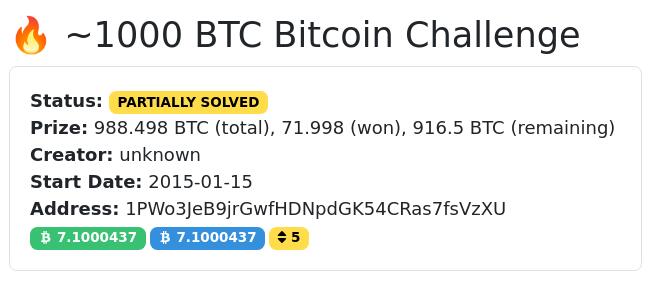
In 2015, an eccentric millionaire placed bitcoins in weak addresses.
For years, the prize has been contested by bots, GPUs, and in the future, it is expected to be the first target of quantum attacks.
The individual's goal was to monitor the advancement of computational power capable of breaking Bitcoin keys.
These keys have up to 256 bits of entropy, which can be understood as the difficulty of discovering them. They are simply large numbers, on the order of 2²⁵⁶.
He then created 160 addresses, each with fewer bits of difficulty, from 1 to 160, and placed a few satoshis in each one, doubling the amount in the next.
The total prize reached nearly 1,000 BTC. There are still 916 BTC left to be claimed.
https://mempool.space/tx/08389f34c98c606322740c0be6a7125d9860bb8d5cb182c02f98461e5fa6cd15
The first few dozen addresses were quickly looted. There are bots monitoring the blockchain and stealing UTXOs that have some vulnerability — such as low entropy in the generation of the private key.
https://mempool.space/tx/0eb5b5c103e68eb0931430e7786cf1b6962f9eed5a2cb5271d4dd1699b77e86f
It was only at the end of 2015 that one of the owners of these bots noticed that the source of the bitcoins all came from a single transaction. He decided to share the discovery on the Bitcointalk forum, and that’s when more people began competing for the remaining prizes.
https://bitcointalk.org/index.php?topic=1306983.0
In 2019, the creator exposed the public keys of some addresses (those with indexes ending in 0 or 5). This is done simply by moving the coins—the key appears in the transaction. With it, other methods can be used, making it easier to crack.
https://mempool.space/tx/17e4e323cfbc68d7f0071cad09364e8193eedf8fefbcbd8a21b4b65717a4b3d3
One of these methods is a very old algorithm from 1978:
Pollard's Kangaroo Algorithm — a clever trick used to find private keys when part of the keyspace is known. Imagine two kangaroos jumping across a number line, one tame and one wild, eventually landing on the same spot. It’s a classic in cryptography, and now it's being used to chase Bitcoin prizes.
Since then, several programs and even participant "pools" have emerged, all trying to crack the next address. "kowala24731" secured an investment in the hundreds of thousands of dollars to rent GPUs and managed to break addresses #67 and #68 in early April.
Yesterday, someone, probably a beginner, cracked address #69 but didn’t secure the spending properly and exposed the public key.
In a few seconds, some bots cracked the key and replaced the transaction, battling for the balance. The last one paid a total fee of 1.2M sats.
https://mempool.space/tx/a52c5046f3097a8c2bd3b9889df2fb47b104d47a16cc679d3357feec003db753
The time to crack these addresses — discovering the private key from the public key — is quite short. A GPU can do it in less than a minute.
That’s why those who crack the keys can't publish it to the network; they must send it directly to a miner to include it in a block (like Mara).
Among the addresses with exposed public keys, the record was 130 bits of entropy, set by "RetiredCoder," who also cracked other keys.
These addresses are likely serving as "canaries in the coal mine" for the attacks Bitcoin may face. As long as there are still hundreds of BTCs sitting in them, yours should be safe.
Fascinating
nevent1qqst73lu0uv2mszay4hlxqazw4fqddaceypd3tf5tmh2yd88aj2ayzcpzemhxue69uhhyetvv9ujuurjd9kkzmpwdejhgyewxwd



Fantastic for people who want to travel the world without leaving the shopping mall.

I guess I don’t see immigration advocates being as superficial. In the US pro immigration groups tend be that way out of empathy or exploitation. Corporations that are immigrant advocates tend to care less about any deep cultural differences as long as it makes sense for the cheap labor. The more liberal minded groups can be pro immigration out of empathy from certain world situations. As far as how well a group assimilates I’m not sure that’s predictable. I also think, at least US culture ( which is what I can speak to) isn’t the culture monolith some pretend to be.
How would this mechanism of determining an individual immigrant’s bandwidth work? Would we observe their native country’s “culture” and create a restrictions list? For instance would we say Cuba is a communist country, communism is antithetical to culture and values of America therefore no one from Cuba is allowed to immigrate?

Investigative journalists.



Wait, I can zap myself?!? Infinite money glitch! 🤓