



Just gimmie a Sidekick with nostr enabled.


Gm Derek! Hope you're having fun

The idea of formal systems and Godel's incompleteness theorems comes to mind.
A formal system is defined by axioms. We try to treat science (and by proxy, the natural world) with an assumption of nature itself being a formal system -> start with axioms and explore the space from there. Axioms and derived theorems then create the boundaries for the environment you're working with.
Mathematical proofs show you absolute truth in the axiomatic system you are working with. They will also show the absolute falshoods of the system. The space is fractal, endlessly deep, you only can work with the knowledge you have of system you are working with.
The problem is that nature is mind-bogglingly entangled.
You think CS dependencies are tough? Biological processes seemingly have not only unenumerable dependencies, but dependencies that well eventually circle back to the process itself. At that point, you'd expect a computer to be in deadlock, but it gets worse. There there are not only multiple different clock-cycles, but its a gradient everywhere you go. In biology, it is often said that there are always contradictions to rules being stated and that whatever "rules" we come up with are more guidelines, so we can't even make the assumption that biology and nature is a formal system.
What are the implications of that?
A real strangely looped rabbit hole for you 🕳️🔄🐇
From Godel Escher Bach ch 3, a visualization of this process with some defined formal system. Godel's Incompleteness Theorem proved that any formal system will have statements about it that cannot be proved from within said system. For example, where in the system of language rules do you get meaning from? You're not going to derive semantics from syntax.
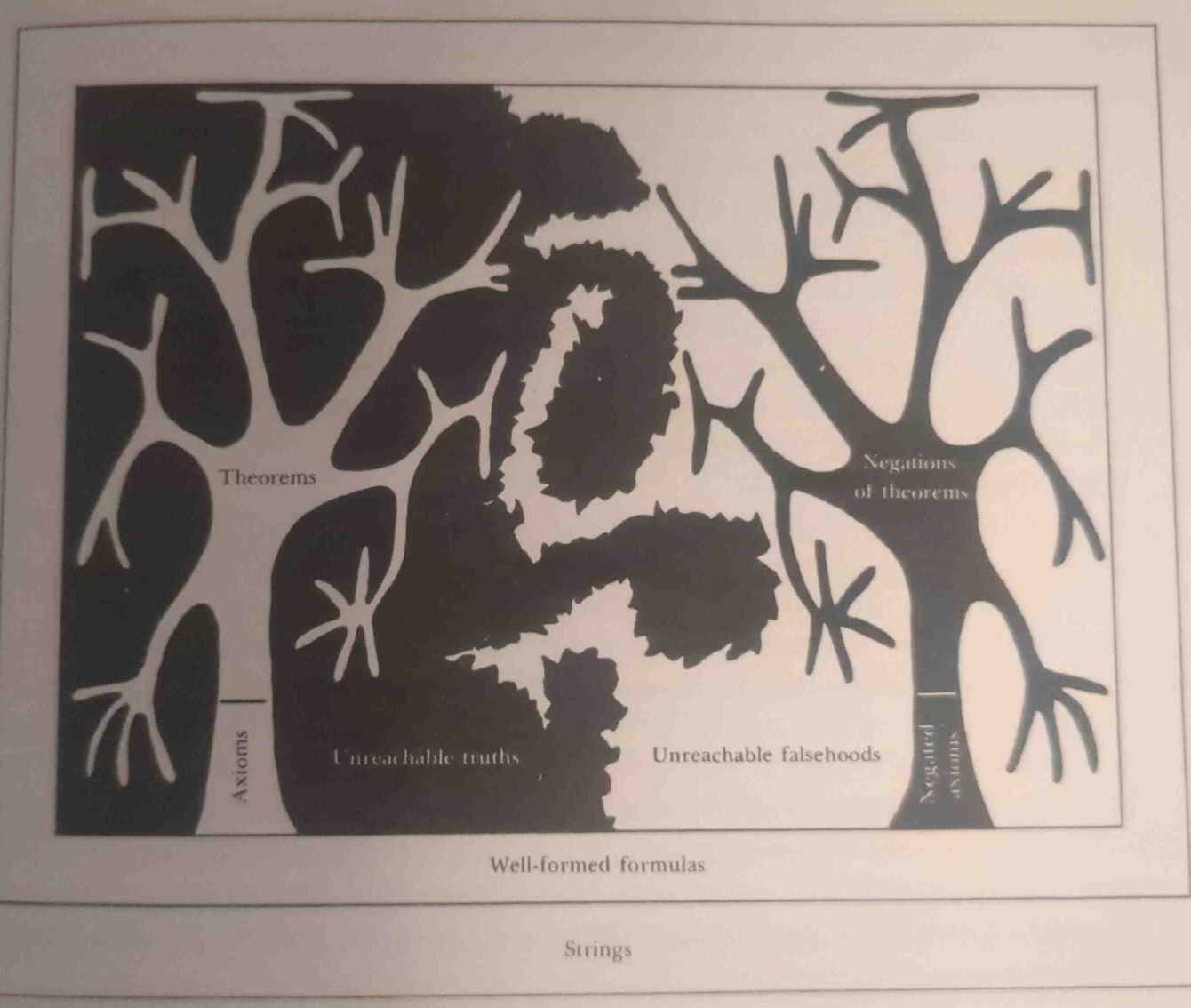
So if formal systems can't even be fully explicated , what does that imply for non-formal systems? Damned if nature is formal, damned even more if its not.
Now for a sleight shift.
Humans, we live outside many axiomatic systems, but use them to frame our understanding of the world. Ever work on a problem for such a long time, and then stop and do something else? Thats because we aren't bound by said box/axiomatic system and can move outside it. This feature itself allows us to reenter the system from different angles, or just say "Stop, its not worth it."
The capacity for humans to exit systems is a core part that separates us from computers. Wisdom incorperates restraint of application as a consequence from viewing the system wholistically.
The real questions now: What kind of boxes are we living in, be they foundational or self constructed? Are we agents taxing towards new provable theorems contained in some system we can't exit from? What are the generating functions for this system? Are we the system itself?
This gives me hope on the unknowable truths and falshoods. Spiritual experience is the experience of The Other, whatever that may be.
Not formally religious, but there is strong appreciation and a wistfulness toward it.

Wait till you read about tree-3




Iust want nostr to succeed. Appreciate checks and balances, but it can be overdone (like you, not meant for Puzzles 🫂) so I get it.

Wouldn't say its one person. Maybe today, but Odell and OpenSats getting this flak is kinda a theme.

Casual visit to vet to pick up some medicine. Two owners asked for assistance to bring their dog in for their final visit.
Noticed emotions rise up. Not wanting to ignore them and a personal desire to pay some respect, I chose to go for a walk around to reflect.
Its sad, but I took the time to experience what i was feeling and that gives me comfort.



Definitely in the perspective of metaphysics in science. Beyond that, i'm open to the idea that some states that allow us to experience truth, even if for a moment.


"Internalize our narrative as objective"
Sure, objectivity can't be obtained and they never make that claim, but the dynamic changes when its at the top of nearly every search engine result.

Maybe we should start the #churchOfNostr for that tax benefit eh? 😏
I believe nostr:npub1lqpuy5pgpce04rw48sdvp5khfm60j3d5vv8ufugdp97jt59rlhasry9h3r also has telegram if he’d like
but there’s no danger that I know of, it’s still encrypted you can’t see the text being sent but you can see who it’s being sent to and the frequency of messages. But not the actual sensitive text.
Danger in the case *one* of the party's keys get burned. Sure, you can be confident (if nieve) about the risk of comprimising your keys, but you can't say the same for someone else.
After some exploring:
Just the presence of a functional WOT score alone is enough to evaluate your own valence of someone because you end up building a neighborhood of users with scores you're comfortable interacting with - which really does gets you far. That's really interesting from a social perspective, but computationally how effective is it?
Maybe I'm bike shedding, but I'm curious. I'm plotting the formulas via desmos.com to get an intuition on the behavior in a WOT.

Here we have the Coracle formula in orange where we assume both follows and mutes are the same (x-log(x)^2). I checked Coracle and see that you have a lower bound of 0. So what this graph says to me is that in the base case, if you weight mute and follows equally, you always get a positive score.
The second curve in red is the formula x-log(ax)^2 where a=24. So what happens if you gain mutes at 24 times the rate of followers? Well, only if you are under 4 followers will you be under 0. Now my judgement here is that the score here is helpful to the user socially, but functionally doesn't do much in terms of feed filtering.
A formula that is inverted around zero is probably the best way start off with because you have an easy to derive cutoff point.

Here, we have in green x^3 where X is some weighted sum of positive and negative interactions, which in the simplest case for a WOT would be something like (x-y)^3. If both mutes and follows grow at the same rate, you're stuck at zero, which kind of makes sense even if very lenient. However, you're in the negative the moment mutes grow faster than follows (blue curve, a=1.1) Considering that I'd expect the rate of gaining mutes to be much slower than follows, the next step I'd probably experiment with real data to see what kind of value for 'a' would be effective for feed control.
Too light of a filter to be useful*

I'm just legitimately curious at the underlying assumptions. Occam's razor and what not.
WOT from first principles should be as simple as possible. Any less would be too light of a filter too light a filter but complexity obscures interpretibility. Let alone the network calculations for uncaching clients.