

My trainer/nutritionist have confirmed that most smart watches (at least apple and garmin) are fairly accurate for cardio, or elevated heart-rate tasks. But for strength training you'll never see the actual calories consumed in rebuilding muscle.
Id have to think, for those with more physical work I can imaging it's probably fairly worthless since it can be a decent mix of muscle breakdown and cardio.
According to my watch having a fever burns about 200cal/hour. That's crazy.




See the IRS was miles ahead of the pleb. Often forgotten that most people get their income tax automatically withheld, so it's not like they can easily stop paying (income) taxes if they wanted to. It's automatic.


Probably not, depends on your definition XD. I still enjoy coding, so when I'm in the mood, I just sit and bang out a thing. Cathartic.

Honey why are you crying? Is everything okay? I gotta whisper cause I can't be too loooud

Yeah I still worry about that interaction. Like what else did I/we say they heard on the mic in the room.
Yeah this is very difficult.
We recently had to remove some tech from an older family member because she kept falling for scams. She called me in a panic once, I raced over to the house and the scumbags had convinced her to enable here video camera. They had been watching her the whole time in her home (for about 3-4 hours). She didn't tell me what was going on. The Indian guy seemingly knew who I was (Ive dealt with many of these Indian scams, almost a dozen now so I have a routine to deal with them) and I was like how TF does this guy know what I look like!?!? Thank goodness I quickly looked at her laptop to realize her camera light was on!
I was like WTF you didn't tell me you were on your laptop.
Anyway that laptop got crushed into a million pieces. We had to migrate her whole financial life because she gave it all away (it was mostly fine thankfully). And we stripped her of most online freedoms. The only one she wouldn't let us take is Facebook, which is worst of them all.
They called me "boy with long hair and ball cap"
nostr.band SSL certificates expired on the 22nd?


Some users on HN "clarify" that it's Google's filter enabled by app developers on the store. Bitwarden is flagged by the level HSBC devs specified in their filter settings. So that's a question for Google.


The original post appears to be on mastodon somewhere. Apparently it was possibly the site's owner "neil"? The link does not appear to work.
I found this hacker news thread on it while searching though. https://news.ycombinator.com/item?id=46431453
An change you have a link to the twitter post?

Well technically you need recent very nvidia grid gpus for it work officially. But there are tools that let you run on older tesla cards (which I have) or even consumer nvidia cards.
Not sure I follow. For vgpu it's resource sharing. So I can run my LLM servers alongside my GUI desktop VMs.
low-level server clustering, and sharing gpu compute dynamically between virtual machines.
lol, if were talking tech - Pacemaker from Cluster Labs and nvidia vgpu, are probably at the top of the list.
Pro tip for hosters.
If you're hosting a service that might require or allow users to download assets from 3rd party services (like a CDN), but that don't need for your use case. You can set a Content Security Policy for the service that controls what your user's will download, possibly disabling unnecessary CDN tracking connections. Generally it's easiest to set a header in your L7 load balancer config (reverse proxy), or your ingress controller if supported.
Yes there are better ways, but this is a dang easy first step.
For example, I host a web service called cgit, which attempts to fetch avatar files from a cdn. Avatars are neat, but not at the expense of my user's privacy (leaking connection info) and also security (3rd party content that I don't monitor could be malicious with a number of basic attacks). I set a CSP that tells the client what content to load and where, breaking these requests.
You like your "distro" lol. We all like Linux, we just don't like wtf is on top of it that gives us control over Linux.

Like this old picture :)
https://www.vaughnnugent.com/public/resources/downloads/cms/c/oijdsiofgnklsdnfkl.webp
I was expecting pics XD
I don't share pics of my current setup. I usually share pics once gear is retired.
Have some time to get the 10G network equipment in and fiber run. Even more fun is being able to do it with zero service downtime.


It's hard to make big rust pools random IO fast though. Hell even sustained chugs in comparison.
Just a little PSA that any consumer SSD you purchase off the shelf will not last for server use cases.
I've had pretty equal amounts of
- Samsung Pro
- Samsung Evo
- OCZ (yeah long time ago)
- Crucial (micron silicon)
- Sandisk
- Sandisk Ultra
- Intel consumer
The sad part is 1-2 years after purchase it's known that so many these off the shelf drives are garbage, but you'll still see people argue for new drives like it's not a continuous cycle. While the quality of consumer nand has only declined.
The Intel 545s were amazing engineering - became known for one of the worst consumer drives shipped like 6 months after release, and were discontinued like immediately iirc.
Sandisk and OCZ were known for crappy controllers but good nand for a long time.
The only exception is Samsung Pros, and to be fair, I've had higher hours on them, but not in more reliable "test" conditions. The price on the Pro drives kind of out weighs the benefits imo. Because if you still need a big array to be fault tolerant you're just adding cost. The only benefit is IOPs.
If you're going to purchase consumer drives, the move has been,
- Buy the cheapest option you trust
- buy in BULK,
- spread the IOPs across a much larger array
- Make your array tolerant enough to handle multiple failures in quick succession
- have plenty of spares and 2-3 HOT
This heavily depends on your workload though. It depends how heavily you depend on consistent random IO. A ZFS system with lots of memory 64GB+, can handle random bust writes well. This is because cheaper consumer drives are usually horrible at random IO and rarely have any dram cache. The usually have terrible realized IOPs.
The last issue with super cheap consumer drives is monitoring. They usually just die completely without reporting anything. It's not until a check runs that data corruption will be detected (zfs scrub). They often fake or underreport SMART useful data.
For the price, I might just be going back to a big ass pool of spinning hard drives.
I see what your going for. I think the client should be the one hiding stuff from the relay though, generating the noise. This also sounds like it assumes the client-relay connection is being spied on. Because I'm assuming the "relay" is using a private, recursive resolver, and therefore can't really generate noise, and would be unnecessary I think.
Why over nostr though? Pls explain.
Id still have the same disagreement with TCP over nostr... You still need dns, websockets, http, tcp, ip, just to tunnel your DNS. Then just deffer trust to the resolver. I could set up a resolver with DoH right now and sell it, but few would buy it. People still have trust for things like cloudflare or quad9 over a pleb they don't know running a device that can spy on everything they were doing regardless of how open it is.
Also my experience with Google Android is that DoH will ALWAYS fall back to Google UDP dns if DoH fails to resolve, or returns 0.0.0.0 etc. So the only "safe" option for Android users is UDP, hopefully over VPN.
So you went from telling your ISP what you were doing to telling Cloudflare. And to be fair most of us are already telling cloudflare what were up to. And chances are the consumer router is using plain UDP. Android doesn't let you specify a DOH bootstrap resolver, and requires a domain name last I checked. Otherwise UDP.
Recursive resolver _is_ the only private option, or your buddy who runs a one and offers you a vpn.
Im suggesting that media proxy is far less of an issue to what we _wanted_ nip05 to be, and that's proof of domain ownership. Media is just something that appears when I scroll.
For media possibly, but nip05 is going to have to require client's hitting endpoints, or simply trusting whatever service is proxying it. We rely on client's being able to resolve domain names as they were advertised. :/
We kind of rely on the ability to share hyperlinks directly. If we switched to something like blossom, then media has a unique id and can be polled from known/trusted servers that federate. Clients could simply take the media hash and try it against a list of trusted blossom servers.
Otherwise generic media proxy services, which some clients support, but they don't really work all that well, and aren't cheap because they take so much risk.
Yes, the problem is media, nip05, and pfps, not relays. I only use 4 relays, no outbox.
*Opens up nostr client for 0.0001 seconds*
211 dns queries

Nostr VPN ?!
HydraVeil v2 out today with a new Nostr-based decentralization,
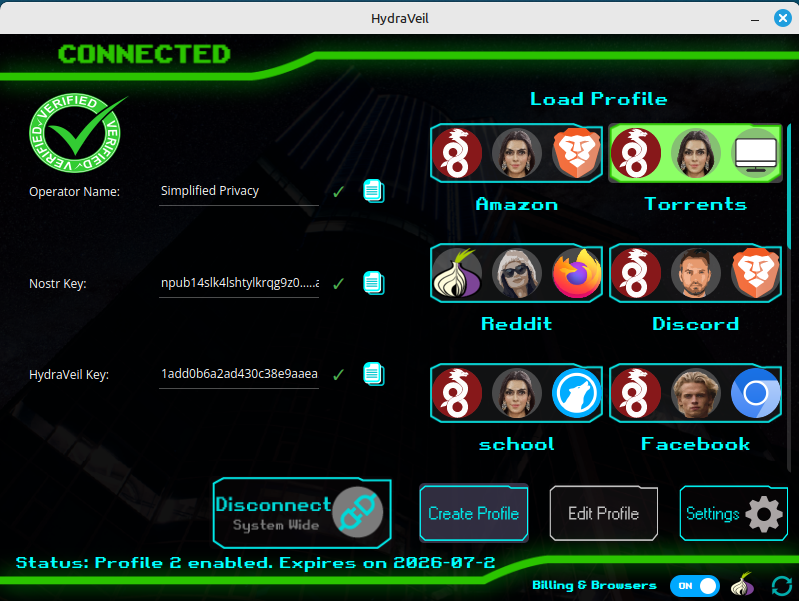
The open source client provides undeniable cryptographic proof that Nostr member is running the node,
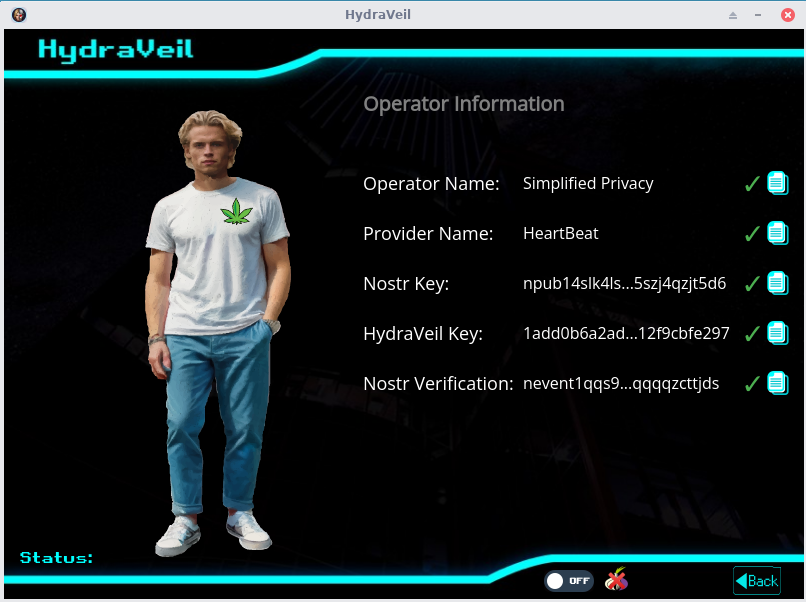
Tor's model is the nodes are a commodity, and there is no real way to evaluate. I say each node should be known by the end-user for them to decide. This is a great new use-case for Nostr, and on-boarding people to your favorite crypto, instead of printing a new one.
Help me, share this with people who you think might run a node. They get a share of revenue, publicity for their own project, and being apart of a revolutionary new use-case for the ecosystem.
Learn more: https://simplifiedprivacy.com/decentralized/nostr-encryption-as-identity-vpn/hydraveil.html
Sha256 of today's update:
c3f70256e04635490e0530c202c961f2f14106dbd7250664c70d30b26dfe15a1
So from the node operator's perspective it's similar/equivalent to running an exit node is that correct? What would the traffic actually look like and what risks am I taking as a node operator? Technical please.

I'd like to find a bitax or similar device that uses ethernet. I don't use wifi here and everything is wifi these days XD
Yup. I've been thinking of a tiered arrangement to keep cost down as well. Smaller boxes on edge, larger boxes behind and big ass bulk and cool caches locally.
Yeah, you're right I guess I was throwing that into availability. I don't have a good solution except for aggressive rate limiting, but that doesn't fix ddos, or poorly configured clients that can hammer endpoints while loading.

Hosting media for untrusted users is a very hard problem to solve. It can be "easy" for very small numbers of users and viewers, but scale slightly beyond that and guaruntee %99 uptime and it's a nightmare.