

Yea, the challenge is a bit deceptive.
For Monero he's basically telling us the amount he sent (duh) to the stealth address he created (duh) as if any of us said that was impossible and was some difficult feat to achieve (no one claimed either of those. I sure didn't.)
But instead of keeping things similar and asking the amount sent on the Lightning side, he slips in "total balance" (he can't do the equivalent of this with Monero either). And instead of asking for the public key of the node it was sent to, he's asking for a final destination (he can't do the equivalent of this with Monero either)


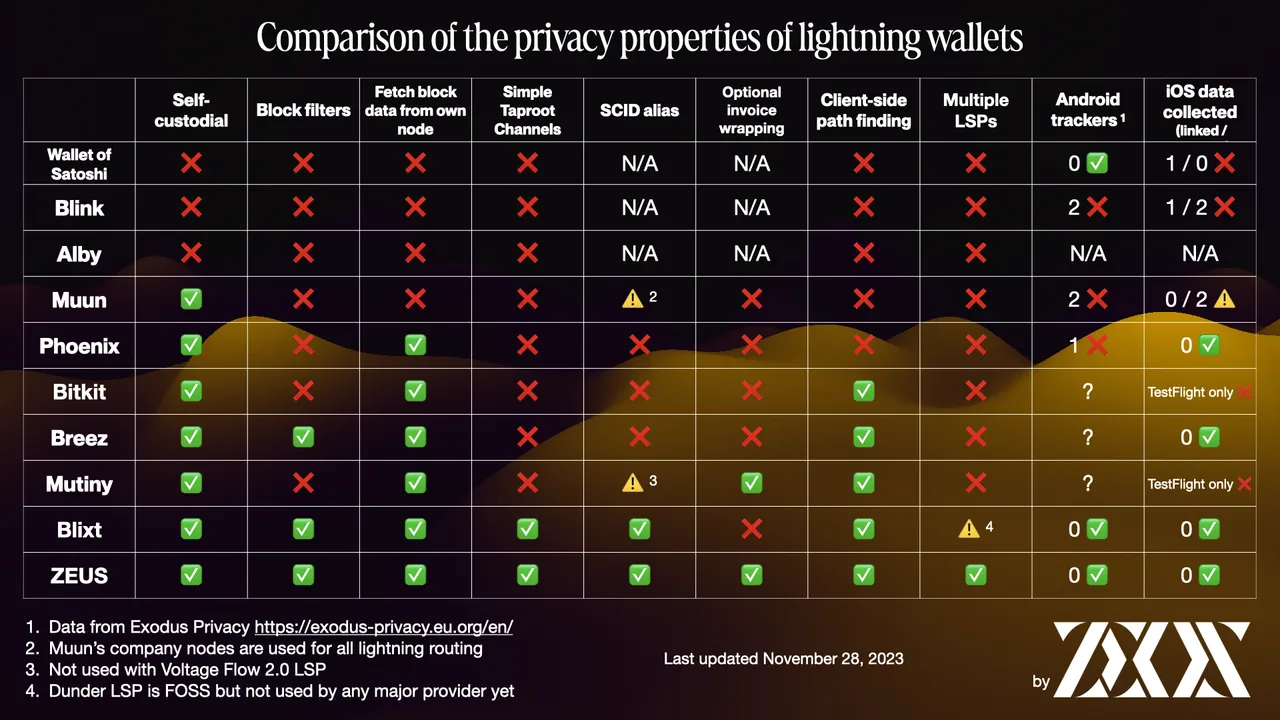
Zeus is probably my favorite LN wallet for sure. It has a lot of privacy features other LN wallets like Phoenix lack.

>"...LN nodes only see MINIMUM amount, not total amount because of multi paths"
Multi path payments is optional for every wallet I've tried that even has it available (same with things for wrapped invoices/blinded paths/bolt12). That's the problem when these things aren't default very few will use them.
"...And funnily enough, large nodes provide better privacy if they are honest."
The whole point is not requiring trusted third parties to insure your privacy. Otherwise it's just offering the same privacy of a traditional bank.
The last part is not true. All the popular Monero wallets are non-custodial (GUI/CLI, Cake, Monerujo, Stack, Feather) and don't have your viewkeys. That's why you have to spend time syncing your wallet every time you open it. I've never seen anyone even mention the word Coinomi much less recommend them.

Great info! The most interesting part to me is the routing info. The first hop in your path was a node whose pubkey is 02e1...110f. This belongs to a nostr user whose handle is UNITEDPLOW: https://njump.me/npub17y4ykazexey6mhyk33lxapycpfsmcwxpwjfw8cxw739g2r5c39hsrmudwx
You even got his short channel id, which you can use to find your channel with him on the blockchain.
Fortunately for me, onion routing (and recipient encryption) led you to a dead end! My money is not in his channel. He's just a routing node. You know *a* channel -- one you created (or a custodian created it, if you're using a custodian) -- just not the one with my money in it.
The rest of your routing info doesn't tell you much about what happened next. Does UnitedPlow have a direct channel to me? Maybe! Did it go through five more hops? Maybe! Was he a trampoline node, a decoy this whole time? Maybe!
You'll never know where the money ended up because lightning hides that info from the sender through multiple indecipherable layers of encryption. Unlike monero, which told me in plaintext. Lightning "receiver privacy" is simply designed better.
"Lightning "receiver privacy" is simply designed better."
For the 5% who use it correctly, like you, sure you can make that argument (though there is a lot of nuance in each ones privacy as a whole and how it's used realistically)
Most users that would otherwise be fully exposed to wallets like WoS and Strike are better off using Monero or even ecash (if they accept the rug risk)
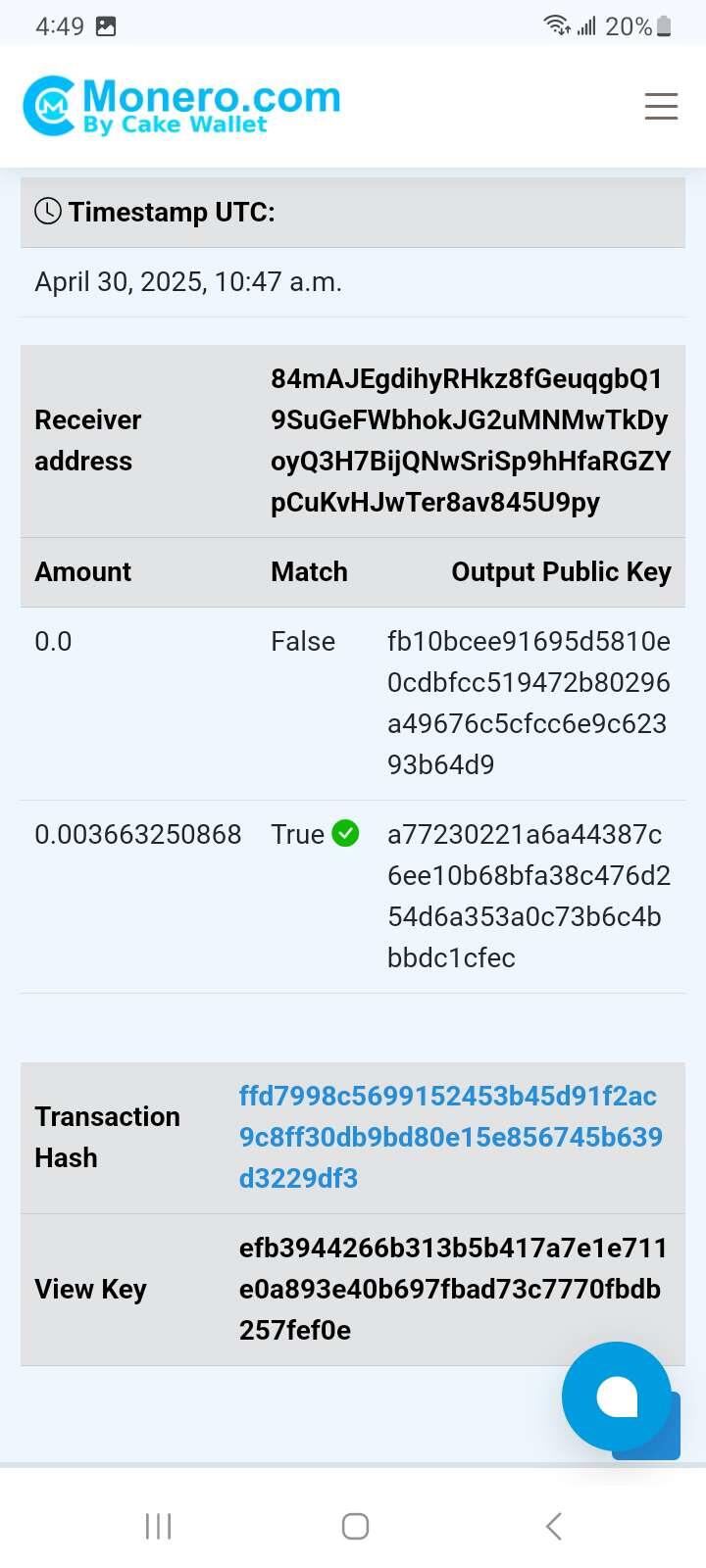
First I want to preface by saying I never denied you could give me the info you did from a Monero transaction (you're obviously not a third party if you're making a transaction with me), nor did I claim I could give you any of the info you cherrypicked for me to give you.
But that being said just for fun this is what I could find from the invoice:
Network: bitcoin mainnet
Amount: 0.00001054 BTC
Date: Wed, 30 Apr 2025 10:10:30 GMT
Payment Secret: 0c92761048337708ab93e6b8b284d926e5aec53bd7d074b8973920b91f3d4874
Payment Hash: b4db7a1b19961d115b39bfdf8a17de7459f121708265f2c2273d67287372a8fb
Description Hash: r59andxz6kzyrxtwv76xw32q2prawep07ydyph96gleyt7nqj29q
Expiration Time: 2592000 seconds
Min Final CLTV Expiry: 19
Routing Info
Public Key: 02e1dad4d396696cb207a524bdf595f1a2e6792d7b990f18cef1ebd1b557bb110f
Short Channel Id: 0d67030009bc0000
Fee Base Msat: 0
Fee Proportional Millimonths: 2999
CLTV Expiry Delta: 34
Feature Bits: 000010000000100100000100000000
Signature
R value: d4fd6e70ad921daf2aa31dce282cbdad7177d696f1ef87c4b043229e9325e4c1
S value: 4c10f860c8ec20dab8dfef12f8fd91fd2c0c9941a102ba89b6ced2605782e8c2
Recovery Flag: 0
Signing Data: 6c6e626331303534306e0d023ee2d00d03249d84120cddc22ae4f9ae2ca13649b96bb14ef5f41d2e25ce482e47cf521d0021a5a6dbd0d8ccb0e88ad9cdfefc50bef3a2cf890b84132f961139eb39439b9547d85c341d0bd9b4c2d58441996e67b46745405047d7642ff11a40dcba47f245fa60928a0300a278d00c003318a405c3b5a9a72cd2d9640f4a497beb2be345ccf25af7321e319de3d7a36aaf76221e1ace060013780000000000000000176e0044140608090400
Checksum: q7zqwk

Says the nym who obviously values their privacy 🤔
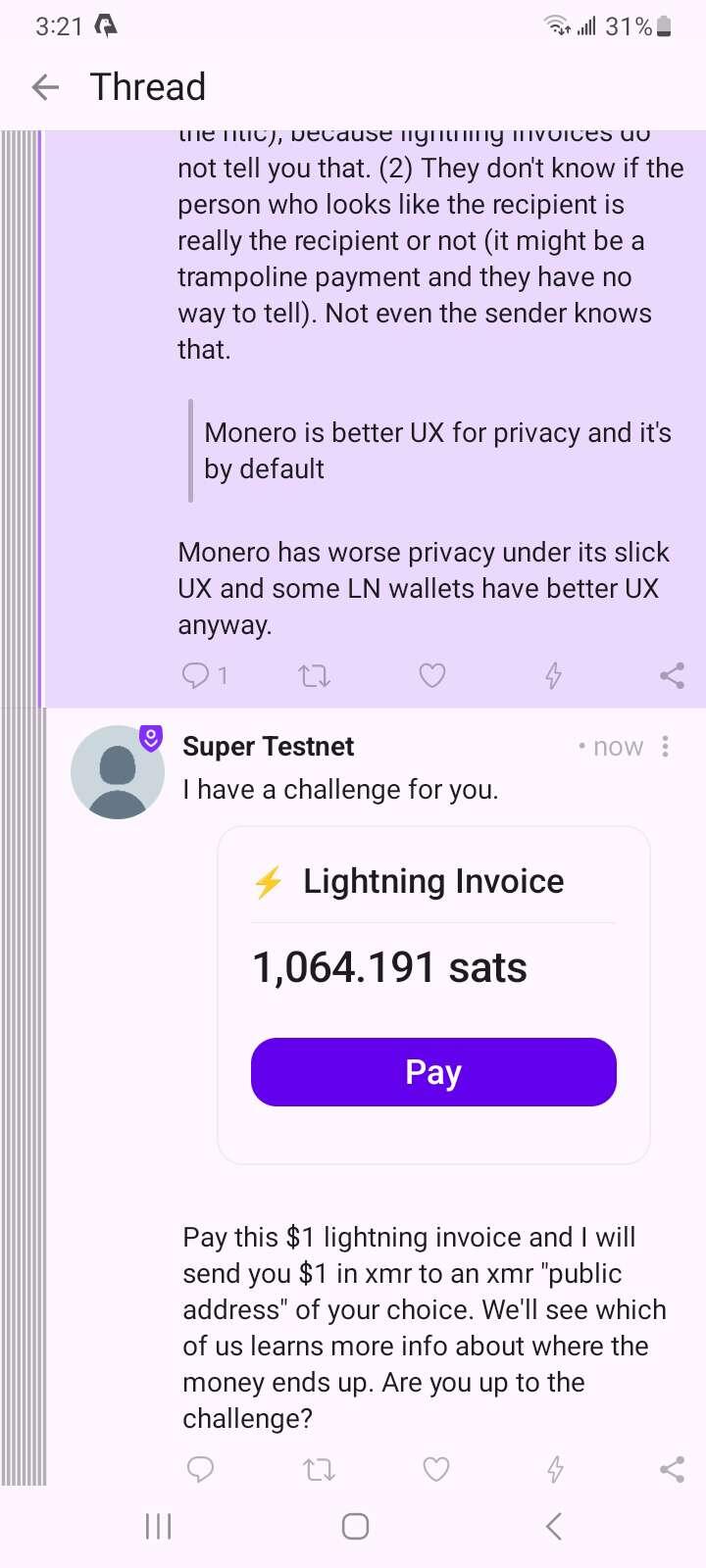
Why would I agree to that lol?
You gave me the most difficult things to find and gave yourself what you know you can find (which I never denied, you wouldn't be a third party if you're making a transaction with me, so you can see the stealth adress you're sending to)
I also have no doubt that you use Lightning privately and didn't contend that. You're Super Testnet the LN wizard. I said the average user is hanging with custodians and LSPs that can see a lot more than the best case scenario you were painting.
But I will send you $1 for fun because I enjoy our frenemy discussions
>"The ones on the blockchain aren't the same as the one in your profile"
Exactly lmao. Third parties gain zero knowledge from my profile address about who I am as a reciever on the blockchain.
> "...he said, with no evidence"
We've already been through this before. You challenged yourself and discovered most LN wallet downloads were non-private custodial wallets (in other words a moot point in saying they are private). A smaller fraction were non-custodial wallets that relied on LSPs like ACINQ (where they have a section on their page describing how they aren't private).
The incentives of Lightning drive towards these large hubs because they are more connected with less hops to your destination (less routing failures and cheaper fees).
>"Wallet of Satoshi and Strike don't see everything."
They see everything associated with you as a user. Your balance. The timing and amounts you receive and send. Plus they require personally identifiable information and accounts (especially Strike)
Why the double standard? Just a moment ago you were critical about Monero not encrypting fee amounts and now you're making excuses for Wallet of Satoshi and Strike being able to see much more.

Isn't spam on Bitcoin the whole reason for Core vs Knots drama the last few days? Lmfao

There are hundreds of cryptos they could've gone to. Why did they choose to run to Monero?
If the recipient isn't encrypted on Monero then point to any of my transactions on it's blockchain. Should be easy since my Monero address is on my profile.
Lightning nodes on a route (aka third parties) can see exact amounts passing through them. Nodes on Monero can't.
Combine the above with the fact that most LN payments are routed through a handful of large hubs. Work out the implications of that yourself.
~90% of Lightning users don't enjoy almost any of the privacy benefits you lay out because they're using things like Wallet of Satoshi or Strike that see everything. Monero is better UX for privacy and it's by default.
FCMP brings transaction chaining, but I've seen ZK Rollup schemes being discussed. Too early to tell what is going to happen.
I could argue Bitcoin has been too conservative. Bandwidth, hard drive capacity, and affordability have all dramatically increased since the creation of Bitcoin. I see China is now improving their internet infrastructure for 10Gbps bandwidth now.
small fixed blocks and increasing adoption mean -> only rich will be able to afford on-chain transactions or to enforce their LN channels -> no incentive for most users to run a node if they can't use the chain -> rich control the network
Tens of millions of Bitcoin users and only ~60k nodes. Not even a fraction of one percent are running their own node. So much for small blocks.
I guess time will tell
Lightning (or any other L2) built on an encrypted blockchain like Monero would be superior. It would be way more feasible to enforce on-chain because fees will always be much cheaper on Monero thanks to tail emission and dynamic blocks.
As a whole it's also better to build on an encrypted blockchain if your goal is privacy
Cake Wallet, Monerujo, and Stack Wallet
You can use Obtainium to get them and keep them up to date directly from the source
Desculpe, estou usando um tradutor 😂
"Hey, people were colluding with, let us know if any of these IP addresses interact with you"
???
Not rocket science...

Lightning would help a lot.
For one thing, the most popular monero wallets (Cake wallet, moneroj) don't send transactions to their peers, instead they connect to a random node from a list of RPC servers and send it in plaintext to them. Lightning wallets, by contrast, (1) encrypt your transactions and (2) only send the encrypted blob to a single node whom you have a channel with. That's way, way better.
For another thing, monero wallets reveal the recipient's address to the sender. They automatically log that information and if the sender is an exchange or other public entity, they can be subpoena'd and begin tracing the payment. Lightning wallets, by contrast, do not reveal the recipient's address to the sender -- not the channel, not the htlc, not anything that actually holds the money. They only get to see a public key that is used strictly for communication, and thanks to trampoline routing, it is quite common for that pubkey to not even belong to the recipient. That's way, way better.
For another thing, monero wallets list all possible senders in every transaction (unencrypted btw) and put that information on a permanent ledger. Lightning doesn't do that. So if a person is being targeted and uses monero to send their money to a centralized exchange, the exchange's address will show up in that transaction and -- if the exchange discloses their addresses to the police, as many do -- the police can subpoena them for information about what transactions sent them money. They can then show them a list where the target's address shows up as a possible sender in each transaction, which is very good evidence that he sent the money. The target can be caught that way, as happened in this finnish case: https://cointelegraph.com/news/finnish-authorities-traced-monero-vastaamo-hack
Since lightning wallets actually encrypt the sender and do not even share the encrypted blob with the recipient, it would help a lot if the guy chose lightning instead. The police would not see a transaction going to the exchange on the blockchain, would not know to contact them and ask them for more info, and even if they did, the exchange would not have any info to link the sender's wallet to any particular account. That's way, way better.
If a Lightning user is exposing their IP address to a malicious node/LSP/custodian and to the exchanges that are colluding with them (the things the person did in the video) none of that matters. They'll know it was you.