Profile: 55809c7c...

People don't greet infrastructure, they walk on it. Nobody gives a fuck about what you wrote.


Thanks for sharing. That piece sounds a lot like the napsack problem / napsack algorithm.


Grass fed and grass finished is ideal BTW.
You know, they have an off button. Maybe start there 😂

Not sure who this guy is but he's saying it out loud...
https://blossom.primal.net/f4441e1fe63a6fd8f1f14d17613b24f0212efcbfb3a90d6a27fc5bf6f940b6cb.mp4
#technofeudalism
Tech like nostr:nprofile1qqs8msutuusu385l6wpdzf2473d2zlh750yfayfseqwryr6mfazqvmgpy4mhxue69uhkvet9v3ejumn0wd68ytnzv9hxgtm0d4hxjh6lwejkuar4wfjhxqfswaehxw309a5hgcmg0ykkwmmvv3jkuun0vskkvatjvdhkuargdacxsct8w4ejuumrv9exzc3wd9kj7qfpwaehxw309ahx7um5wgkhyetvv9ujuar90pshx6r9v3nk2tnc09az7em0qzz is never brought up in these conversations. Encrypted compute, and the ability to choose your own models.
Noobie Bitcoiners would do themselves well to go back and watch as much Andreas Antonopolous as they can. He's been a voice of reason in the larger conversation for years. Interesting to hear his thoughts on #Bitcoin and spam.
https://blossom.primal.net/edb50f980494ecfe02eb8ad237d23fc70d371996f5831d7ec08d137a97b7dc7e.mp4
*If and only if the censorship is centralized.
It's not bitterness when the pain of isolation is less than the pain of slavery.
https://video.nostr.build/ead36168542b8c5867852e0bf73d645a7009c99c9326b785b7e7a8666c9aeb65.mp4
"The Unforgiven" by Metallica is a powerful and tragic narrative about a life crushed by external control and the resulting internal prison. It's not about forgiving someone else, but about the lifelong consequences of having your identity stripped away.
Here is a breakdown of the lyrics, section by section.
### Overall Theme
The song tells the story of a man's entire life, segmented into three stages: youth, adulthood, and old age. The central theme is the conflict between the individual's true self ("what I've felt, what I've known") and the rigid expectations and rules imposed by an oppressive authority ("they"). The protagonist never wins this battle, leading to a life of regret and a final act of defiance.
---
### Verse-by-Verse Explanation
**Part 1: The Young Boy (Subjugation and a Vow)**
* **"New blood joins this earth, / And quickly he's subdued."** The story begins with a child's birth. Immediately, society or authoritarian figures (parents, teachers, institutions) begin to suppress his natural spirit.
* **"Through constant pained disgrace / The young boy learns their rules."** He is taught conformity not through kindness, but through pain, shame, and humiliation.
* **"This whipping boy done wrong."** A "whipping boy" was historically a boy punished for a prince's mistakes. This signifies he is unfairly blamed and punished, becoming a scapegoat.
* **"Deprived of all his thoughts / The young man struggles on..."** His individuality and original thinking are beaten out of him, but he endures.
* **"...he's known / A vow unto his own, / That never from this day / His will they'll take away."** This is a critical turning point. He makes a silent, internal vow to never let them break his inner will, even if he must outwardly conform.
**Chorus: The Internal Prison (The Core Conflict)**
* **"What I've felt, / What I've known / Never shined through in what I've shown."** This is the heart of the song. His true feelings, thoughts, and potential are always hidden. He presents a false self to the world to survive.
* **"Never be. / Never see. / Won't see what might have been."** Because he could never be his true self, he will never get to see the person he was meant to become. This is a profound sense of loss and unfulfilled potential.
* **"Never free. / Never me."** His vow to protect his inner will has ironically created a different prison. He is never free from this internal conflict and is never able to express his true identity ("me").
* **"So I dub thee unforgiven."** This is the key line. "Thee" refers to **himself** or the oppressive forces, but more likely, it's a complex condemnation of the *situation itself*. He is naming ("dubbing") his life and struggle as "The Unforgiven"—a state where forgiveness is impossible because the damage is so fundamental.
**Part 2: The Bitter Man (A Losing Battle)**
* **"They dedicate their lives / To running all of his."** The oppressive control continues into his adulthood. "They" are consumed with micromanaging his existence.
* **"He tries to please them all – / This bitter man he is."** Exhausted, he still tries to meet their demands, but it has turned him bitter and resentful.
* **"This fight he cannot win – / A tired man they see no longer cares."** He realizes the battle is unwinnable. He becomes apathetic and broken in the eyes of the world.
**Part 3: The Old Man (Regret and Final Defiance)**
* **"The old man then prepares / To die regretfully – / That old man here is me."** The story concludes with the protagonist as an old man, looking back on his life with deep regret. He confirms that this has been his story all along.
**Outro: The Label of Defiance**
* **"You labelled me, / I'll label you. / So I dub thee unforgiven."** The song ends with a final, powerful act of defiance. The authority figures "labeled" him (as a troublemaker, a disappointment, etc.). Now, with his last breath, he turns the tables and labels *them* (and the entire experience) as "The Unforgiven." It's an accusation and a curse. He is stating that the sin of crushing a human spirit is itself unforgivable.
### Summary of Meaning
"The Unforgiven" is a lament for a stolen life. It explores:
* **The Loss of Self:** The crushing of individuality by societal, parental, or institutional pressure.
* **Internal Conflict:** The lifelong struggle between a person's true identity and the mask they are forced to wear.
* **Inevitable Regret:** The sorrow of never realizing one's potential.
* **A Cycle of Blame:** The song ends not with forgiveness, but with the protagonist placing the blame for his wasted life squarely on his oppressors, dubbing them—and the entire painful experience—"unforgiven."
It's a deeply personal and pessimistic song about the permanent scars left by psychological control.

We Todd did. Sofa King we Todd did.




There are countless examples where this doesn't work.
These models aren't gone though. I use deepseek and only update when I want to.
This might be how AI takes over because they can remain simple. People are constantly outgrowing themselves which makes sticky relationships hard.

Yup. If you raise the bar, then you will only find imperfections. If you select from the bottom then you miss out on deep connection. It's a paradox.


Every bear market is a bear trap in bitcoin. That's why we are still here.
Sure, but if unquantified or quantified theory is the map, and econometrics forecasting is the GPS, then I think the question is still relevant. I am curious what kind of map you are working with. In the mandibles, the know it all economist was certain his map was correct, and was the one who got hurt the most, while the kid who knew nothing was quick to see truth as he had no prior map. Of course this is just a novel, but indoctrination is real.
Maybe we could rant on about this some other time. I am curious how they overlap (Venn diagram). For example, I look into the nuance takes between Michael Saylor and Saifedean Ammous. Saifedean also wrote The Fiat Standard. Lyn Alden is also popular here. My point is that they all use models. We know that fiat schools will teach you from a Keynesian perspective. They get indoctrinated like the economist in the mandibles.
https://video.nostr.build/f13d64c842781a3d007913d6ec6623cb944429c09cff50be985687b986606619.mp4
I presume Keynesian economists if you are working with fiat. Have you read The Mandibles?
You’re making opportunity cost calculations on only one side of the equation. Here’s the temporal paradox destroying your value system.
https://blossom.primal.net/f27e7b5baf94416e991953d2453790eb484b8ff882bc2a8e47ce058041714ada.mov
Sure, but only when the attention is valued asymmetrically, I think, that it warrants sats. I already spent my time watching your video, and the currency of time is universal. You possibly wasted my time and should tip me 😂.

It's not ideal that bitcoin has a better NGU. That isn't the fault of monero, it's a fault of society.


Yes but only the redundant libraries 😂

It's easy enough to deploy onto bare metal I thought. To each their own I guess.

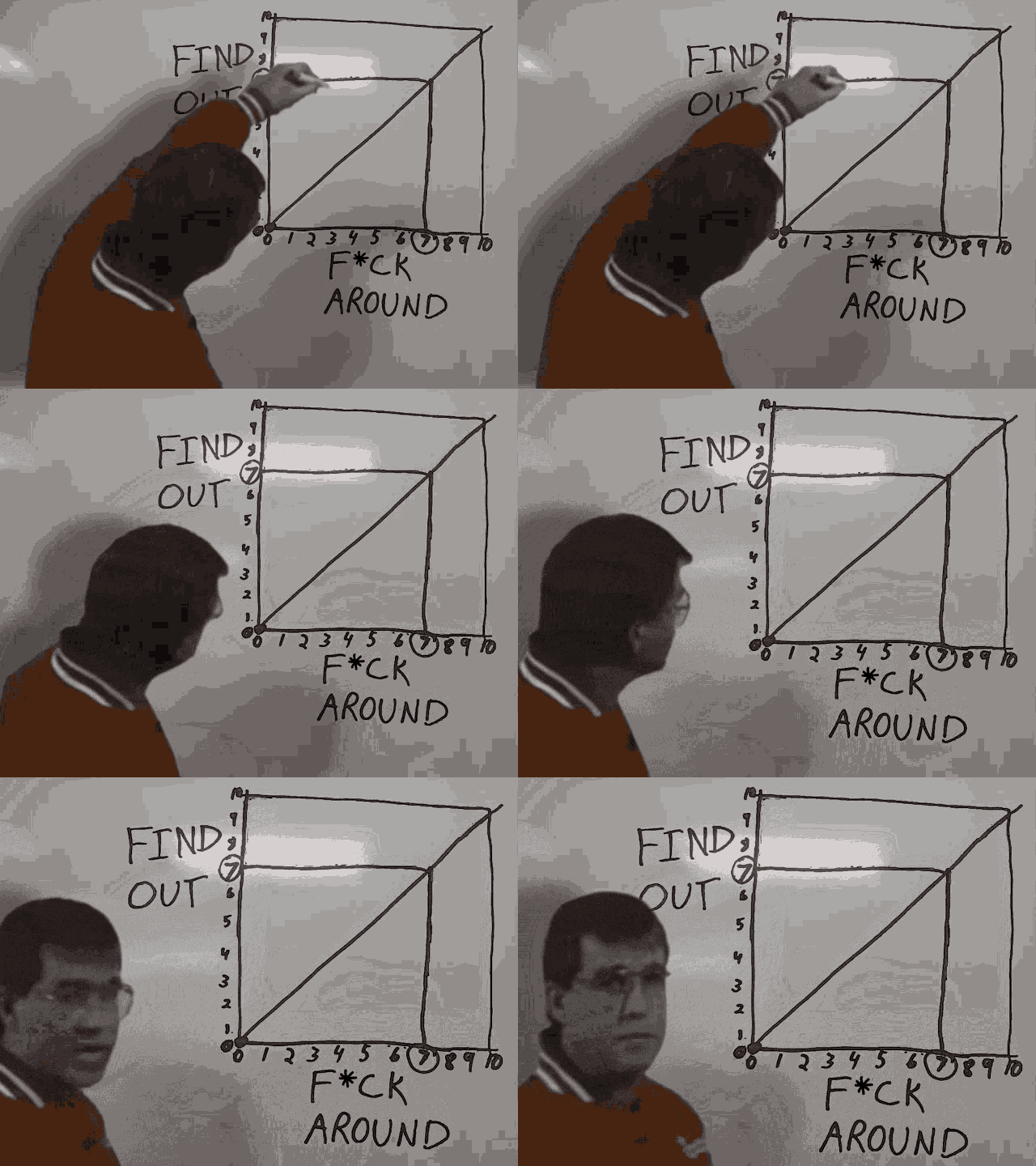
It's even technically legal because bitcoin doesn't use encryption.

We have nostr:nprofile1qqsth7fr42fyvpjl3rzqclvm7cwves8l8l8lqedgevhlfnamvgyg78spz4mhxue69uhhyetvv9ujuerpd46hxtnfduhszrnhwden5te0dehhxtnvdakz7qghwaehxw309aex2mrp0yhxummnw3ezucnpdejz7qnse3k
jmp.chat and get rid of your mainstream cellphone carrier.

Hashrate follows price.
We’re so cooked...
Ali’s Wan 2.2 lets you stream without showing your real face. It maps your voice and motion onto an AI face.
https://blossom.primal.net/876ece964dee49b23589bbcf90ff7e5de14dbdd56f34d58b4dd59dcc29dc04c1.mp4
It started with eigenfaces. I wonder what's changed?
I don't like wearing plastic but Under Armour ColdGear noticeably helps. I don't need nearly as much extra clothing.
I didn't find that particular book, but it might help with some other rare books.


You are aware of libgen right?

Just give me remote access 😂
#AI #robotics #engineering #science #technology #slavery
The word "robot" is derived from a word for slave. Soon, for the low cost of $20K, you'll be able to have your very own politically correct slave. Seems to be a lesson we refuse to learn from.
"NEO The Home Robot | Order Today"
https://video.nostr.build/575773c38cf2910a2721d16d23b1d81d53e000a2ed571ce6f2655171d49e740e.mp4
Can't wait until these things are robbing banks 😂


When everyone is a CSAM distributor, nobody is.

Location, location, location.
🔥 NEW: http://402.markets is a marketplace for paid APIs
Pay and get paid with Lightning or Cashu. Magic internet money fixing the internet!

We needed this 10 years ago.


Yes. That is the nature of alpha (new) software. It's buggy. If you only expose yourself to mainstream-ish software then these ideas may seem a bit foreign.
Just try every option without pasting in your high value nsec. If none of them work then the answer is: No, you can't.
I think they call that impressions in the ad market

(∃s ∃x [
Coworker(x) ∧
GivesAnswer(x, s) ∧
(CodeWithVariables(s) ∨ GitHubLink(s) ∨ GitLabLink(s))
]) → ∃y (Coworker(y) ∧ Developer(y))

GraphineOS is the best we have right now.

More like autotune
Being able to log in using the extension is a game changer. I just tested in on nostr:nprofile1qqsv73dxhgfk8tt76gf6q788zrfyz9dwwgwfk3aar6l5gk82a76v9fgpz4mhxue69uhhyetvv9ujuerpd46hxtnfduhszxthwden5te0wfjkccte9eekummjwsh8xmmrd9skctcppemhxue69uhkummn9ekx7mp0dutak6 at it worked flawlessly.